Industry experts warn the industry’s fixation on AI and new rails risks missing a simpler mandate from most users: secure, predictable payments that work every time.
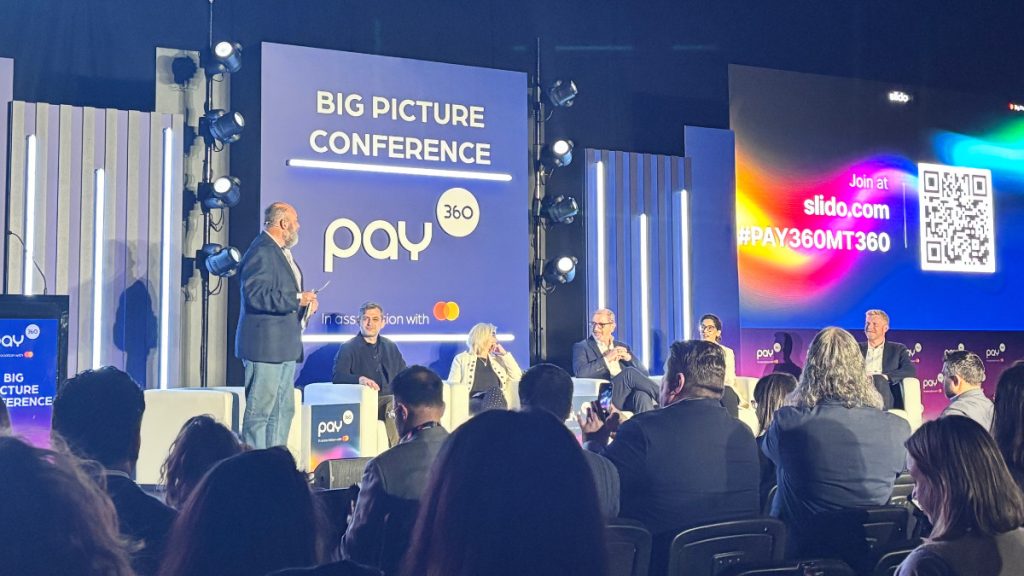
Customers don’t actually want the radical “future of payments” the industry keeps promising them. They want their money to arrive on time and in one piece, according to a high‑profile panel at Pay360 on March 25.
During the event, senior figures from Swift, Santander, First Direct, NVIDIA and Cardaq repeatedly returned to the fact that for the vast majority of consumers, boring reliability still beats shiny innovation.
“We get excited about things when we’re in the payments bubble,” says Paul Horlock, Chief Payment Officer at Santander “Four out of five customers just said, actually, don’t change anything. Just make sure it arrives on time, and it’s safe.”
According to Santander’s research, only one in five of the customers surveyed had experienced problems, typically related to fraud or delays. Yet those edge cases have come to dominate the industry’s agenda and product roadmaps.
The effect, the panel suggested, is a widening gap between how providers talk about the “future of payments” and what customers themselves really ask for: uncompromising trust, predictability and safety.
From faster payments to faster fixes
In recent years, the industry’s race has been to make money move faster. But several panellists argued the next competitive frontier is instant resolution when things go wrong.
Claire Huddleston‑Stevens, Chief Operating Officer at Cardaq, pointed out that massive investment has gone into the rails, but far less into what happens after the transaction:
“From a consumer… yes, they want their money to go fast, but they also want… instant dispute resolution. I want instant refunds… We’re quite slow on that side of things at the moment,” she says. She argued the industry has optimised for “go” but under‑invested in “aftercare” – the disputes, chargebacks, reversals and confirmations that shape customer trust in the real world.
So where does AI really matter today for consumers who say they mostly want things to “just work”?
One answer, from the banks on stage, was fraud and economic crime – domains where AI is already deeply embedded but largely hidden from the customer. From Santander’s side, Horlock explained how AI is being used to strip out noise in fraud operations, not to replace people at the sharp end:
“It’s making it… more efficient. We’re getting more time for our agents to talk to customers rather than spend more time investigating hits,” he said [0:19:58]. “This ability to talk to customers, break the spell of the scam that they’re under… is so important.”
In this framing, AI works in the background while human agents get more time to talk to customers at the critical moment. Consumers do not see a “clever AI feature”; they experience faster outreach, clearer explanations and more timely interventions.
But the conversation around AI was far from uncritical. Moderator David Parker, voiced a frustration that many in the room recognised: rather than simplifying onboarding and compliance, AI is sometimes being used to multiply documentation requirements, creating more friction – not less.
“All I’m seeing, actually, at the moment, is AI is causing more problems,” he says, “All I can see is it’s helping people find intelligence to ask me, give me more work to do.”
Instead of streamlining due diligence, AI‑driven rules engines are, in some cases, spitting out longer, more complex document lists for even relatively straightforward transactions. That stands in stark contrast to customer expectations of one‑tap, embedded experiences inspired by ride‑hailing, delivery and social apps.
On the consumer‑facing side, Huddleston‑Stevens argued trust in AI‑initiated payments is still fragile: “If I were going to be a consumer and I was going to make a payment, or I’m going to allow that AI to do it, I want them to do it for my trusted usual payees. If there’s something that’s not quite right, that it’s flagged, and there’s a confirmation.”
The data is there – but it’s trapped in silos
If AI promises so much, why isn’t the day‑to‑day experience already markedly better?
From NVIDIA’s vantage point, represented by Head of Payments Georgios Kolovos, the problem is less about algorithms and more about operating models. Financial institutions are awash with data, but customer insight is scattered across fraud, compliance, marketing, customer service and product teams, each with their own tools, models and incentives.
“The bigger challenge continues to be silos, silos within organisations,” Kolovos says.“You have all these teams working in silos, so you end up [with] customer insight… scattered across the organisation.” Even when AI is deployed – particularly in fraud and AML – the embeddings and insights created in one part of the bank are rarely reused elsewhere.
Kolovos argued for a common “transaction foundation” layer: shared, institution‑wide models and embeddings that capture the full relationship context between customer and institution, and can be applied across fraud, compliance, growth and servicing. Without that, even sophisticated AI programmes risk becoming just another silo.
“Data without the insight is not necessarily [enough],” he said. The real step‑change, by 2030, will come from those who can “take this vast ocean of data and then transfer it into insight” that is reused across the value chain.
Open banking under‑delivers, cheques refuse to die
Regulation and core infrastructure also loomed large over the Pay260 discussion. Parker pressed the panel on whether the industry is still designing products around what regulation and legacy rails permit, rather than starting from what customers truly want.
On open banking, there was unusual frankness. “The fact that we haven’t really seen the benefits of open banking the way that [we] potentially expected has been one of our challenges,” says Horlock, who noted that expectations had outpaced reality. He pointed to recent moves around Confirmation of Payee (CBRP) and pay‑by‑bank/pay‑by‑link journeys inside banking apps as signs that banks are finally finding more fluid, customer‑friendly applications.
Perhaps the sharpest infrastructure comment, however, came on the topic of cheques. Asked what they would remove if given a regulatory “magic wand”, Horlock didn’t hesitate:
“We still invest in cheques, right?” he says. “We’re having to upgrade our cheque infrastructure… We have to get to a point that… we can really help customers and not keep trying to keep every single payment.” He linked this directly to the UK’s Consumer Duty regime, arguing that cheques – opaque, slow and data‑poor – sit uneasily alongside regulatory expectations for transparency, data‑driven support and good outcomes.
In his view, clinging to cheques drains investment from the very capabilities regulators and customers now expect.
Fraud as the AI “beachhead” – and what comes next

There was broad agreement that fraud is the most compelling initial use case for AI in payments: the ROI is clear, the financial impact measurable, and the benefits from modelling complex networks of behaviour are immediate.
“Fraud is always the easiest ROI project to justify,” says Kovolos. “The faster you process the data, the better signal you start getting, the better results.”
But he warned against treating it as a dead‑end point solution. The most advanced adopters, he said, start in fraud, go very deep, and then use the same methods, infrastructure and embeddings across the enterprise, avoiding the need to rebuild AI stacks function by function.
Horlock countered that fraud is far from “easy” in practice, particularly with Authorised Push Payment scams, where well‑behaved, legitimate customers are socially engineered into sending money in good faith: “You can find a perfectly well‑behaved, normal customer who’s buying something in absolutely good faith, and we find out the ultimate [beneficiary] isn’t there – and that’s one of the challenges that we can’t necessarily predict.
This is where new architectures – including conditional payments and smart‑contract‑like flows – are coming into play.
Smart money and safer marketplaces
On that front, Horlock described work within his group on “smart money” for marketplace payments, using GPT‑style technology and smart‑contract mechanics to address APP scams at their source.
“One of the use cases we’re building… is that marketplace payment,” he says. “We want to put smart money at the point [of] the transaction, and not move money separately to the conversation between buyer and seller.”
The idea is to lock funds into a structure where buyer and seller must both confirm the trade – “turn the key” at each end – before the payment is fully released. That approach blends familiar account‑to‑account rails with blockchain‑inspired conditional settlement, but is framed to customers as added safety, not as a crypto product.
The goal, once again, is to deliver an outcome customers have clearly asked for – security and confidence – without forcing them to care about the underlying technology.
Merchants in the age of generative commerce
Although merchants weren’t on stage, their fate in an AI‑driven ecosystem was a recurring theme.
Kolovos characterised “generative commerce” as both an opportunity and a threat. If consumers start journeys with general‑purpose AI assistants, he argued, those assistants will:
- Aggregate products across merchants,
- Optimise for criteria like price, availability or delivery, and
- Potentially weaken direct brand relationships.
“There are so many different ways for them to either start changing the way they are thinking,” he said of merchants. “Why do I open my ecosystem to start allowing third-party [agents] to shop directly, where I lose the opportunity to manage the customer relationship?”
He floated the idea of merchants launching their own agents – for example, an airline that, once you’ve booked tickets, triggers an AI‑driven shopping flow to help you buy everything from swimwear to travel insurance on other sites.
Meanwhile, Saira Khan, First Direct stressed that customers on the merchant side will push relentlessly for better value and speed: “They want cheaper payments and Faster Payments. In the future, they… will not tolerate, you know, higher fees [and] journeys that are less speedier as well.”
Towards 2030: the disappearing checkout
Asked to imagine best‑in‑class experiences by 2030, panellists converged on a vision where payments fade into the background.
“Everybody wants predictability,” says Adam Bealey from Swift. “Speed is important, yes, but actually, predictability of when that payment is going to arrive, full transparency… traceability… and full value transfer, so the amount you send is the amount that’s received”.
He noted that around 80% of total elapsed time in cross‑border payments sits in the last mile – the beneficiary bank to end‑customer leg – and argued that moving from batch to real‑time processing, via longer operating hours and instant payment schemes, will be crucial to meeting expectations of “instant” money.
On the retail and merchant side, Huddleston‑Stevens articulated a more radical ambition: “From my perspective, [the payment] just happens. They’re not having to click multiple times to actually… make a transaction.”
In that world, identity is known and trusted, consent is captured more intelligently, and the visible “checkout” all but disappears. The customer’s focus returns to the underlying activity – travelling, shopping, investing – while the payment recedes into the infrastructure.