After years of planning, Colombia’s central bank–backed instant payments infrastructure, Bre-B, officially began operation on 23 September, ushering in a controlled rollout phase to test interoperability across the financial system.
In this article, we break down what Bre-B is, how it works, what the phased launch entails, potential risks and opportunities, and how it compares to other instant payment systems around the world.
Bre-B (an acronym for the Spanish “Billetera de Registros Electrónicos – Banco de la República,” loosely the “electronic registry wallet” system) is Colombia’s new low-value, real-time payments rail aiming to enable interoperability among banks, fintechs, and digital wallets.
The system is intended to make peer-to-peer (P2P) and person-to-merchant (P2M) transfers instantaneous, 24/7, with minimal or no fees (especially in early years) and a simplified user experience.
Bre-B is not a standalone app but an underlying infrastructure integrated into the digital banking and fintech channels of participating institutions. Users will see a “Bre-B zone” or “button” within their existing banking or wallet apps.
The central bank handles the settlement and infrastructure roles, but day-to-day use is done via institutions.
Key Features & Mechanics
Here are the core building blocks of how Bre-B is designed to operate:
| Feature | Description / Notes |
|---|---|
| Aliases (“llaves”) | Instead of having to know full account numbers, users register one or more “keys” (llaves) that map to their account. Accepted key types include: national ID (cédula), mobile phone number, email address, or a custom alphanumeric code. |
| Interoperability & Connectivity | All participating financial institutions and wallets connect into the common infrastructure so that funds can move instantly across accounts regardless of provider. |
| 24/7, real-time operation | The system supports real-time settlement any hour, any day. |
| Controlled / phased launch | From 23 Sep to 5 Oct, operations run in a controlled mode with a limited client set to validate interoperability across 227 entities. From 6 October onward, full (mass) operations are scheduled. b |
| “Bre-B zone” / button | From 6 October, banks and wallet apps will include a “Bre-B button” or zone in their UIs to initiate payments or transfers. |
| Fee structure | For the first three years, Banco de la República will not charge participants (i.e. financial institutions) for service use. Users are thus expected to enjoy free or minimal-cost transfers in this initial period. |
| Transaction limits | The system reportedly supports transactions up to COP 11,552,000 ($2,700–2,800) per transfer, though individual institutions may impose lower internal limits for security or risk management. |
| Security & identity mapping | Users’ account details are shielded by the alias system, and the infrastructure is built with oversight from the central bank. |
One detail to watch is that some media reports claim that sending funds might not require that the sender has a ‘llave’, while receiving a transfer always does. But this nuance depends on the institution’s implementation and risk rules.
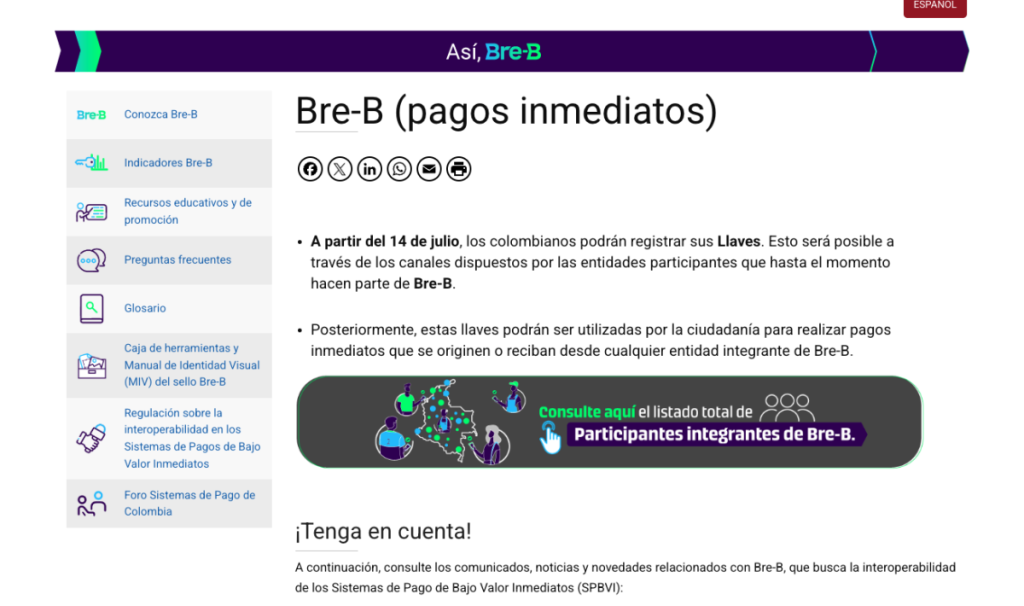
Launch plan and early rollout
On 18 September, the central bank announced that from September 23, the operational core of Bre-B will begin running in a controlled mode. This period is designed to test interoperability among the 5 existing instant payment systems and 227 participating financial entities.
During this window, only a limited set of clients will engage in transactions so that systems can be stress-tested and issues resolved before universal availability. From October 6, Bre-B will shift into mass operation. At that point, transfers between persons and commerce via the Bre-B zone or button in apps/web portals will become active and broadly available.
This two-phased approach helps mitigate risk and manage complexity in a large, fragmented financial sector.
Pre-launch registration and adoption
- From July 14, users could start registering their llaves in their financial institutions.
- By September 23, Colombia had 35.7 million llaves registered, across 14.5 million users, with each user holding 2.4 keys on average.
- Also, 21.2 million “medios de pago” (payment means) had been linked into the system.
These figures indicate a significant latent user base entering the live phase. The central bank described 227 entities as participants, including banks and fintechs.
Stakeholder involvement and technology partners
In February 2025, Credibanco, Colombia’s largest card and merchant acquirer, announced an alliance with Brazil’s Dock, a payments infrastructure firm with direct experience supporting Pix. Together, they are building a cloud-native platform dedicated to Bre-B, designed to allow banks, fintechs and merchants to integrate with minimal friction.
Credibanco has positioned itself as a gateway for adoption, leveraging its merchant relationships, while Dock brings the technical expertise honed in Brazil’s real-time payments market. The partnership also includes fraud-prevention collaboration with Feedzai, the AI firm that monitors suspicious activity across Pix, underscoring the importance of risk controls from day one. For Colombia, the combination of local reach and imported know-how could prove pivotal in accelerating merchant acceptance.
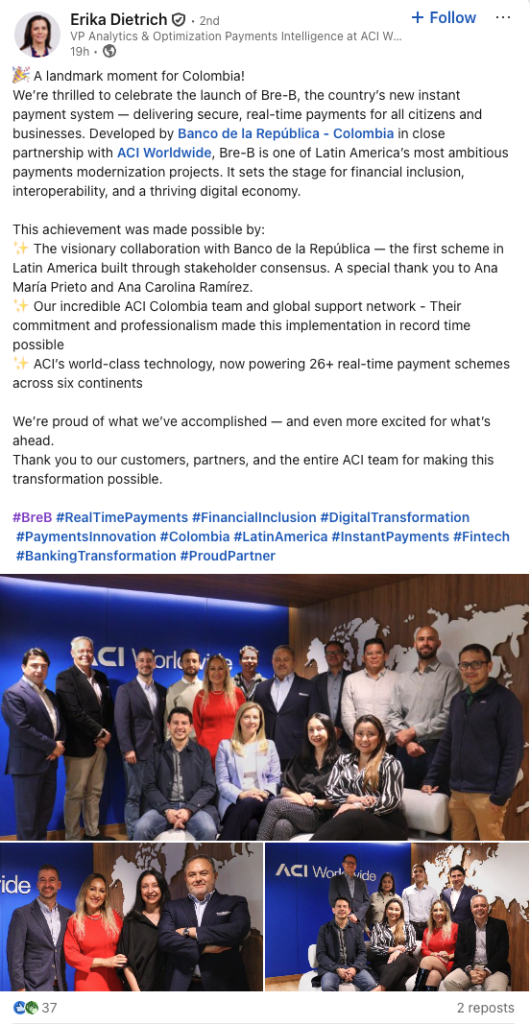
At the infrastructure core sits ACI Worldwide, the US payments technology company contracted by Banco de la República to support Bre-B’s processing and orchestration. ACI has supplied the backbone for more than two dozen instant-payments schemes globally, and its role in Colombia signals an intent to align with international standards such as ISO 20022 while ensuring resilience at scale. Publicly, ACI has framed its involvement as “powering” Bre-B.
In a statement on LinkedIn, vice president of analytics and optimisation payments intelligence at ACI – Erika Dietrich – said “Bre-B is one of Latin America’s most ambitious payments modernization projects. It sets the stage for financial inclusion, interoperability, and a thriving digital economy.
A wholesale upgrade for Colombia
For Colombia’s central bank, the platform is a lever for financial modernisation and inclusion at a national scale. The system arrives at a moment when cash use remains stubbornly high. According to figures cited in El Colombiano, the stock of cash in circulation has been growing by around 20% annually, far outpacing deposits in current or savings accounts. By creating a seamless, low-cost alternative, the authorities hope to tilt more of the economy onto digital rails.
Traditional interbank transfers in Colombia can carry fees of nearly COP 8,000 per transaction, a deterrent for smaller payments. Under the Bre-B model, Banco de la República will waive charges for at least the first three years, a policy the City Paper Bogotá described as designed to bring down barriers for consumers and merchants alike. Analysts at BBVA Research have suggested that this pricing strategy is essential if Bre-B is to win adoption beyond early adopters.
The central bank also sees Bre-B as a tool for financial inclusion. By making it easier and cheaper to move money, it can encourage the millions of Colombians who rely on informal cash transactions to interact with the formal financial system. BBVA Research has argued that the resulting digital footprint could unlock access to credit and other financial services, broadening participation in the economy.
Access Partnership has noted that by mandating interoperability across banks and fintechs, Bre-B levels the playing field for smaller institutions that have historically struggled to compete with the country’s largest lenders. This structural reform, they argue, could stimulate new entrants and innovation.
Bre-B also represents a wholesale upgrade to Colombia’s financial plumbing. It consolidates fragmented instant-payment schemes into a single backbone, introducing common standards and real-time settlement. As Ana María Prieto, director of payment systems at Banco de la República, put it, the platform draws inspiration from Brazil’s Pix and India’s UPI with the ambition to “connect what already exists — and make it work better for everyone.”
Her colleague, co-director Mauricio Villamizar, has been more blunt, describing Bre-B as intentionally “disruptive” and acknowledging that some banks may resist the loss of fee revenue.
Not without risk
Despite its promise, Bre-B faces a complex path to maturity. The most immediate concern is fraud. Instant settlement leaves little room to unwind transactions once they are made, and while the use of aliases shields account numbers, it does not eliminate the risk of social engineering or identity theft.
Banco de la República has published a series of recommendations to mitigate these risks, but as El Colombiano has reported, consumer advocates warn that more robust monitoring and dispute-resolution frameworks will be required.
Behavioural change is another hurdle. In rural areas and for micro-transactions, cash remains entrenched. Convincing households and merchants to migrate to a digital system will demand education campaigns, incentives and, above all, trust that the system is secure and reliable.
For banks, the challenge is more commercial as institutions that have relied on transfer fees stand to see that revenue stream eroded. While the central bank insists Bre-B will broaden the market for digital services, some incumbents may be slow to promote a product that undercuts their margins.
Operationally, integrating 227 institutions is no small task. As BBVA Research has pointed out, mismatches in technology or downtime could erode confidence in the early stages. The controlled rollout is intended to smooth these risks, but the transition to full scale will test resilience.
Limits also matter. While the system supports payments of up to COP 11.5 million institutions are free to impose stricter caps. Rocket Remit has cautioned that uneven limits across providers could hamper use cases and confuse consumers. Regulators will also need to ensure anti-money laundering and data-protection frameworks evolve in step with Bre-B’s growth.
Finally, Bre-B enters a landscape with legacy competitors. For more than five years, Transfiya has offered immediate P2P payments in Colombia. With Bre-B’s arrival,
reports that Transfiya will be displaced for consumer transfers, forcing it to reposition towards other niches such as business payments. The coexistence of systems will be a test of coordination in the short term.
Cat among the pigeons
Colombia is not alone in attempting this transformation. Brazil’s Pix, launched in 2020, is now so ubiquitous that it has become the default method of payment for millions of consumers and merchants. Pix’s success – and its role in reducing cash reliance – was likely a key reference point for Bogotá policymakers.
India’s UPI, which has scaled to billions of monthly transactions, is another benchmark, especially for its simple user experience and merchant adoption. Mexico’s CoDi, by contrast, has struggled to achieve critical mass, offering lessons in how adoption can falter without the right incentives and QR acceptance infrastructure.
Systems that succeed typically combine free or low-cost transfers with aggressive outreach and a smooth customer journey. They also prioritise fraud prevention from day one. Bre-B’s phased rollout reflects these lessons, signalling Colombia’s intent to avoid some of the pitfalls while emulating the more successful models abroad.