Block will reduce its headcount from more than 10,000 to under 6,000 employees, as CEO Jack Dorsey argues AI tools now allow a “significantly smaller team” to build and run the payments group more effectively
Block is cutting nearly half of its workforce, despite delivering what executives described as one of the strongest financial years in the company’s history.
In a message to staff published on X on 26 February, CEO Jack Dorsey confirmed the company will reduce headcount from more than 10,000 employees to just under 6,000. The move affects more than 4,000 roles and marks one of the most significant restructurings in the fintech sector to date.
Dorsey framed the decision not as a defensive reaction to deteriorating performance, but as a shift driven by artificial intelligence.
“The core thesis is simple. Intelligence tools have changed what it means to build and run a company,” he told investors during Block’s fourth quarter earnings call held on the same day.
He added that “a significantly smaller team, using the tools we’re building, can do more and do it better,” arguing that most companies are “late” to recognising the implications of AI on workforce design.
Cuts from a position of strength

The announcement accompanied Block’s Q4 2025 earnings, which showed accelerating growth across its core payments and financial services businesses.
For the fourth quarter, Block generated $2.87bn in gross profit, up 24% year-on-year, while adjusted operating income rose 46% to $588m. Adjusted diluted EPS increased 38% year on year. For the full year, gross profit reached $10.36bn, up 17%, with executives noting that growth more than doubled from Q1 to Q4.
The company also confirmed it surpassed its internal “Rule of 40” metric in Q4, reflecting the combined strength of gross profit growth and operating margin.
Rather than trimming costs amid slowing momentum, Block is pairing its workforce reduction with upgraded 2026 guidance. The company now expects 18% gross profit growth in 2026 to $12.2bn, alongside adjusted operating income of $3.2bn, representing 54% year-on-year growth.
Chief Operating Officer and CFO Amrita Ahuja said the “organizational changes… represent a deliberate choice about Block’s next phase of growth,” adding that the company expects margins to expand each quarter throughout 2026.
Inside the CEO memo: what Dorsey told staff
In his note to employees, Dorsey stressed that the decision was not linked to financial weakness.
“We’re not making this decision because we’re in trouble. Our business is strong,” he wrote, highlighting rising gross profit and improving profitability. He acknowledged the scale of the move, calling it “one of the hardest decisions in the history of our company”.
Employees affected will receive 20 weeks of salary plus one additional week per year of tenure, equity vesting through the end of May, six months of healthcare coverage, their corporate devices, and a $5,000 transition payment, with variations outside the US based on local law.
Dorsey said he had considered making gradual reductions but chose instead to act immediately. “Repeated rounds of cuts are destructive to morale, to focus, and to the trust that customers and shareholders place in our ability to lead,” he wrote.
He also stated that Block would not immediately revoke internal communications access, allowing employees time to say goodbye, and committed to hosting a live session to address staff directly.
The memo repeatedly emphasised that the restructuring reflects a belief that AI-enabled tools fundamentally alter workforce requirements, rather than a reassessment of the company’s commercial trajectory.
AI-native operating model
Central to the restructuring is what Dorsey described as an “intelligence-native” operating model.
Block has reported a greater than 40% increase in production code shipped per engineer since September, attributing the improvement to AI tooling and automation. Executives said engineering work that once took weeks can now be completed “in a fraction of the time” using agentic coding tools.
The company’s forward strategy rests on four pillars: customer capabilities, composable interfaces, proactive intelligence based on real-time data, and an intelligence model to orchestrate operations.
Dorsey also indicated that Block is moving toward enabling customers to “build their own features directly on top of our capabilities,” suggesting a deeper platform shift within its Square and Cash App ecosystems.
Today (27 February) Dorsey added further context to the restructuring, acknowledging Block expanded too aggressively during the pandemic. “Yes we over-hired during Covid because I incorrectly built two separate company structures (Square and Cash App) rather than one,” he said, referencing a dual-structure approach that was consolidated in mid-2024.
However, he argued the complexity added through lending, banking, and buy now pay later expansion also materially increased operational load. Block is now targeting more than $2m in gross profit per employee – roughly four times its pre-pandemic efficiency level, which Dorsey said remained around $500,000 per employee between 2019 and 2024.
Dorsey concluded that Block “has and does run an efficient company… better than most.”
Business performance backdrop
Operationally, both Cash App and Square delivered momentum.
Cash App gross profit rose 33% year on year to $1.83bn in Q4. Monthly active users reached 59 million by year-end, while primary banking actives grew 22% year on year to 9.3 million. Consumer lending originations increased sharply, with borrow volumes more than tripling year on year in Q4.
Within Square, gross payment volume (GPV) grew 10.3% in Q4, with management noting further acceleration into Q1 2026. Sales-led new volume added rose 62% year on year, and the company expanded its Independent Sales Organization partnerships to more than 100.
The stronger performance, combined with the cost reset, has materially lifted profitability expectations. Block expects margin expansion to accelerate in the second half of 2026, with nearly 60% of annual adjusted operating income delivered in H2.
Market reaction
Investors responded positively to the announcement. Block shares rose sharply in after-hours trading on 26 February, climbing more than 20% following the earnings release and workforce reduction news, reflecting support for the upgraded guidance and cost restructuring.
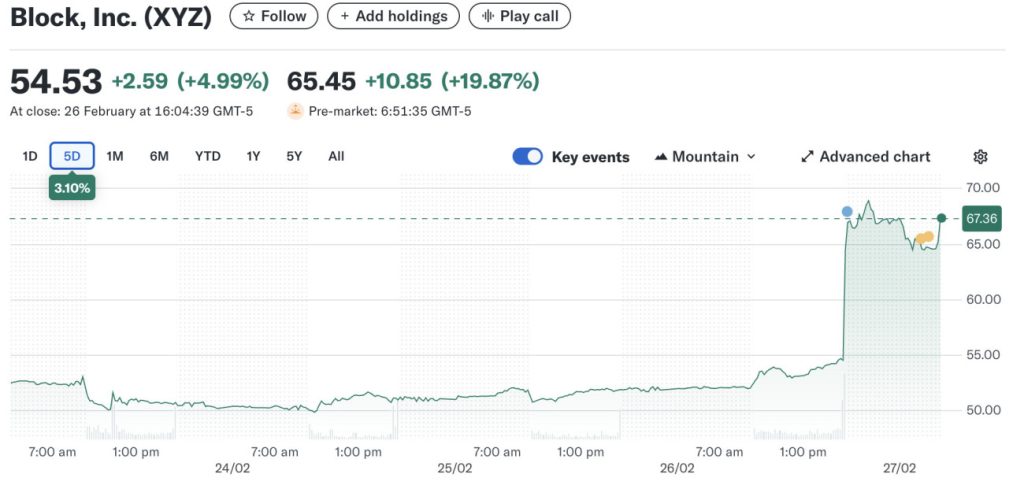
The reaction underscores a broader market dynamic: public investors continue to reward margin expansion and structural efficiency, even when accompanied by large-scale layoffs.
Dorsey predicted that “within the next year… the majority of companies will reach the same conclusion and make similar structural changes”.
If that proves accurate, Block’s decision may signal the beginning of a new operating template for listed fintechs – one in which AI-driven productivity gains are explicitly used to justify permanent reductions in workforce scale.