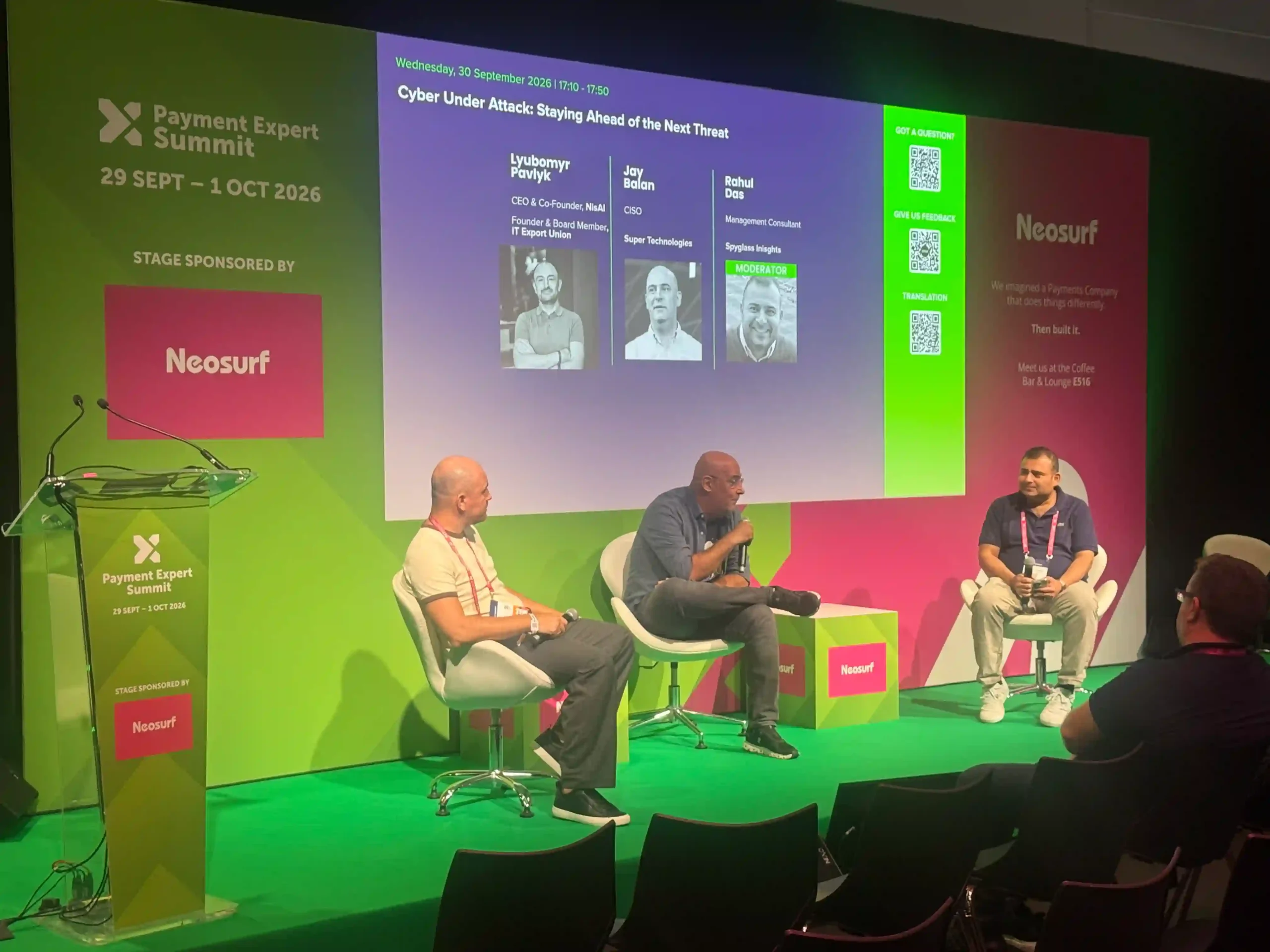
As attacks grow more sophisticated and APP losses persist, industry leaders at PAY360 told Payment Expert why better tools alone won’t close the gap
The fraud problem in payments has never been about any one vulnerability. But the nature of the threat is shifting in ways that matter. Deepfake fraud attempts in the UK rose 94% during 2025, according to Sumsub‘s Identity Fraud Report 2025–2026.
The headline rate of identity fraud has actually edged down globally, but that is only half the picture: sophisticated multi-step attacks – those combining synthetic identities, deepfakes, device telemetry tampering and cross-channel manipulation – rose 180% year-on-year, from 10% to 28% of all identity fraud attempts.
Fraudsters are making fewer attempts but landing more of them. In 2024, the rise of fraud-as-a-service platforms and ready-made toolkits democratised identity crime, making it widely accessible to non-technical fraudsters – and in 2025, this trend matured into fewer but more professionalised operations designed for higher-impact damage.
Biometric verification was never designed to hold the line against this kind of threat alone, and the proliferation of cheap generative AI has exposed that.

Mick Amelishko, AI advocate at Sumsub, told Payment Expert at PAY360: “You can imagine living in a small town – your neighbours know your face, they know how you shout at your dog, they’ve seen your passport, they know the car you drive.
“A fraudster might wear a realistic mask and get your coffee. But he can’t shout like you do, and he’s not driving your car. It’s about having multiple layers – catching all those things together.”
Those layers now extend into device fingerprinting, behavioural signals, and the precise timing of how a user moves between applications – signals never disclosed as part of the verification process and therefore hard to reverse-engineer.
“With modern AI it’s really easy to catch those behaviours,” Amelishko said. “They’re super hard to emulate.” Alongside deepfakes, he flagged a concurrent issue; fraud networks using mule accounts to exploit the same liveness-check pipelines, adding another front to a threat that was already multi-directional.
Simeon Miles, Senior Partnership and Global Schemes Manager at G+D Netcetera, saw the same migratory pattern on payment rails. Progress on card fraud through 3DS and PSD2 was real – but it pushed fraudsters toward instant payment infrastructure rather than eliminating the threat. The solution, he says, was not simply more data fed into detection models: “It’s picking the right data so that it gives you a better picture.”
The false positive trade-off
An incorrectly blocked payment damages customer trust, introduces friction into legitimate commerce, and in some cases pushes customers toward less regulated alternatives.

Improving this judgement without simply raising thresholds – and accepting more fraud as the price – is one of the harder problems the industry faces.
Iain Armstrong, Executive Director of FCC Strategy at ComplyAdvantage – who spent nearly a decade in enforcement at the Financial Conduct Authority (FCA) before financial crime compliance roles at HSBC, Barclays, and NatWest – traces a significant part of the problem to tooling fragmentation.
ComplyAdvantage‘s State of Financial Crime survey, covering around 600 C-suite and compliance leaders in financial services, found that 97% of institutions use multiple screening tools, with 34% using eight or more.
“Eight or more tools is eight or more points at which your payment could fall into some gap, or set off an alarm,” he tells Payment Expert at PAY360. Every respondent wanted that number reduced.
The fragmentation also places heavy cognitive load on the analysts running those systems – people switching between multiple platforms to process a single transaction, in jobs with notoriously high burnout rates. “That level of context switching means you’re more likely to miss genuine risk,” Armstrong says.
Amelishko pointed to a further dimension: a single device shared across multiple users is unremarkable in some markets and an instant red flag in others, so static thresholds produce the wrong outcomes depending on jurisdiction.
He describes a near-term direction in which AI adjusts sensitivity dynamically, responding to observed fraud rates in real time within regulatory bounds. “I can see a day when this adaptation is done automatically – the system can see that fraud rates are low today, loosen things a bit, and then tighten again.” The goal is not to accept more fraud but to stop applying maximum scrutiny indiscriminately.
What agentic AI needs to work
These kinds of responsive, adaptive systems point toward a broader question on agentic AI – autonomous models capable of executing multi-step compliance and fraud-prevention workflows without constant human instruction. The technology is moving from pilot to production, but scaling it requires solving data problems the industry has only partially addressed.
Amelishko identified two. The first is availability: the real value of agentic AI in AML and KYC sits at the intersection of transaction monitoring, onboarding, and verification data – systems still siloed across different vendors in many institutions, meaning models operate with a partial view of the customer. The second is security. “It’s not like generating a meme,” he says.
“The stakes are real. People don’t trust it to the extent that it’s totally safe, and that’s one of the reasons adoption isn’t where it could be.”
Passing sensitive data into large language models introduces prompt injection risk, and in a regulated industry where a miscalculation carries direct financial and regulatory consequences, it’s vital to get it right.
Armstrong suggests treating AI agent performance by first running them in recommendation mode, checking outputs, documenting the rationale so it remains explainable to a regulator a year later, then extending autonomy as performance is evidenced.
On the FCA’s recent signal that it may eventually look to regulate agentic AI in payments, he saw the space as an opportunity rather than a constraint. “The mistake is, if they’ve given you an inch, don’t take a mile. Make it explainable. Make it observable. Agents don’t need to sleep – take advantage of the benefits, but be reasonable about the guardrails.”
The problem reimbursement can’t solve
The same logic – good incentives, partial reach – runs through the APP fraud debate. £450.7m was lost to APP fraud in the UK in 2024, a fall of just 2% from the year before.
The PSR’s mandatory reimbursement regime, in force since October 2024, has been meaningful for victims – 88% of money stolen through APP fraud has been returned since the regime launched – and Armstrong credits it with creating the financial incentive for firms to invest in controls they had previously deprioritised. “I think it genuinely forced firms to up their game. That was really the point of it,” he says. But its reach ends at the payment itself.
The fraud – weeks or months of social engineering – happens entirely outside the bank’s visibility. According to 2024 UK Finance data, 72% of APP scams originate online, primarily on social media platforms and search engines.
“On Instagram, Telegram, TikTok – an entire external ecosystem – and then it lands at the bank’s door,” Armstrong tells Payment Expert. Reimbursement redistributes the financial pain; it does not move the point of intervention upstream.

This is where data sharing becomes the missing piece because as fraud networks operate across institutions and jurisdictions simultaneously, any single firm’s view of the threat is partial by definition.
The Economic Crime and Corporate Transparency Act gave UK firms legal permission to share intelligence with each other, but Armstrong said uptake outside specific verticals like wealth management has been slow. The asymmetry between how fraudsters share information – freely, across borders – and how the industry does remains the deepest structural problem.
“We need better controls, pressure on platforms to act upstream, regulator-to-regulator cooperation, and more active public-private intelligence sharing,” he said. “We need all of those things happening at once.”
It is the same argument Amelishko made from the technology side; models see further with more connected data, and if one institution identifies a fraud network, every institution benefits from knowing about it. The industry is building better layers. The question is whether it can start acting as a connected system. As Amelishko put it: “When all layers are working together, it’s really, really hard to pass.”
Sumsub’s Identity Fraud Report 2025–2026 analysed over four million fraud attempts between 2024 and 2025. ComplyAdvantage’s State of Financial Crime report surveys approximately 600 C-suite and compliance professionals in financial services annually.