Barr warns the new US stablecoin law still permits uninsured deposits in reserve pools, urging tight limits as regulators tackle repo-linked crypto exposure, fragmented oversight, consumer gaps and the case for bank-issued tokenised deposits.
The Federal Reserve’s Michael Barr has warned that the new US stablecoin law still allows issuers to hold uninsured bank deposits in their reserve pools, a feature he linked to the March 2023 banking turmoil and one he said must be tightly constrained in rulemaking.
“Permissible reserve assets include uninsured deposits,” Barr said, adding that while supervisors can cap concentrations, “it will matter how these rules are written.”
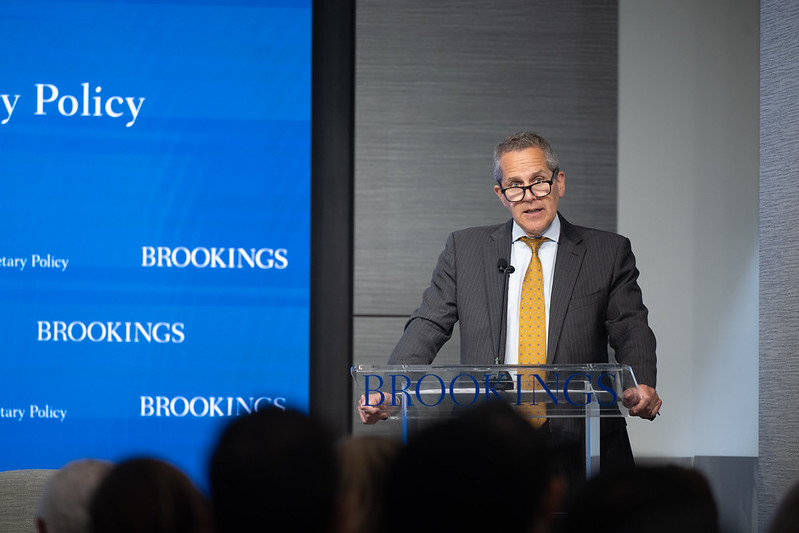
Speaking at DC Fintech Week on October 16, Barr welcomed the bipartisan GENIUS Act for narrowing reserves to “an itemised list of highly liquid assets” and pairing that with supervision and capital and liquidity requirements. He emphasised that the law’s promise rests on coordinated federal and state implementation that fills gaps and hardens guardrails so coins can be “reliably redeemed at par under a wide range of conditions.”
Barr’s core message is that the credit quality and liquidity of reserves drive a coin’s ability to function as money, particularly without deposit insurance or central bank backstops. The incentive for issuers to seek yield “as far out as possible,” he argued, is exactly why specifics on eligible assets and concentration limits are pivotal to preventing runs.
Bitcoin-by-repo and the risk of unintended exposure
Barr highlighted a second reserve wrinkle. The Act lets issuers count assets obtained through overnight repo in “money” authorised by a foreign government.
He warned this could be interpreted to include Bitcoin, citing El Salvador’s legal framework, creating the risk that an issuer is “stuck holding the Bitcoin that had declined in value” during stress and compromising one-to-one backing.
“To the extent possible, regulations should be put in place to eliminate or minimize such risks,” he said.
Multi-charter model invites arbitrage without coordination
A third concern is fragmentation. The Act allows four federal agencies and all US states and territories to act as primary supervisors. Barr said that could produce “a great deal of heterogeneity” and incentivise charter shopping unless agencies closely coordinate.
He also flagged how broad “digital asset service provider” permissions could enable issuers to stretch into exchange and brokerage activity and even “the full range of activities conducted by FTX” if unchecked.
He linked these governance choices to lessons from history. Trust-bank charters with lighter oversight, he noted, were central to the Panic of 1907. Allowing uninsured trust charters to conduct bank-like activities today could recreate vulnerabilities if consolidated capital and resolution regimes do not bite.
Consumer protection gaps and mixing commerce with finance
Barr argued the statute’s scope does not cover every instrument marketed as a “stablecoin,” raising the risk that consumers rely on products they assume are regulated but that lack prudential safeguards.
He urged federal and state regulators to use their unfair and deceptive practices powers to police misrepresentation.
The law also “lacks sufficient protections to prevent the mixing of bank-like activities and commerce,” which could distort competition, and it does not provide unauthorised transfer protections equivalent to card or account payments.
AML blueprint points to permissioned rails and richer data
On financial crime, Barr sketched a compliance architecture better suited to bearer-style tokens.
He said “permissioned networks with only trusted nodes doing the know your customer work can reduce the risks,” and that AI may help “reduce the volume of false positives,” particularly when payments carry richer metadata consistent with ISO 20022.
He also referenced wallet identity tokens that satisfy customer identification requirements and the use of smart contracts to freeze funds in problematic wallets.
Tokenised deposits get the comparative nod
Barr closed by contrasting today’s coins with bank-issued tokenised deposits, which he said sit inside a tested framework that combines supervision with deposit insurance, orderly resolution and discount window access.
“I don’t want to say this system is perfect… but it is far more robust than what we have developed so far for stablecoins,” he said, suggesting policymakers and markets “consider how tokenized deposits will fit into this ecosystem.”