The US credit union regulator has published proposed operational and risk management rules for payment stablecoin issuers tied to federally insured credit unions, as lawmakers push to advance the broader crypto market structure framework
US credit unions could soon be allowed to issue regulated dollar-backed stablecoins under a new framework proposed by the National Credit Union Administration (NCUA).
On 15 May, NCUA published a supplemental notice of proposed rulemaking setting out the standards which would govern federally insured credit union (FICU) subsidiaries licensed to issue payment stablecoins under the Guiding and Establishing National Innovation for US Stablecoins (GENIUS) Act.
The proposal builds on an earlier NCUA rulemaking from February 2026 addressing licensing and investment requirements for permitted payment stablecoin issuers (PPSIs).
Together, the two proposals form the agency’s primary regulatory response to the GENIUS Act, signed into law in July 2025.
If finalised, the framework would create a federally supervised pathway for credit union-affiliated entities to enter the stablecoin market, widening participation beyond traditional banks and crypto-native issuers at a time when Washington is accelerating efforts to formalise digital asset regulation.
What NCUA’s proposed standards cover
The supplemental proposal sets out the operational requirements NCUA-licensed PPSIs would be required to meet.
These include one-to-one reserve backing using approved liquid instruments – US Treasuries, central bank balances, and demand deposits among them – alongside redemption policies capped at two business days for standard requests, and comprehensive risk management standards covering internal controls, interest rate risk, information security, and anti-money laundering compliance.
The proposal also introduces capital requirements, including a $5m minimum for de novo issuers and an ongoing operational backstop tied to twelve months of operating expenses.
Custody standards for covered assets – including payment stablecoin reserves and private keys – are addressed in a dedicated subpart, with principles-based requirements applicable to both federally insured credit unions (FICUs) and NCUA-licensed PPSI custodians.
The proposal also introduced detailed custody and safeguarding standards for reserve assets and private keys, reflecting the increasing regulatory focus on operational resilience and asset protection across the stablecoin sector.
On share insurance, the proposal clarifies that reserve assets held at FICUs on behalf of PPSIs would be treated as corporate accounts of the PPSI rather than insured on a pass-through basis to stablecoin holders – a position consistent with the GENIUS Act’s explicit prohibition on marketing payment stablecoins as federally insured products.
The proposal also reflected broader GENIUS Act restrictions preventing payment stablecoins from functioning as interest-bearing products, reinforcing the position that regulated stablecoins should operate primarily as payment instruments rather than investment vehicles or synthetic bank accounts.
In addition, rhe proposal also placed significant emphasis on safeguarding reserve assets and ensuring that payment stablecoin holders maintain priority claims in insolvency proceedings.
Alignment with bank regulators a priority
NCUA Chairman Kyle Hauptman said the agency had sought to match the standards proposed by other primary federal payment stablecoin regulators, including the Office of the Comptroller of the Currency (OCC).
“This proposed rule supports my view that credit unions will face no disadvantage compared to other entities regarding standards,” Hauptman said. “Stakeholders will see that we worked diligently to align the standards for NCUA-licensed PPSIs with the standards that are proposed for bank subsidiaries.”
The NCUA’s publication lands against a backdrop of continued legislative momentum on Capitol Hill. The US Senate Banking Committee voted 15-9 last week to advance the Digital Asset Market Clarity Act (CLARITY Act) out of committee – the most significant step forward for crypto market structure legislation to date.
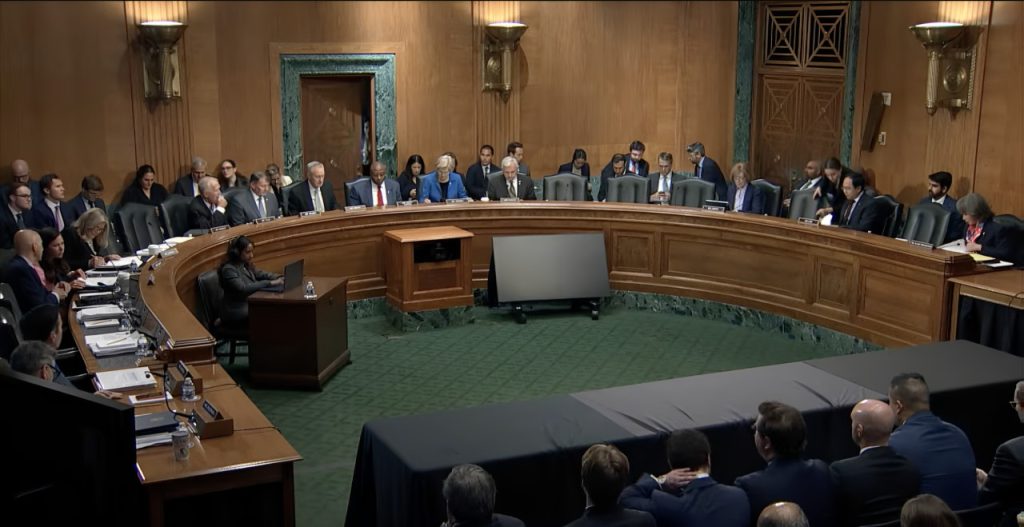
That bill, a 309-page measure that would divide oversight of digital assets between the Securities and Exchange Commission (SEC) and the Commodity Futures Trading Commission (CFTC), now heads to the Senate floor where it will need 60 votes to pass – a threshold that requires Democratic support beyond the two crossover votes it secured in committee.
The GENIUS Act and the CLARITY Act represent parallel tracks of the same broader push to bring the US digital asset market under a coherent federal framework.
Where the GENIUS Act governs the issuance and regulation of payment stablecoins specifically, the CLARITY Act is concerned with the wider question of which assets are securities, which are commodities, and who regulates what.
Senator Cynthia Lummis, the Republican from Wyoming who has led the CLARITY Act through committee, framed the absence of legislation as itself a risk: “The risks exist now, right now, because there is no regulatory framework.”
Comment period open until July
The NCUA’s proposed rule is available in the Federal Register, with a comment period closing on 17 July 2026. The agency has posed 199 numbered questions across the document covering definitions, reserve asset requirements, redemption standards, capital calibration, and custody arrangements.
Final rules implementing the GENIUS Act must take effect no later than eighteen months after the Act’s enactment date of 18 July 2025, or 120 days after final rules are published – whichever comes first.