Panellists at SBC Summit 2026 said data and AI-driven routing decide whether players complete deposits and withdrawals, not payment methods alone.
Payments without data leave operators working blind.
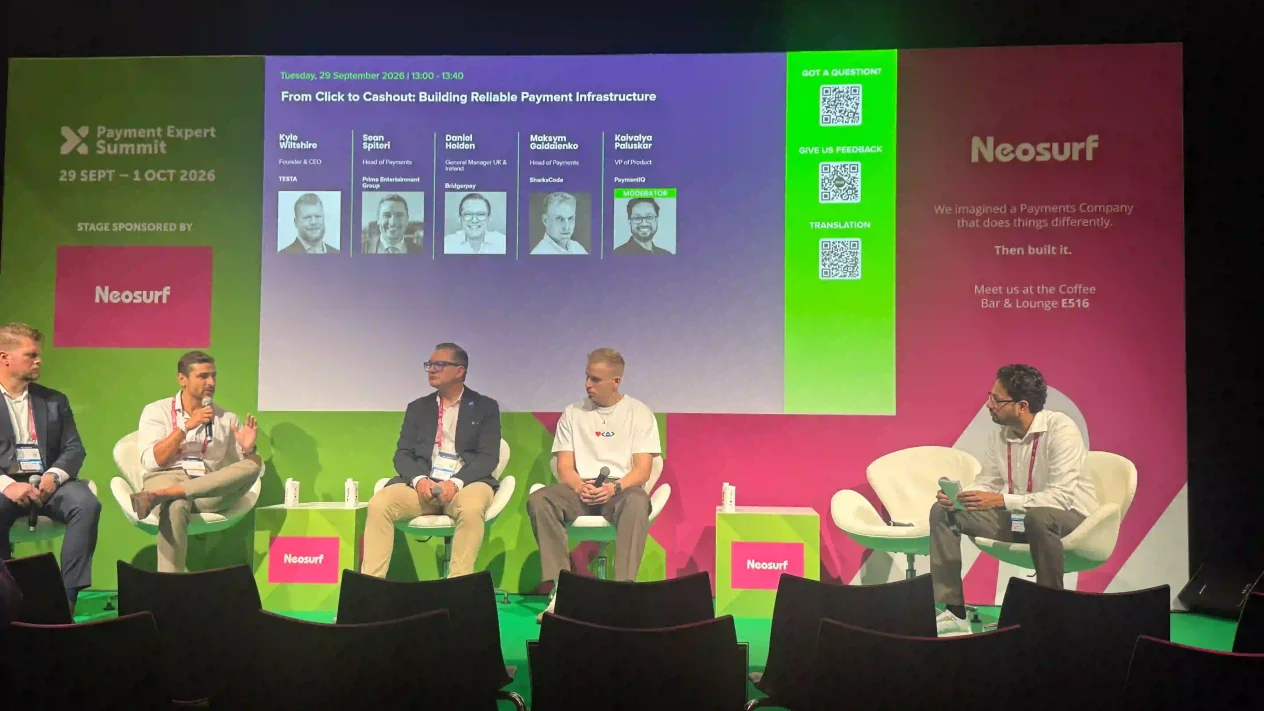
This was discussed at-large by panellists on the Payment Expert Summit at SBC Summit 2026 in Lisbon during a session titled “From Click to Cash to Cashout: Building Reliable Payment Infrastructure”.
“To work with payments without data, you’re like a blind man,” said Maksym Gaidaienko, Head of Payments at SharksCode, setting the theme for a discussion moderated by Kaivalya Paluskar, Head of Product at PaymentIQ.
Daniel Holden, General Manager UK&I at BridgerPay, said the industry has spent a decade calling payment methods a utility, and that the value has moved to the operators holding better data.
He said AI is stripping margin from pure-play providers while rewarding data businesses that help operators read customer behaviour. BridgerPay has built AI into its own product to make real-time routing recommendations for the best-optimised path for a given transaction. “That’s what operators are demanding now,” Holden said.
New data sources, not more of the same
Kyle Wiltshire, Founder and CEO of TESTA, said operators after better numbers are looking in the wrong place. “If you want more data, it’s not about squeezing more out of your existing tools. It’s about finding new tools and new sources,” he said.
Most payments teams already know their revenues, transactions, turnover and failure rates by channel, continued Wiltshire; the areas of concern are in the spaces they never cross-check.
He advised pulling the same information from more than one source to test whether the figures match, and warned against taking providers at their word. “Don’t ask the barber if you need a haircut,” he said of operators asking their own gateways whether everything is working.
Paluskar said raw data changes nothing until it is made usable. “You can have a base layer of data, but if it’s just lying around without being visualised, it doesn’t add value,” he said, citing heat maps of where players click inside the cashier.
Testing personas, measuring failure

Wiltshire said one operator ran its first-time deposit process using different personas, from experienced bettors looking for bonuses, to people who had never signed up to bet online.
Each group behaved differently, he said, which raised the question of whether the funnel should change by player type.
Paluskar gave a case where measurement caught a hidden fault. First-time deposits were failing only on 3D Secure transactions, across every operator involved, and no one had noticed. “You have the data, but if you can’t measure it, it’s a lost cause,” he said.
Sean Spiteri, Head of Payments at Prime Entertainment Group, said operators too often ask for more data before defining the question. Approval ratios read at portfolio level can hide the real problem, he said; read at BIN level, they show which card ranges a provider handles well and which it does not.
“Instead of throwing a dart at the board and hoping something sticks, an operator can tell a provider exactly which BINs are underperforming and ask why”, Spiteri said.
Withdrawals and the invisible referee
Wiltshire added operators fixate on the deposit while players care more about getting money out. “If you survey players, they care a lot more about the withdrawal,” he said, and advised collecting verification details earlier so payouts clear quickly.
Spiteri said friction still has a place. A player who deposits and withdraws large sums without a single check might reasonably doubt the operator is safe, he said; the skill is applying friction where there is good reason for it.
Gaidaienko summarised a good payment setup to a match official. “If you don’t notice the referee on the pitch, he’s doing his job well,” he said.