Stats Perform warns that US operators are losing revenue in their payout flows after new research revealed widespread blind spots in how withdrawals are managed
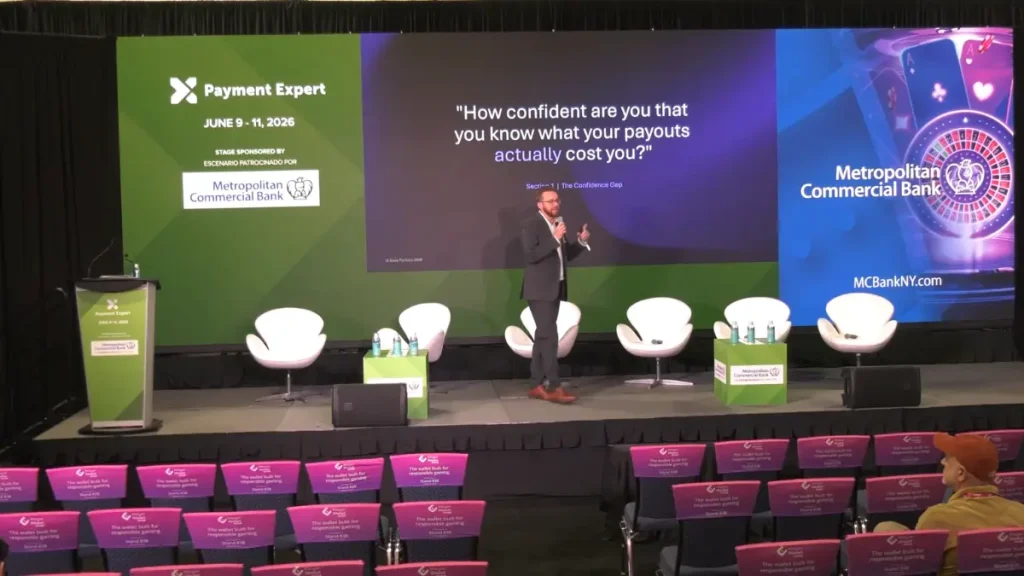
During a presentation at SBC Summit Americas last week, Andrew Skweres, SVP of Product at Stats Perform, told those in attendance that operators have little visibility into the true cost of getting money back to players.

The study, carried out by Stats Perform in partnership with SBC Insights, found that 45% of operators don’t have a complete view of their payout expenses, a finding that becomes more concerning once the reasons behind this gap are understood.
Failed transactions, provider fragmentation and support overheads sit across payments, fraud, product and customer service teams, which means the true cost of a withdrawal is spread across functions and, as Skweres noted, nobody has a full picture on a single screen.
A further 14% of respondents couldn’t state payout costs as a percentage of GGR, and Skweres noted that this lack of visibility becomes commercially significant when the difference between 4% and 8% of GGR can amount to several million dollars for a mid-sized operator.
“So those costs that hurt the most are the ones that are the hardest to see.”
– Skweres
Speed as the new retention metric
The research also highlighted a gap between what players expect and what operators deliver.
Skweres referenced a Paysafe report, noting that the company found that “41% of US betters say that payout speed is the single most important thing” when choosing where to play.
Despite that expectation, only 30.5% of operators deliver withdrawals in under five minutes.
Skweres said licensed sportsbooks lead the group, while 39% of operators offer a mixed experience with some payouts landing quickly and others taking hours or days. The remaining 30% are mostly slow, which means close to 70% of the market is failing the metric that players say matters most.
Speed is not only a priority for bettors, but it has become an expectation across day‑to‑day payments, leading to the rise of real‑time transactions. Faster movement of money, however, reduces the time available for accuracy and fraud checks, and operators face the same tension in their withdrawal flows.
Skweres told the audience that a significant share of withdrawn funds return within 24 hours, yet many operators do not track the behaviour and therefore don’t have the data.
The most common range reported was 20% to 30%, but “nearly 20% of operators see 40 to 50% of funds come back within a day.” He also explained that 20% do not track the metric at all.
“78% of players who received a payout within 24 hours put it back in that book within a week,” he said.
Among players who waited more than five days, that figure fell to 32%. Skweres described the pattern as straightforward, stating that the faster players receive their money, the faster they put it back into the book, which increases betting cycles and strengthens retention.
The automation gap operators cannot close
When asked what single change would most improve their payout operations, operators gave near-identical answers. They mentioned automated approvals with real-time fraud checks, instant processing, lower costs, simpler workflows for players and fewer manual reviews.
He said operators know what they need, but most have not been able to build it, and the challenge is not ambition but the resources required to execute it.
Legacy workflows, slow fraud models and multi provider integrations make it difficult for operators to deliver instant payouts at scale.
“Everyone wants the same thing,” he said. “The question is, how do you get there without building it from scratch?”
Skweres then put forward Stats Perform’s proposed solution, the SP Payout Card, which he described as a white label virtual debit card developed with Mastercard, Fluz and GBank.
According to Skweres, the card uses a closed loop structure that reduces redeposit costs by 50% to 75% compared to traditional banking or card methods and gives players immediate access to their winnings.
He finished by posing a question to the room. “What if every withdrawal was the start of the next bet?” he asked. “The payout card is not just a cost that you manage, but it is revenue that most of the industry is not using today.”