Just weeks after Coinbase warned a yield ban could hurt industry growth, the crypto sector says a new White House report validates its position.
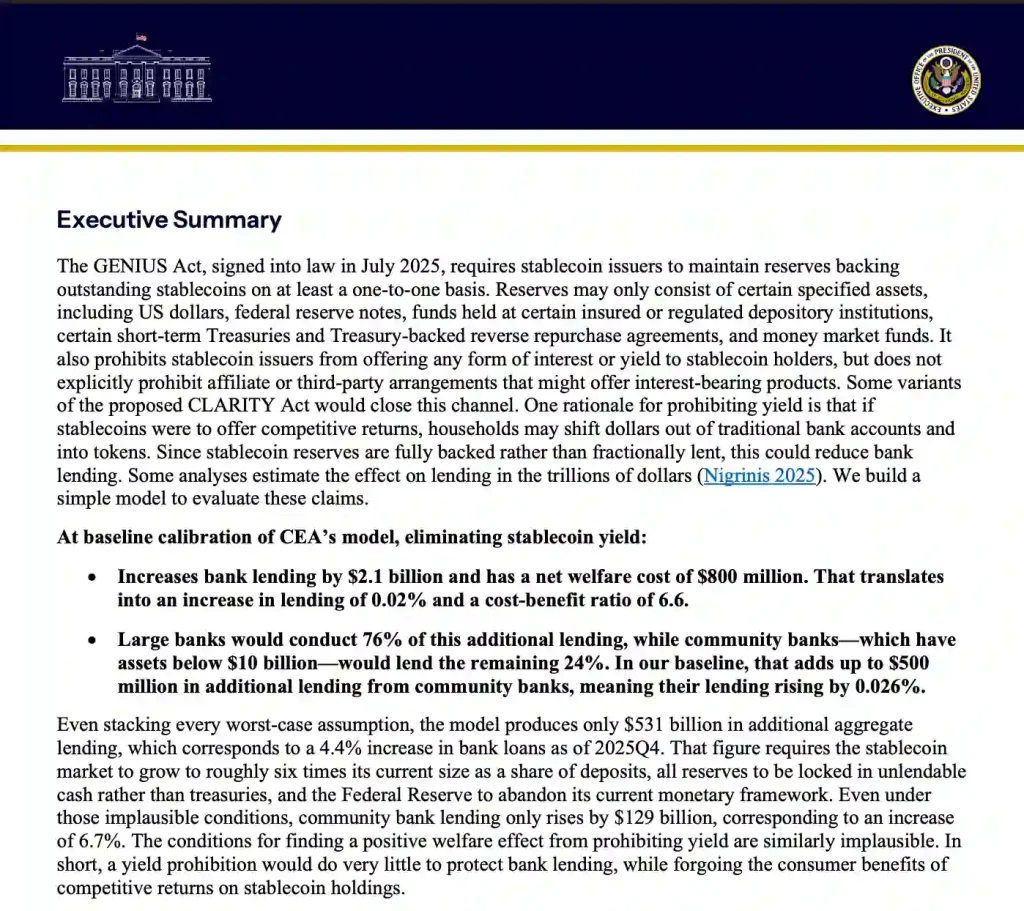
Banning stablecoin rewards would have only a limited effect on bank lending, according to a new report published by the White House.
The analysis, produced by the Council of Economic Advisers, comes as stablecoin yield has become one of the most contested issues in US digital asset policy, particularly in relation to the Digital Asset Market Clarity Act.
According to the report, banning yield on stablecoins would not significantly reduce deposit outflows from the banking system, nor materially increase lending which is a significant issue repeatedly raised by the banking sector.
While some deposits may leave banks for stablecoins, the study found that most reserve assets stay within the financial system and often flow back into banks in different forms.
The report also highlighted a welfare trade off, noting that banning yield would remove a source of income for users while offering only marginal benefits to financial stability.
What the report says
The economists use a detailed general equilibrium model which tracks how money actually moves through the financial system when users shift between bank deposits and stablecoins. Rather than assuming funds simply “leave” banks, the economists follow each dollar across balance sheets, showing that in most cases, it is redeposited elsewhere in the banking system and continues to support lending.
As the report explains, when stablecoin issuers invest reserves in Treasuries, “aggregate deposits in the banking system are effectively unchanged – they have simply moved from one institution to another.” This framing is central to the analysis: the impact on lending depends less on the total level of deposits and more on how those deposits are structured and regulated.
To quantify the effects, the economists model household behaviour, bank balance sheet constraints, and loan demand simultaneously. Households allocate funds between deposits and stablecoins based on relative returns, while banks decide how much of their deposits to lend versus hold as reserves.
Crucially, the model incorporates the fact that only a small share of stablecoin reserves are held in ways that restrict lending. In practice, “most stablecoin reserves recirculate through the banking system as ordinary deposits,” with only a limited portion “locked out of the credit multiplier.” Even when deposits do shift back into banks under a yield prohibition, multiple layers of friction reduce the effect on lending. A portion of funds is held in non-lendable reserves, banks retain liquidity buffers, and some of the additional capacity is absorbed rather than lent out.
As a result, “the reallocation of deposits may be large, but the effect on lending is orders of magnitude smaller.”
Putting these mechanisms together, the model finds that eliminating stablecoin yield would increase lending by just $2.1 billion (around 0.02% of total bank loans) while imposing a net welfare cost on consumers.
The authors conclude that meaningful increases in lending would require “simultaneously assuming the stablecoin share sextuples, all reserves shift into segregated deposits, and the Federal Reserve abandons its ample-reserves framework,” conditions they describe as implausible.
Crypto sector says report validates its position
Figures across the crypto sector were quick to point to the report as evidence that concerns around deposit flight may be overstated.
Paul Grewal, Chief Legal Officer at Coinbase, took to X to say the findings showed why critics had pushed back against its publication.
“The CEA report is finally out and we now know why stablecoin rewards critics wanted it suppressed,” he wrote. “The most respected economists in the government found nothing that shows rewards cause deposit ‘flight.’ Facts are hard sometimes.”
This response is perhaps hardly surprising given Coinbase and the wider crypto sector have repeatedly stood by the point of yield being a core feature of stablecoins. In a recent Payment Expert Podcast episode, the team highlighted that rewards programmes tied to stablecoins have become a significant revenue stream for companies like Coinbase.
Banking sector questions stablecoin report
Reaction from the banking sector has been a lot more critical, focusing less on aggregate lending and more on how deposits move through the system.
Journalist Eleanor Terrett reported early responses from banking sources suggest the analysis “missed the mark,” pointing to how it frames the risks associated with deposit outflows.
According to those sources, the issue is not the volume of deposits leaving the system, but where they go and how that affects funding stability. Smaller and community banks, which rely more heavily on retail deposits, could be disproportionately affected if funds shift towards stablecoins or larger institutions.
They also argued that deposits do not move on a one to one basis, meaning even if stablecoin reserves are recycled back into the banking system they may return in a different form, potentially changing how credit is funded and priced over time.
Banking and administrative law expert Todd Phillips added on X that the debate has always been around the distribution of reserves, noting that the report itself acknowledges limitations in modelling how deposits flow to community banks.
What comes next for the CLARITY Act
The report, which some may have hoped would provide some clarity and help negotiations, has only added fuel to the fire.
The latest Senate draft, published last month, included a strict ban on paying yield on stablecoin balances. Coinbase has already rejected multiple versions of the bill, warning the ban could impact wider industry growth.
Stablecoin related revenue exceeded $1.3bn for Coinbase in 2025, with estimates suggesting a significant portion could be at risk if yield is prohibited. This has raised questions about whether industry resistance is driven by broader principles or specific commercial interests.
The White House itself also has a stake in the outcome. While the report puts forward an economic assessment, its conclusions feed directly into the ongoing policy debate where the administration is involved.
President Donald Trump has become closely associated with the crypto sector, backing initiatives such as a Strategic Bitcoin Reserve, as well as his family’s ventures such as World Liberty Financial.
Want to hear more stories like this? Check out the new SBC Media YouTube Channel, the new home of all things multimedia at SBC, where our team deep-dives into the biggest stories from across the sports betting, iGaming, affiliate and payments industries.