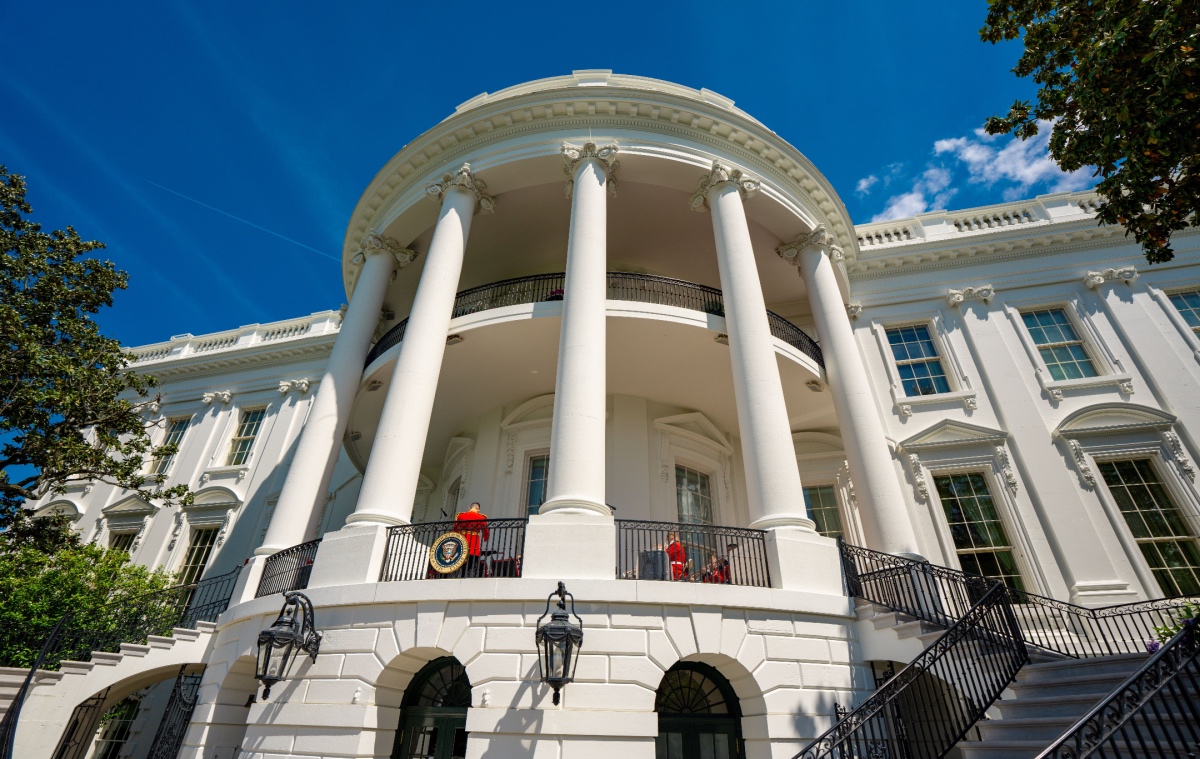
Banking and crypto firms met inside the White House yesterday to smoothen issues surrounding the proposed ban of interest and yield on stablecoins, which is currently holding back the progress of the CLARITY ACT.
Crypto market officials and banking representatives congregated inside the White House yesterday (February 2) in an attempt to come to some form of agreement on the CLARITY Act.
While no definitive agreement was reached during the two-hour meeting inside the Eisenhower Executive Office, it served as a restart for the Senate Banking Committee’s markup of the Crypto Market Structure Bill.
The discussion was led by President Donald Trump’s Policy Lead on Digital Assets, Patrick Witt, who met with officials from Coinbase, Ripple, Tether and Crypto.com, among others. Representatives from the banking sector were significantly less, with representation from the American Bankers Association (ABA) and SoFi.
CoinDesk reported crypto officials came away from the meeting feeling banking reps were “dragging their heels” on the crypto market structure bill, while Bloomberg noted a memo from Digital Chamber revealed banking and crypto representatives reviewed current proposals in the Banking Committee’s draft.
Central to discussions was the disagreement from both sectors on rewards and yield attached to stablecoins, a highly divisive debate which led to Coinbase pulling its support for the markup entirely one day before its vote on January 15.
CoinDesk’s report revealed the White House called on both sectors to come together and agree on a policy for stablecoin rewards and yield by the end of February, according to people familiar with the matter.
Despite the White House’s tentative deadline, Witt said the discussion was “constructive, fact-based, and, most importantly, solutions-oriented”.
The stablecoin sticking point increasing tensions
Rewards or yield on holding stablecoins was initially banned in the Banking Committee’s most recent draft, causing an even greater rift between banking and crypto sectors.
Banking representatives are calling for the ban over fears stablecoin interest, between 3%-5% APR, could cause a surge in flight deposits, as well as long-term financial instability to the banking system.
Standard Chartered released a report last week which revealed stablecoin interest could cause up to $500m pulled out of traditional banking accounts in just two years.
Banks are also calling for the ban as the ABA discovered a “loophole” in the GENIUS Act. This showed that crypto affiliate platforms were able to offer stablecoin interest, while US crypto exchanges and banks were prohibited.
Conversely, representatives from the crypto sector are pushing to include stablecoin interest and yield as they view a ban as anti-competitive. Interest is also positioned as customer-friendly from the crypto sector.
Bank of America CEO Brian Moynihan believes there is a “possibility of $6 trillion in deposits” being lost due to stablecoin interest commenting on the ban proposals during the bank’s Q4’ 2025 financial report.
During the World Economic Forum in Davos, Coinbase CEO Brian Armstrong spoke to CNBC criticising the US banking sector’s push for the ban while noting there is a competitive issue arising.
“Banks should have to compete on a level playing field and if the American people feel like the banks are not paying high enough interest rates, and stablecoin rewards can offer them more, then maybe the banks should have to pay high enough interest rates,” said Armstrong.
Armstrong also told CNBC he had been meeting with bank executives in Davos which led to reported tense discussions between Moynihan and JP Morgan CEO Jamie Dimon.
Moynihan reportedly told the Coinbase CEO,” if you want to be a bank, just be a bank”, while Dimon reportedly told Armstrong he was “full of s***” in his critiques of the US banking system and how it handles deposits.
Resolution in sight before it’s too late?
This heightening of tensions in Davos could have possibly led to the meeting at the White House yesterday, but it was absent of C-suite executives such as Armstrong.
Instead, according to Crypto America journalist Eleanor Terrett, Coinbase’s Head of US Policy Kara Calvert attended alongside representatives in similar positions.
The ABA released a statement following the meeting thanking the White House for the discussion and “recognising the importance of the banking industry’s perspective on market structure legislation”.
“As we shared in the meeting, we must ensure that any legislation supports the local lending to families and small businesses that drives economic growth and protects the safety and soundness of our financial system,” said the ABA statement.
The Blockchain Association’s CEO Summer Mersinger also issued a statement following the discussions with banking representatives. The Association said it “remains committed to working with policymakers across the aisle to get good legislation signed into law”.
“We will continue pushing for pro-innovation, pro-consumer policy that positions the United States at the forefront of global technological innovation and ensures the President’s vision of America as the crypto capital of the world is fully realised.”
A statement from the Banking Trades – a coalition of bank trade groups – noted banks of all sizes would continue to work with legislators to develop a “thoughtful, effective policy around digital assets,” noting the conversation at the White House has been “constructive”.
If a tentative end-of-February deadline has been set for both sectors to come to an agreement on their proposals for the Banking Committee’s draft, it may ultimately come down to stablecoin interest and yield.
The Banking Committee’s markup is the last hurdle for the CLARITY Act to progress to a full floor Senate vote. This is due to the Senate Agriculture Committee passing its draft on January 29 with a party-line vote of 12-11 despite all Democrats voting no.