Despite market volatility, the crypto platform’s stablecoin infrastructure and institutional expansion signal a strategic shift beyond trading
Coinbase‘s Q4 2025 results are symptomatic of the crypto market’s characteristic volatility.
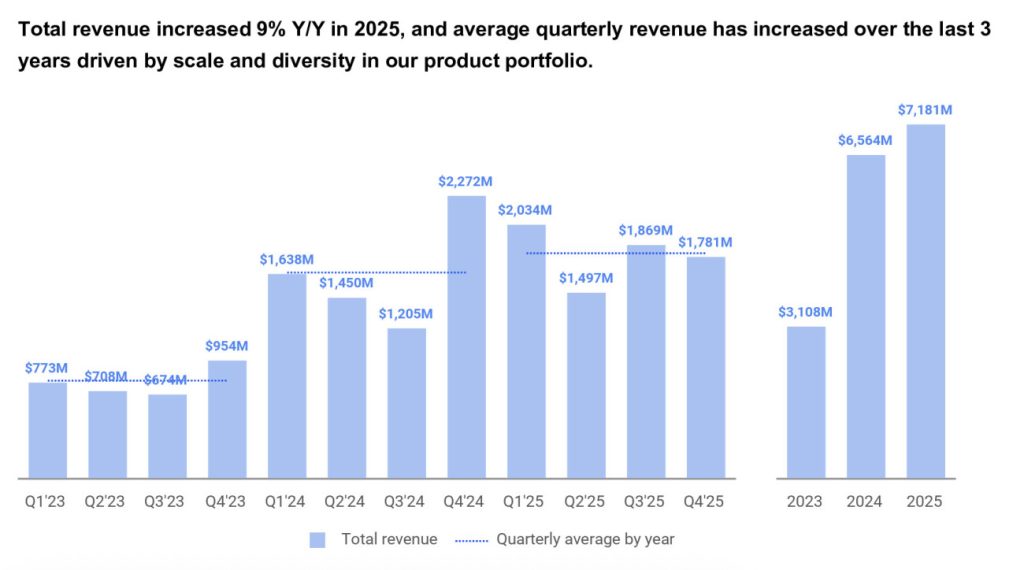
The company announced its revenue fell 5% quarter-on-quarter to $1.78bn on February 12, as crypto market capitalisation declined 11%, consumer transaction revenue dropped 13%, and reports of a $2.49 loss per share when analysts had expected a $1 profit.
Its net loss was driven largely by $718m in unrealised losses on the company’s crypto investment portfolio and $395m on strategic investments.
Beneath the quarterly turbulence, however, structural progress continued. Coinbase now runs 12 distinct products, each generating over $100m in annual revenue, with six exceeding $250m, and two surpassing $1bn.
Notably, subscription and services revenue – the recurring income less tied to crypto price swings – proved more resilient, declining just 3% quarter-on-quarter while reaching $2.8bn for the full year, up 5.5 times from Coinbase’s 2021 cycle peak.
Stablecoin infrastructure emerges as strategic cornerstone
At the heart of this revenue stream is stablecoin activity, which has grown to account for nearly half of total subscription and services revenue.
Average USDC held in Coinbase products reached an all-time high of $17.8bn in Q4, up 18% quarter-on-quarter, driving stablecoin revenue to $364m. The numbers highlight Coinbase’s emerging position as a major player in the digital dollar ecosystem now gaining traction with enterprises.

“Stablecoins are the second killer app in crypto, and most are still underestimating the potential of a digital dollar,” CEO Brian Armstrong told investors during the earnings call.
“In Q4, we hit an all-time high in USDC stored in Coinbase products, which helped USDC reach an all-time high market cap of about $75bn. In 2026, we’re focused on expanding stablecoin utility with deeper product integrations, scaling out our payments infrastructure in Coinbase Developer Platform and Coinbase Business.”
For B2B payments, the value proposition for stablecoins is obvious. They enable instant settlement, minimal transaction costs, and round-the-clock availability.
In Q4, Coinbase launched payment APIs and a B2B payments UI/API, allowing businesses to embed stablecoins at checkout, send 24/7 payouts, automate treasury workflows, and settle in USDC on Base – its Layer 2 blockchain – through a single integration.

“We are focused on driving a payments vertical where we create the best place for businesses to come transact in USDC on Base to enable their payments businesses. You’ll see more about this as we go through the year. This is early in our product journey, but we’re really pleased with the advancements in Q4 to build out the product set and APIs,” CFO Alesia Haas said.
The company also rolled out embedded wallets and expanded merchant distribution by integrating USDC on Base into Shopify Payments.
Institutional trust enables stablecoin payments scale
Coinbase’s stablecoin payments ambitions rest on its established institutional credibility. Its Q4 report reveals it now serves over 270 crypto-as-a-service clients and 150 government agencies, while storing roughly 12% of all crypto globally – more than the next four competitors combined.
This trust translates directly into stablecoin custody; today it holds custody for over 80% of US Bitcoin and Ethereum ETF assets.
Recent regulatory approvals have also enabled its stablecoin infrastructure expansion, and not just in the US. Coinbase became the largest Financial Conduct Authority-registered Virtual Asset Service Provider in the United Kingdom and completed its pan-European expansion under MiCA by securing a licence in Luxembourg.
These regulatory foundations, combined with the revenue resilience stablecoins provide amid crypto volatility, help explain Armstrong’s confidence in Coinbase’s strategic positioning.
“Financial services is a huge industry and there are multiple trillions of dollars of revenue up for grabs. Crypto is updating the financial system, from trading to payments to lending,” he concluded.
“Coinbase is the best-positioned company in the world to capitalise on this transformation.”