For the second time this month, neither banking nor crypto representatives backed down from their position on the fiercely contested stablecoin interest debate as the CLARITY Act draft bill remains unresolved.
A second White House meeting in the last week with banking and crypto officials over the CLARITY Act has once again come to no resolution on the proposals to ban stablecoin interest in the bill.
The meeting, which took place yesterday (February 10), was a second push from President Donald Trump’s Digital Asset Policy lead Patrick Witt to mediate an agreement between banks and crypto firms over highly-divisive proposals of the Senate Banking Committee’s draft of the CLARITY Act.
Attendees from the banking side, which included representatives from Goldman Sachs, JP Morgan and Bank of America, and the crypto sector, including Coinbase, Ripple and the Blockchain Association, were asked to come with a document of “prohibition principles”.
Representatives were also reportedly told to come with a “willingness to compromise” over a bill draft that has stalled over the past month.
Despite no agreement being made during the latest meeting, talks progressed to a more in-depth discussion around the structure of the bill with both crypto and banking representatives detailing their proposals surrounding stablecoin interest, account activity, and enforcement.
Chief Legal Officer of Ripple Stuart Alderoty, who attended the second meeting, came out of the discussion believing “compromise is in the air”.
“Productive session at the White House today – compromise is in the air,” he said in a post on X. “Clear, bipartisan momentum remains behind sensible crypto market structure legislation. We should move now – while the window is still open – and deliver a real win for consumers and America.”
Banks stand firm on stablecoin interest ban
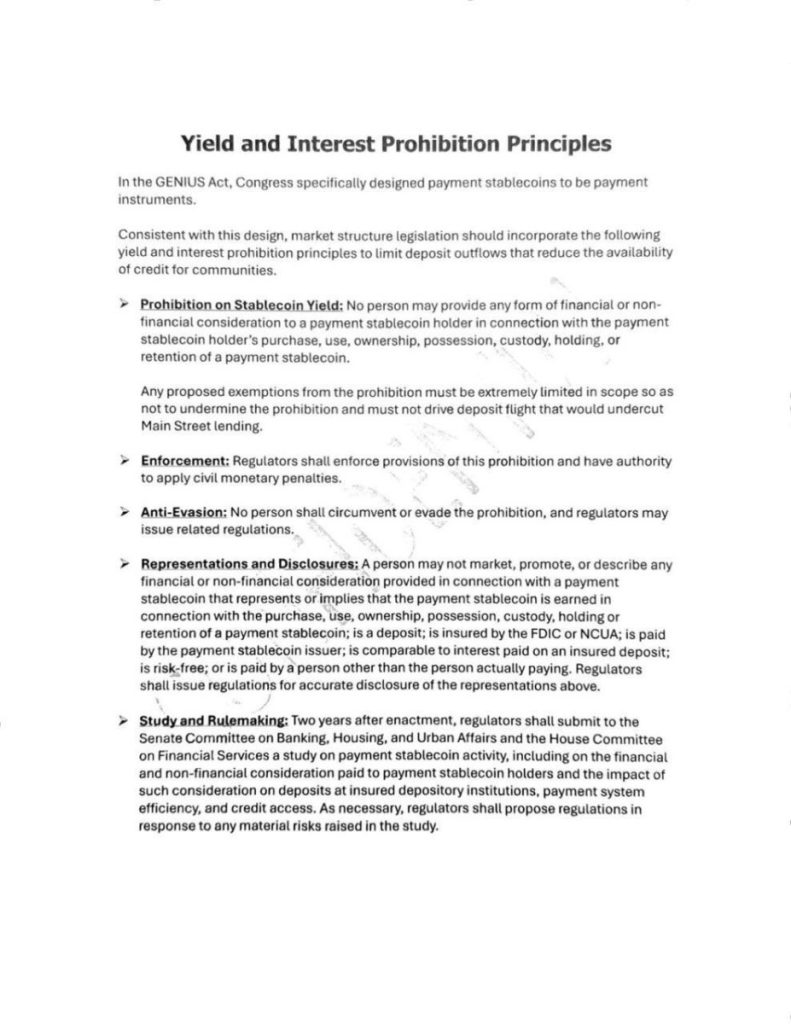
The banking industry’s set of prohibition principles laid out at the White House said maintaining interest, whether via rewards or yield, on stablecoins should be banned.
The document outlined that due to stablecoins being defined as a payment instrument in the GENIUS Act, “no person may provide any form of financial or non-financial consideration to a payment stablecoin holder’s purchase, use, ownership, possession, custody, holding, or retention of a payment stablecoin.”
Banks have continued to push for a ban on stablecoin interest to be included in the Banking Committee’s draft over fears this could cause a flight on deposits.
The set of prohibition principles also outlined that “any proposed exemptions from the prohibition must be extremely limited in scope,” and if these proposals were to be broken, banks would then call for civil monetary penalties.
Another proposal lodged was the prohibition of marketing or promoting financial interest attached to stablecoin payments to customers. Banks want to ensure stablecoin deposits are insured by the Federal Deposit Insurance Corporation (FDIC) and paid by the stablecoin issuer.
If the banks’ proposals are drafted and voted on, they are seeking a two-year review study on the impact of stablecoin payments on insured depository institutions to ensure any risks associated with flight deposits are raised and addressed.
Trump in the crosshairs of debate
Another debate that erupted during this meeting didn’t even involve banks and crypto firms; Democrats and Republicans debated Trump’s personal interests in pushing for the CLARITY Act to be passed.
Democrats on the Senate Agriculture Committee raised the issue of Trump and his family’s crypto reserves, which are believed to be around $867m in total, during its markup of the CLARITY Act in late January.
Elissa Slotkin felt “disappointed” over the lack of bipartisan agreement as the markup was passed 12-11 with no Democrat support, questioning the ethics of Trump’s pursuit to accelerate the progression of the Act to be passed
“If we’re honest with ourselves, if any President, Democrat or Republican, had earned what I understand to be $867m worth of various cryptocurrencies, I know the other side of the aisle would be having a conniption right now if this was Joe Biden or Barack Obama,” said Slotkin.
“$336m is just from (the President’s) memcoin. We have to address that issue, it is a glaring issue. It’s just so obvious and I understand this is hard, but that is the job of separate branches of government to push back on that kind of abuse of power.”
Witt told CoinDesk on February 3 the CLARITY Act will not receive any sign off if they believe it has legislations that ‘target the president individually or his family members’, arguing “this is not an ethics bill”.
Questions also remain whether the CLARITY Act will receive a full Senate vote if the Banking Committee’s markup is passed due to many Democrats holding out support due to Trump’s ethics, stronger provisions for decentralised finance and more objections.
Crypto firms not budging but progress made
Crypto firms have consistently pushed for stablecoin interest to be allowed, framing it as a pro‑consumer benefit and warning that a ban would be anti‑competitive.
The issue has emerged as the key fault line between banks and the crypto sector, holding up the Banking Committee’s draft legislation. A markup planned for January 15 was cancelled at the last minute after 130 amendments were submitted and companies including Coinbase withdrew their support.
Unlike the banking sector, the crypto sector did not bring to the White House a list of prohibition principles. According to Executive Vice-President of the Blockchain Association, Dan Spuller, banks “did not come to negotiate” the bill.
“Stablecoin rewards were front and center,” said Spuller in an X post. “Banks did not come to negotiate from the bill text, instead arriving with broad prohibitive principles, which remains a key disagreement. The Trump Admin’s decision to keep convening stakeholders reflects a real commitment to working through these issues as the Senate Banking Committee continues its work.”
Also in attendance at the White House yesterday was Coinbase Chief Legal Officer, Paul Grewal, who emphasised that “crypto showed up ready for work” and believes progress was made with the advancement of the bill.
“There’s still more work to do for sure, and we hope everybody will stay at the table to do what’s right,” said Grewal via X.
Will the bill resume?
The second White House meeting followed the previous meeting last week, where representatives discussed the bill for the first time since stalling in January.
Although no agreement was made during the first meeting, Witt walked away from the meeting believing “constructive, fact-based, and, most importantly, solutions-oriented”.
Despite this, it can be argued the second meeting brought progression but a lack of certainty on whether banks and crypto firms can come to an agreement on the stablecoin interest debate.
With the Senate Agriculture Committee having passed its draft of the CLARITY Act on January 29, the Banking Committee’s draft now needs to be passed before it can progress to a full Senate vote.