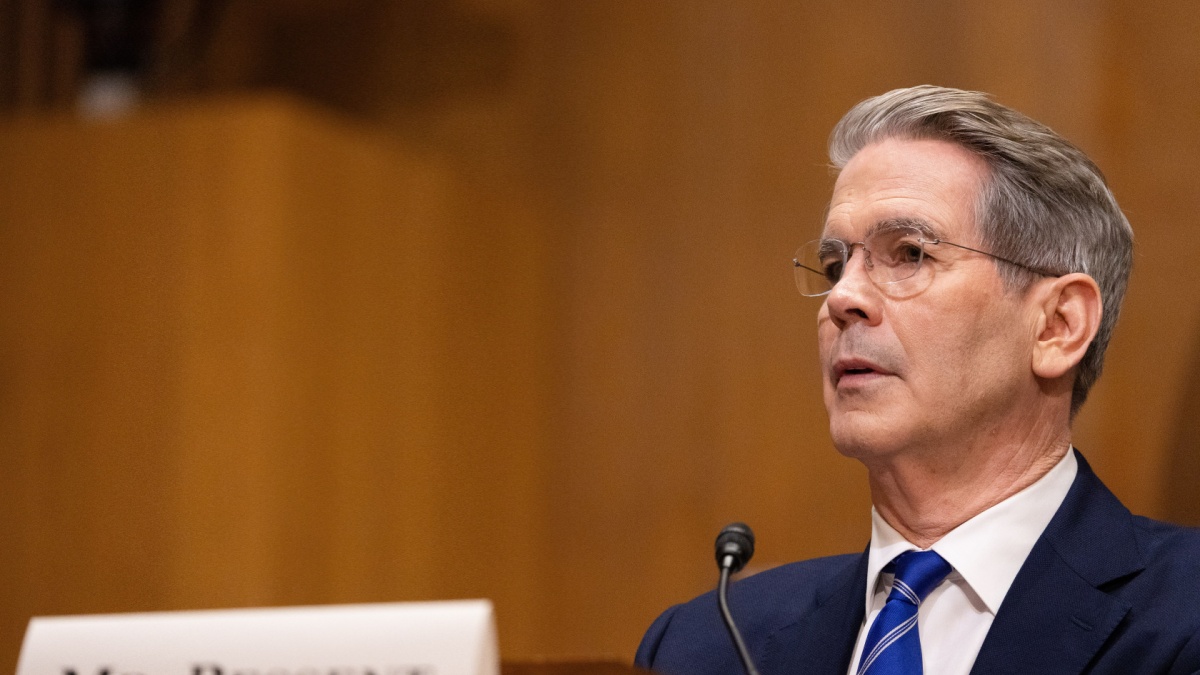
Bessent’s appearance marked a clear pivot in FSOC’s approach, with the Treasury Secretary arguing that years of “regulation by reflex” weakened smaller lenders and stifled growth
“Stablecoins could become an important feature of financing the US government.”
Treasury Secretary Scott Bessent’s line – delivered midway through a heated House Financial Services Committee hearing on February 4 – was one of several moments which signalled a major shift in how the administration views digital assets, bank regulation, and the broader financial plumbing.
The session, convened to examine the Financial Stability Oversight Council’s (FSOC) 2025 annual report, quickly veered into political territory. But beneath the partisan clashes were clear signals for the payments and fintech sectors, from stablecoin policy to community‑bank supervision and AI oversight.
Here are the five key takeaways for the payments industry.
1. Stablecoins move to the centre of US financial strategy
Stablecoins dominated one of the most consequential exchanges of the hearing, with Bessent offering his clearest endorsement yet of the administration’s digital‑asset agenda.
Pressed by FSOC Chair French Hill on the implementation of the Genius Act – the administration‑backed stablecoin framework passed late last year – Bessent described the legislation as a turning point for US competitiveness in digital assets. He framed it as a deliberate effort to bring stablecoin issuance and oversight firmly back onshore.
“The Genius Act was an important piece of legislation for bringing back on into the US the regulation creation of digital assets and making the United States a national champion,” he said.
Bessent went further, linking stablecoins directly to the functioning of US public markets. In one of the most striking lines of the session, he argued that properly regulated dollar‑backed tokens could play a role in sovereign financing.
“The Genius Act… and the stablecoins that will be created with that could in fact be an important feature of financing the US government,” he said.
The comment came during a broader discussion about Treasury market resilience and the need to ensure that the US continues to anchor global liquidity. Bessent positioned stablecoins as part of that effort, suggesting they could deepen demand for US assets and strengthen the country’s position in global financial infrastructure.
He also told lawmakers that Treasury is moving “with deliberate speed” to implement the Act and “round out the House and the Senate’s intention” on the framework, signalling that rulemaking and supervisory guidance are already underway.
2. Community bank deregulation takes centre stage
A second major theme of Bessent’s testimony was the administration’s push to revive the country’s shrinking community‑bank sector. He repeatedly argued that smaller lenders had been over‑regulated for more than a decade, leaving them unable to compete or support local credit formation.
Responding to Hill’s questions about the Main Street Capital Access Act and broader tailoring efforts, Bessent described the decline in community banks as both severe and avoidable.
“Thanks to onerous regulation… community and small banks became too small to succeed.”
He highlighted the scale of the contraction since the 2008 financial crisis: “More than 50% of our community banks have disappeared since the great financial crisis — not during, since,” he said.
Bessent also pointed to the collapse in new bank formation, noting that the US had gone from more than 50 de novo banks per year before the crisis to “virtually none” in the years that followed. He attributed this to regulatory frameworks that applied large‑bank standards to small institutions, citing an anecdote from a South Carolina banker: “She was told that she should be more like Bank of America, the second‑largest bank in the country.”
The hearing underscored the administration’s intention to reverse this trend. Bessent said he had met with “more than 200 community bankers” individually and in roundtables, and argued that tailoring was essential to restoring a diverse banking ecosystem.
He also linked community‑bank health directly to broader economic goals, including housing supply and small‑business lending. Hill noted that banks under $10 billion in assets originate 60% of one‑to‑four‑family construction loans, a point Bessent echoed as part of the case for regulatory recalibration.
3. FSOC pivots to a growth‑first regulatory philosophy
Arguably, the most defining theme of Scott Bessent’s testimony was a clear repositioning of the Financial Stability Oversight Council’s mandate. Rather than cataloguing systemic risks across every major asset class, Bessent said the 2025 report was intentionally structured around economic growth and economic security.
He argued that the post‑2008 regulatory framework had become overly reactive, describing it as “regulation by reflex” that often responded to crises after the fact rather than preventing them. In his view, this approach not only failed to strengthen the system but actively contributed to economic stagnation.
“Too often in the past, we have seen regulation by reflex. Rather than pre‑empting crises, regulators have frequently reacted to them after the fact. They’ve played the role of a hazmat cleanup team instead of preventing dangerous spillovers in the first place.”
Bessent said this reflexive posture had created a form of “regulatory myopia,” where supervisors focused on issues with limited relevance to financial stability while overlooking core risks. He singled out the previous administration’s emphasis on climate‑related financial risk, reputational risk and governance matters, arguing that these priorities distracted examiners from the fundamentals of safety and soundness.
“Under President Biden, the bank regulators preoccupied themselves with reputation risk, climate‑related financial risk, and other risks with no clear nexus to safety and soundness,” he said.
He linked this directly to the bank failures of 2023, calling them “predictable” consequences of supervisory distraction.
The philosophical shift was also evident in Bessent’s warning against attempts to engineer a risk‑free financial system. He argued that excessive caution can itself become destabilising, suppressing lending, innovation and capital formation. “Federal agencies must avoid the temptation to create a zero‑risk financial system, which would result in what others have called the stability of the graveyard,” he said.
Instead, he argued the FSOC’s role should be to identify vulnerabilities that could lead to systemic crises and encourage the private sector to mitigate them, reserving additional regulation for cases where market‑based solutions are insufficient.
Bessent also highlighted changes to the structure of the annual report itself. He said FSOC had “shifted away from its past approach where nearly every major market and financial sector was described as a financial stability vulnerability,” and instead focused on four priority areas: Treasury markets, cybersecurity, regulatory modernisation and AI.
4. AI risks are downplayed as FSOC elevates cybersecurity and third‑party oversight
AI and cybersecurity featured prominently in the hearing, but Bessent drew a sharp distinction between the two. While Democrats pressed him on AI‑related consumer‑protection risks Bessent made clear that FSOC does not view these issues as central to financial stability.
Responding to questioning, he said the Council’s focus is on resilience and operational integrity, not consumer‑level harms: “AI consumer‑protection issues are not a financial stability priority,” he said.
This marked a notable shift from FSOC’s 2024 report, which had highlighted AI as a potential systemic risk. In the 2025 report and in Bessent’s testimony, AI was instead framed as a tool that could strengthen the financial system if deployed responsibly.
By contrast, cybersecurity was presented as one of FSOC’s most urgent priorities. Bessent warned that nation‑state actors and criminal groups continue to target financial institutions and critical infrastructure, and said the Council is supporting a series of inter‑agency initiatives to strengthen sector‑wide resilience.
He outlined several measures underway, including expanded information‑sharing, joint monitoring and scenario‑based cyber exercises. Bessent also emphasised the importance of managing risks tied to third‑party service providers — a recurring theme in recent supervisory guidance across multiple agencies.
“The Council is supporting expanded information sharing, joint monitoring, and scenario‑based exercises… and it is emphasising the need for regulated firms to manage cyber risk tied to third‑party service providers.”
5. Deposit insurance reform and Treasury market resilience emerge as structural priorities
The final set of signals from Bessent’s testimony centred on the underlying infrastructure of the US financial system, particularly deposit insurance and the Treasury market.
During questioning from Republican William Huizenga and others, Bessent indicated support for revisiting deposit insurance coverage for operational accounts, including payroll. He argued that the current framework disadvantages smaller institutions and may contribute to destabilising deposit flows during periods of stress.
“We need to rethink deposit insurance for payroll accounts — the current system disadvantages small banks,” he said. The comment aligns with broader discussions across regulatory agencies about whether the existing $250,000 cap adequately reflects the needs of modern payment flows, corporate accounts and fintech‑bank partnerships.
Bessent also highlighted Treasury market resilience as one of FSOC’s four core priorities. He described the US Treasury market as the “deepest and most liquid in the world,” but warned that ongoing monitoring and targeted reforms remain essential to protect it from future shocks.
He pointed to the work of the Inter‑Agency Working Group on Treasury Market Surveillance and the Market Resilience Working Group, both of which are focused on strengthening liquidity, improving transparency and enhancing the market’s ability to absorb stress.