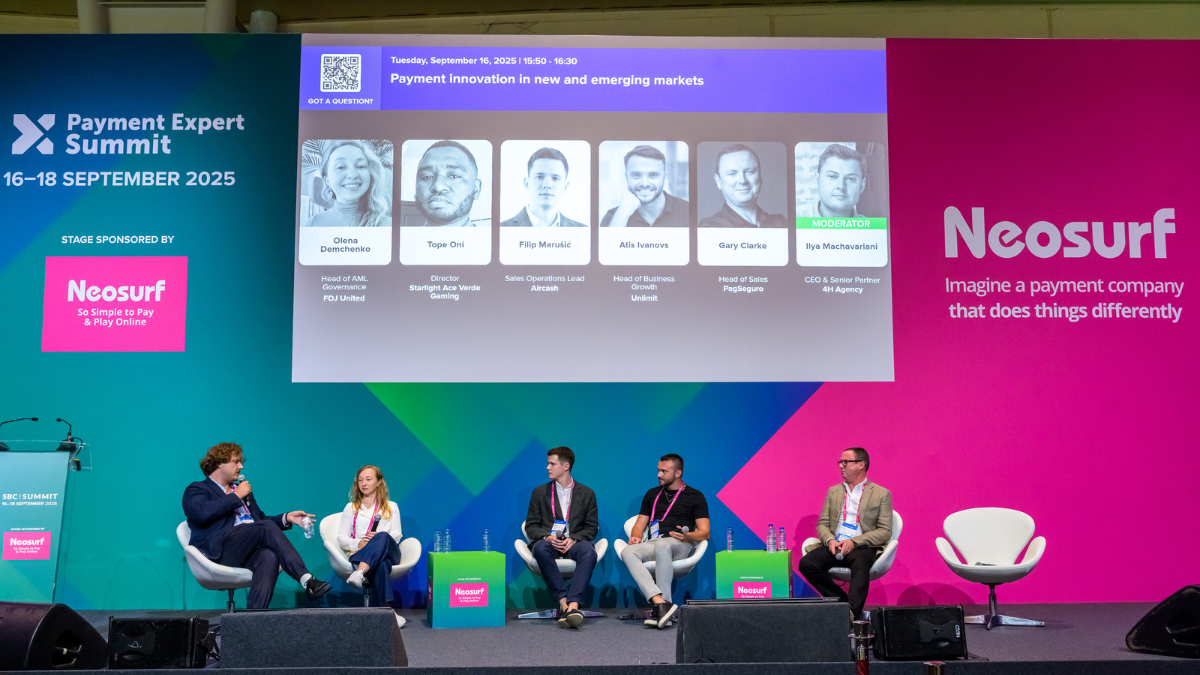
At SBC Summit Lisbon, executives from FDJ United, Aircash, Unlimit and PagSeguro said the success of instant payment systems like Pix, CoDi and Bre-B depends on regulation, localisation and consumer trust.
Instant payments have become the defining infrastructure upgrade in emerging markets, but their success is far from guaranteed. Speaking on a panel at SBC Summit Lisbon, industry leaders highlighted Brazil’s Pix as a benchmark, while pointing to Mexico’s CoDi as a cautionary tale and Colombia’s new Bre-B system as the next test case.
Gary Clarke, Head of Sales at PagSeguro, described Brazil as “a great place at the moment for gambling merchants” following the introduction of licensing and the rise of Pix. “We’re seeing constant growth,” he said, adding that “57% of Brazilian gamblers expect to have their payout immediately. Brazilian regulation says within two hours, but they want it immediately.”
Clarke said that meeting those expectations requires more than just payments processing. “Each country is individual… you need a partner with local expertise. Especially in Latin America. Really, really work with somebody who knows what they’re doing,” he said.
Bre-B enters the spotlight
Colombia’s Bre-B system, launched on September 23, was a focal point for the panel. The infrastructure – backed by Colombia’s centrabl bank, Banco de la República – is designed to enable real-time peer-to-peer and merchant transfers across banks, wallets and fintechs.

Clarke said the launch could transform payments in Colombia: “Bre-b […] we’re very excited about that. That will make the payment journey much easier. Greater user experience. And we expect that to become as popular in Colombia as Pix is in Brazil,” he said.
However, he cautioned against treating the region as a single market. “Brazil, you have to have a license. Colombia licence, etc. Chile, for example, at the moment, you don’t need a license. And they have different methods of payment in each. Mexico is the second biggest country in Latin America… but it’s not that simple to just go straight to Mexico, put up your website and ask people to start betting. There are other regulations that you have to go through.”
As Payment Expert has reported, Bre-B’s controlled rollout is intended to test interoperability across 227 institutions before full mass operation begins in October. Backed by ACI Worldwide, Credibanco and Dock, the system aims to replicate Pix’s ubiquity while embedding fraud prevention from day one.
Offline and cash-heavy markets pose risks
Beyond LatAm, panellists highlighted that cash reliance remains a structural barrier in many regions.
Olena Demchenko, Head of AML Governance at FDJ United, pointed to “offline payments… in the areas where you do not have constant access to internet” as a growth trend, but warned of heightened compliance risks. “It will be important to make sure that all these offline transactions are tracked and that it’s traceable,” she said.
Filip Marušić, Sales Operations Lead at Aircash, said the reality of cash-heavy economies means expansion strategies often start locally. “Most of the time we are starting locally and then spreading. Because as we are a cash payment provider, it’s obvious that we work mostly in the countries that are cash-heavy… such as the Balkans, middle Europe, not Nordics, not Baltics,” he said.
He described building distribution as a challenge: “We have to ensure the distribution there… meaning the places where we can top up our digital wallet with cash, which is a hard process in the market. Educate the distribution. Then we get to start working with the first merchants.”
Compliance versus customer experience
The panel also tackled the tension between anti-money laundering rules and customer expectations for speed.

Demchenko argued that technology must allow for reversibility: “In case, let’s say, instant payment goes through and then after you detect some suspicious pattern, you need to be able to reverse [the] transaction.”
Marušić admitted that long onboarding times deter users: “Obviously, the customers won’t do this… it’s a challenge to make the process the fastest and the best possible for the customers, respecting the regulations.”
For Clarke, communication is central: “The key word here is communication, right? Because you guys have to deliver the KYC, we need KYC, you need KYC from us. So it’s about communicating clearly and saying, we’re not asking you this for the fun of it.”
Competing beyond price
As competition intensifies, panellists warned against relying on cost-cutting alone.
Clarke said: “Everybody can do Pix. What else can you do alongside that? How can you help me minimise the cost of my payment processing? And what additional value can you give me?
Atis Ivanovs, Head of Business Growth at Unlimit, agreed that commoditisation is squeezing providers. “At the beginning, there were only a few providers who were giving ‘Pix’. Now actually, we, payment providers, are killing our own business. Because we are dumping the prices, giving it lower and lower. And the merchants are just running from one to another,” he explained.
The session’s moderator, Ilya Machavariani, CEO of 4H Agency, concluded that the era of relying on a handful of global acquirers is over. Today, he argued, operators must dive into the specifics of each jurisdiction, payment method and regulatory framework.
That decentralisation is both a challenge and an opportunity. As Clarke put it: “It’s a fantastic market. It’s growing quickly. There’s potential business for everybody… but make sure you are doing it correctly.”