UK deals lead the pack with Rapyd and Equals; stablecoins heat up under the GENIUS Act while the UK edges open finance toward payments
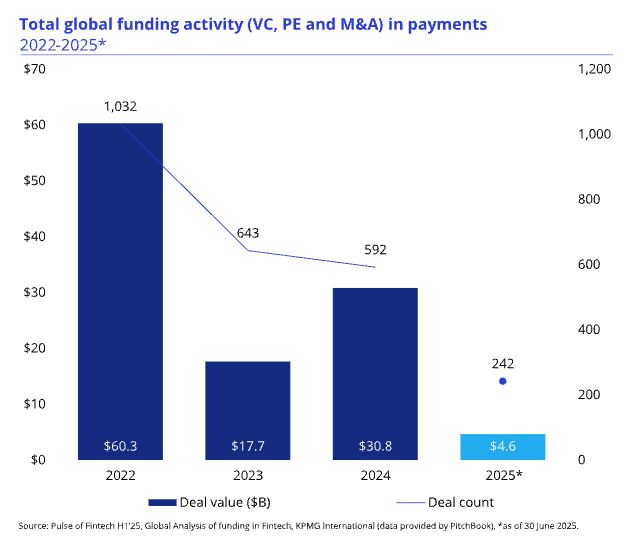
Payments financing fell to $4.6bn in the first half of 2025, a low “not seen in over a decade” after optimism from 2024’s rebound faded, according to KPMG’s latest Pulse of Fintech.
The report links the decline to investors shunning billion-dollar M&A and rotating toward profitable, infrastructure-first businesses.
The two biggest payments transactions in H1 occurred in the UK: Rapyd’s $500m late-stage round and the take-private of Equals Group for $366.3m. In the Americas, Argentina’s Ualá led with $366m, while in ASPAC Airwallex topped the list with $301m.
Where capital is flowing
KPMG says the pullback reflects a strategic shift toward resilient and scalable models. Investors moved away from speculative consumer fintech and leaned into B2B payments, AI-native fraud detection, and payment orchestration.
Activity in emerging markets remained notable. India featured multiple VC raises, including ToneTag’s $78m and other growth-stage rounds, highlighting continued demand for enabling payments tech despite the regional slowdown.
Policy tailwinds: stablecoins, MiCA and UK reforms
Policy signals could reshape payment flows in the second half of the year. In the US, Congress passed the GENIUS Act, providing a federal framework for stablecoins. KPMG expects this to accelerate adoption across retail, wholesale, treasury and public-sector payments, while the Circle IPO (raising $1.1bn, up 168% on day one) may spur further capital-markets activity from mature digital-asset firms.
In Europe, regulators are pushing clarity. MiCA is enabling firms to “fill out” digital-asset stacks across custody, trading and market data, while the UK advanced a comprehensive digital-assets regime through draft legislation and FCA consultations.
KPMG also flags a regional policy priority to move the Digital Euro to the forefront to prevent USD-stablecoins from dominating European markets.
“We’re seeing a major upswell in activity and investment in the digital asset space. Regulations are starting to come into focus in a number of jurisdictions — giving both startups and investors more confidence,” says Karim Haji, Global head of Financial Services for KPMG International.
“Looking ahead to H2’25, digital assets and currencies are well positioned to see investment grow even more. Whether Circle’s highly successful IPO will drive other crypto firms to exit will also be a trend to watch out for in the space.”
Beyond capital totals, the report highlights open banking expanding toward open finance in the UK, with data usage for payments among the next steps policymakers are considering. At the same time, AI agents are beginning to permeate the payments value chain, with corporates prioritising operational AI for AML/KYC and efficiency gains.
Consolidation and discipline?
KPMG characterises the exit window as selectively reopening.
IPOs are returning for profitable, scalable platforms, while M&A remains the dominant path in infrastructure and cross-border payments. Investors are demanding defensible unit economics and clear monetisation before backing scale.
For operators, the sweet spot in H2 looks like infrastructure-led B2B, orchestration across multiple acquirers and rails, and AI-driven financial-crime and risk capabilities. For investors, the UK remains a magnet for large deals, while policy shifts in the US and Europe could pull stablecoin-enabled and tokenisation use cases closer to mainstream payments.