Payment terms can impact cash flow across the supply chain, with suppliers sometimes waiting weeks to receive payment.
Instant gratification isn’t always an option for suppliers, who can wait 30, 60 or 90 days to get paid for a delivery.
The waiting period suits the buyer, giving them a cash cushion that protects working capital and keeps money in their account longer. However, it’s a different story for the supplier, which is left to juggle payroll, raw materials and everyday overheads while they wait for the invoice to clear.
In order to keep cash moving, supply chain finance gives suppliers a way to get paid early for invoices without reducing the time given to buyers to pay.
How payment timing impacts working capital
Timing is important when running a business because money must keep moving at the right time to maintain healthy cash flow.
However, systems don’t always allow for this to happen, with payment timing more often than not creating a mismatch between outgoing expenses and incoming revenue.
Suppliers need to pay staff, purchase materials and cover other costs while waiting for invoices to be settled. The longer it takes for the funds to arrive, the more pressure there is on the supplier’s working capital.
Buyers, meanwhile, can use longer payment terms as a cash-flow buffer, as keeping money in the business for longer provides companies with more flexibility over how they manage their working capital and when they pay their suppliers.
Open account transactions can have payment terms of 30 to 90 days, but the challenge is keeping the balance between both sides of the supply chain. Supplier financing can help address this imbalance by giving suppliers access to money tied up in approved invoices before the original due date.
A standard setup consists of three main stages:
- Approval, where the buyer approves the supplier’s invoice.
- Early payment, where a financial provider pays the supplier early, minus a discount fee.
- Settlement, where the buyer pays the full invoice amount to the financier on the original due date.
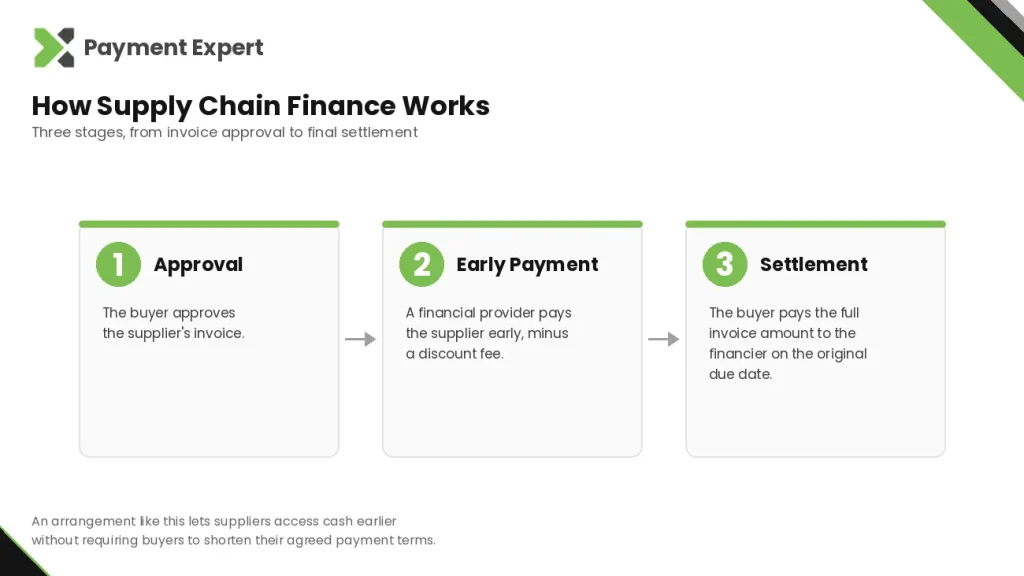
An arrangement such as this enables suppliers to gain earlier access to cash without requiring buyers to shorten their agreed payment terms.
Global programmes such as the IFC Global Trade Supplier Finance initiative use this model, purchasing and discounting invoices that corporate buyers have approved for payment.
Supply chain finance vs. traditional trade finance
While supply chain finance and traditional trade finance keep global commerce moving, they function on different mechanisms.
Traditional trade finance relies on transactional instruments like letters of credit, bank guarantees, and performance bonds, which are usually used when companies trade across borders or deal with unfamiliar counterparties where trust hasn’t yet been established.
The IFC Global Trade Finance Program uses this model, issuing guarantees to cover trade obligations, including letters of credit, promissory notes and bills of exchange.
Supply chain finance works differently, focusing on the ongoing relationship between an established buyer and its supplier network.
Rather than funding an order before or during transit, supply chain finance kicks in after an invoice is issued and approved, making the financing cost tied to the buyer’s credit and not the supplier’s.
A small vendor selling to a major corporation might struggle to secure affordable credit on its own. However, an approved invoice from that enterprise buyer provides instant, low-risk backing.
Specialised vehicles like the IFC Global Supply Chain Finance programme leverage this model, providing affordable short-term working capital to emerging-market suppliers who would otherwise face high borrowing costs.
Optimising cash flow through strategic payment terms
Companies don’t have to choose between maintaining good relationships with suppliers and keeping control of their own cash flow.
The first step is understanding how existing payment terms affect the business. Accounts payable teams can look at how long invoices take to process, how much is being paid to suppliers each month and where delays are leaving money tied up for longer than necessary.
Once businesses have a better understanding of their payment cycle, they can look at ways to give suppliers earlier access to their money without having to bring forward the date when they pay.
Early payment programmes and supplier financing can give vendors access to cash sooner and allow buyers to keep their existing payment terms.
Suppliers have a different decision to make when considering early payment because receiving money sooner can make it easier to cover payroll, purchase materials and manage other day-to-day costs without relying on additional borrowing.
However, early payment can come with a discount, meaning suppliers need to consider whether the cost is worthwhile compared with waiting for the full invoice amount to arrive on its original due date.