Banking-as-a-Service (BaaS) has become one of the most significant infrastructure developments in financial services over the past decade. It allows companies to embed banking products into their own platforms without becoming banks themselves.
At its simplest, BaaS software provides the technology layer which connects businesses to licensed financial institutions. Through APIs and pre-built infrastructure, companies can offer services such as accounts, payments, cards, lending, foreign exchange and treasury management while the underlying banking partner handles regulatory obligations and safeguarding requirements.
The model has enabled everyone from fintech start-ups to global software providers to launch financial products faster than would have been possible through traditional banking relationships.
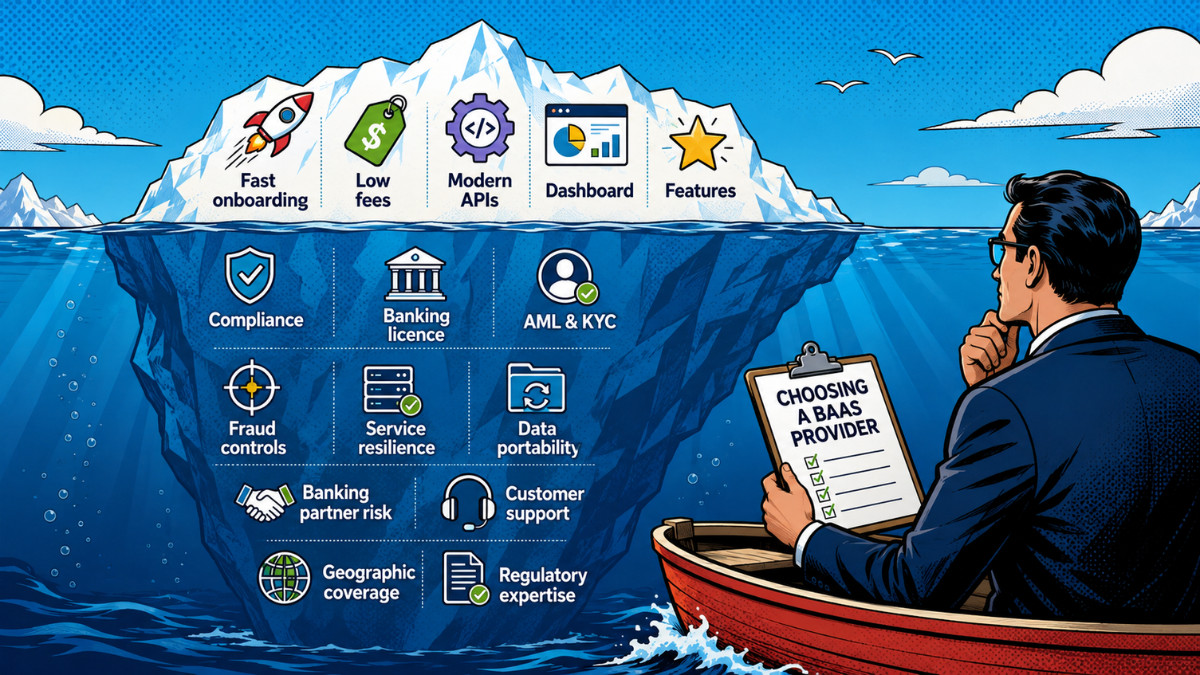
Yet selecting a BaaS provider is rarely straightforward. Beneath the marketing claims of fast integration and embedded finance opportunities lies a complex mix of regulatory considerations, technical capabilities, commercial arrangements and operational risks.
For businesses considering a BaaS partnership, choosing the wrong provider can lead to expensive migrations, compliance challenges and product limitations years down the line.
Who typically buys BaaS software?
- Fintech companies: Many digital-first financial services firms use BaaS providers to launch products without obtaining a banking licence. This can significantly reduce time-to-market while allowing teams to focus on customer experience and product development.
- Software platforms: Vertical SaaS providers increasingly embed financial services into their platforms. Accounting software, payroll providers, property management systems and e-commerce platforms may all use BaaS infrastructure to offer payments, accounts or cards to customers.
- Marketplaces: Online marketplaces often use BaaS providers to manage seller onboarding, payment acceptance, payout services and wallet functionality.
- Enterprise businesses: Larger organisations may use BaaS infrastructure to modernise treasury operations, streamline cross-border payments or create financial products for customers and partners.
- Banks and financial institutions: Some incumbent financial institutions also use third-party BaaS software to accelerate digital transformation projects or expand into new markets.
What should buyers consider when evaluating a BaaS provider?
Regulatory model and licensing
The first question is often the most important: who holds the licence?
Some providers operate under their own banking licence, while others partner with regulated financial institutions. Buyers should understand exactly where regulatory responsibility sits and what protections exist if the banking partner changes.
A strong technology platform cannot compensate for weaknesses in the underlying regulatory structure.
Geographic coverage
A provider’s ability to support international expansion varies significantly.
Questions to consider include:
- Which countries can the provider support today?
- Are local payment rails available?
- Does the provider support multiple currencies?
- Are local compliance requirements already built into the platform?
What works for a UK launch may not support future ambitions in Europe, North America or Asia-Pacific.
Product breadth
Many BaaS providers specialise in specific services; some focus primarily on payments, while others offer a broader suite including accounts, cards, lending and treasury services.
Businesses should consider not only current requirements but potential future needs as migrating providers later can be expensive and disruptive.
API quality and developer experience
The quality of APIs often determines the success of a BaaS implementation.
Documentation, testing environments, developer support and implementation resources should all be assessed early in the evaluation process.
A feature-rich platform can still become difficult to work with if integration processes are poorly designed.
Compliance and risk management
Financial services remain heavily regulated.
Prospective buyers should examine:
- KYC and KYB capabilities
- AML monitoring tools
- Transaction screening
- Fraud prevention systems
- Reporting functionality
- Audit trails
Compliance capabilities should be viewed as core infrastructure rather than optional add-ons.
Reliability and resilience
Downtime in financial services can have immediate commercial consequences.
Key areas to investigate include:
- Service-level agreements
- Historical uptime performance
- Disaster recovery processes
- Incident response procedures
- Redundancy arrangements
- Third-party dependencies
Scalability
A provider that supports a few thousand customers may not necessarily support millions. Businesses should assess whether the platform can accommodate projected growth in transaction volumes, customer numbers and geographic expansion.
Data ownership and portability
Data portability is often overlooked during procurement discussions.
Understanding who owns customer data, how it can be exported and what happens during provider migration can prevent significant challenges in the future.
The questions every buyer should ask
Commercial questions
- What are the implementation costs?
- How are transaction fees structured?
- Are there minimum volume commitments?
- What additional charges apply for compliance services?
- How frequently are pricing reviews conducted?
- What costs would be incurred if we terminate the agreement?
Technical questions
- What APIs are available?
- What development resources are provided?
- How long do integrations typically take?
- How frequently is the platform updated?
- Can functionality be customised?
- What is the product roadmap over the next 12-24 months?
Regulatory questions
- Who is the regulated entity supporting the service?
- What licences are held?
- In which jurisdictions can services be offered?
- How are regulatory changes communicated?
- What happens if the banking partner changes?
Operational questions
- What support is available during onboarding?
- Is support available 24/7?
- What escalation procedures exist during outages?
- Who are the named relationship contacts?
- How are incidents communicated to customers?
The overlooked questions which matter most
Many procurement teams focus on features, pricing and implementation timelines. However, some of the most important questions are often the ones least frequently asked.
What happens if your banking partner changes?
Several BaaS providers rely on third-party banking relationships. A change in banking partner can affect product availability, customer migrations, compliance requirements and operational processes. So understanding contingency plans is essential.
What percentage of your revenue comes from your largest customer?
Overreliance on a small number of clients can create business continuity risks. A diversified customer base may indicate greater long-term stability.
Have you ever exited a market?
The answer can reveal how the provider handles regulatory complexity and strategic shifts.
What happens if we outgrow your platform?
A confident provider should be able to explain how larger customers are supported and provide examples of clients that have successfully scaled.
What does migration away from your platform look like?
Few vendors enjoy discussing customer exits, but the answer can reveal a great deal about data portability, transparency and long-term flexibility.
Which third parties does your platform depend on?
Modern BaaS platforms often rely on multiple partners for banking services, identity verification, fraud screening and payment processing.
Understanding these dependencies provides a clearer picture of operational risk.
How do you handle regulatory investigations or enforcement actions?
No provider expects to face regulatory scrutiny, but buyers should understand how incidents would be communicated and managed if they occur.
Choosing a long-term partner, not just a technology provider
BaaS procurement decisions are often framed as software purchases, but in reality, they are long-term strategic partnerships. The provider selected today may influence a company’s product roadmap, regulatory posture and international expansion plans for years to come.
While pricing, features and implementation speed remain important considerations, buyers should also assess resilience, transparency, governance and long-term viability.
The most successful BaaS relationships are built not only on technology capabilities but on a clear understanding of risk, responsibility and future growth ambitions.