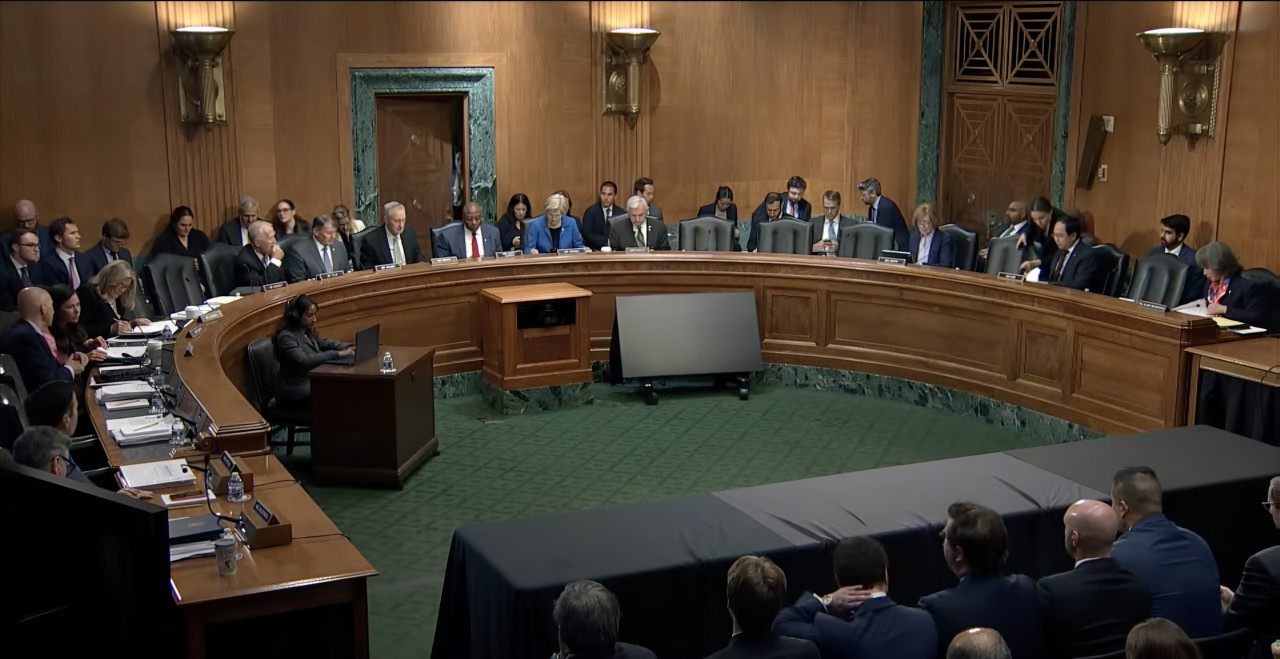
After President Donald Trump agreed to a series of amendments, Senate Democrats delivered a counterproposal on the Digital Asset Market Clarity Act (CLARITY Act) to Republican negotiators overnight, keeping talks alive before the cloture vote (15 September).
The Senate votes at 2:15 p.m. ET (7:15 p.m. BST) on whether to advance the bill. Cloture requires 60 votes. This blog covers developments in the past 24 hours and will be updated.
This blog follows on from: Trump agrees CLARITY Act ethics rules ahead of Senate vote.
15 September: overnight – Democrats send counterproposal
Senate Democrats sent Republican negotiators a counterproposal on the CLARITY Act, keeping negotiations open hours before the cloture vote.
The response followed the revised Republican draft that sponsors described as their “last, best, and final” offer, released on 13 September.

Democratic negotiators met earlier at the office of Minority Leader Chuck Schumer. Senator Mark Warner said as he left the meeting that “the Democrats who’ve been working on this in good faith are sending a counterproposal,” per Politico.
Ethics enforcement on federal officials’ crypto holdings remained the central dispute. The counterproposal’s full contents were not public as of early Tuesday, so the specific requested changes are unconfirmed.
If cloture clears, Republicans plan to offer the Senate text as an amendment in the nature of a substitute, according to sponsors. If it fails, market-structure legislation stalls before the midterm elections.

15 September: ~06:40 ET (11:40 BST) – Bitcoin holds near $77,400 before the vote
Bitcoin traded at roughly $77,400, unchanged over 24 hours but down about 3% from the $79,530 it touched overnight and lower by more than 1% on the week.
XRP rose more than 2% to $1.41. Zcash gained nearly 3% to about $1,149. Ether, BNB, tron, HYPE and dogecoin each slipped less than 1%, and solana was flat just above $101. Over seven days, dogecoin was down 7%, HYPE 5% and BNB 3%.
15 September, morning: Polymarket puts 2026 passage at 18%
Polymarket priced the odds of the CLARITY Act being signed into law in 2026 at 18%, down from a peak near 30% on Monday, after reports that several Democrats had concerns about the revised ethics text. Galaxy Research put the probability at about 10% earlier in September.
Kalshi priced the odds of passage at 44% after the revised text’s release on 13 September, up from 18% earlier, on a separate contract measuring a different question.
14 September: Eight banking groups and 18 attorneys general push back
Eight banking associations wrote to Majority Leader John Thune and Minority Leader Chuck Schumer on 14 September, asking for tighter limits on rewards paid to stablecoin holders. The groups said interest-like incentives could pull deposits from banks and reduce lending.

“Deposits are the foundation of the banking system,” they wrote. Their request centres on Section 10404, covering payments and incentives tied to payment stablecoins.
A bipartisan coalition of 18 attorneys general – 17 states and the District of Columbia – led by New York’s Letitia James, urged the Senate to revise or reject the bill over federal preemption of state enforcement. James said the bill “would embolden scammers” and could strip state attorneys general of authority to protect investors.
The coalition cited more than 330 state anti-fraud actions involving crypto since 2017. It cited $11.4bn in FBI-recorded cryptocurrency losses in 2025, up 22% year on year, and $1.78bn reported by the Federal Trade Commission, up 25.6%.
14 September: Treasury backs the revised text
Treasury Secretary Scott Bessent supported the revised draft, saying it gives his office authority to protect community banks from stablecoin-related risks. Bessent said the bill is “essential to ensuring America wins the global race for new technology”.
The revised text lets the Treasury Secretary impose an 18-month circuit breaker on stablecoin rewards if payment stablecoins cause substantial deposit outflows from community banks.