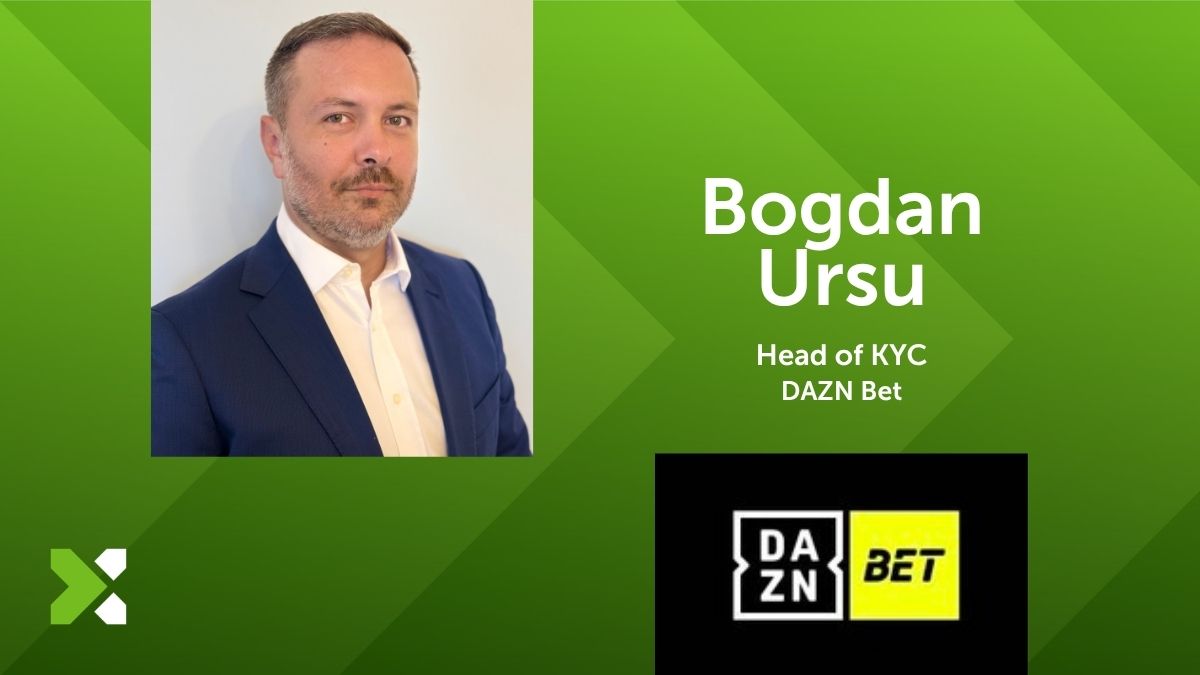
DAZN Bet’s Head of KYC on identity as a one-time check, why the EU AML package won’t mean starting from zero, and where automation stops and human responsibility begins
Ahead of SBC Summit 2026, we spoke to Bogdan Ursu, Head of KYC at DAZN Bet, about the identity and AML challenges facing gambling operators as the EU’s AML package moves toward full effect.
From verifying identity and monitoring risk, to what the new rules actually change for operators and where automation ends and human judgement begins, DAZN Bet’s Ursu makes the case for risk-based verification aimed at the players who need it.
For more details on your chance to attend SBC Summit 2026, and hear from Bogdan Ursu in person, follow the link HERE for more details.
Read the full interview below…
What does the customer relationship look like from a KYC perspective after onboarding, now that identity verification is treated as a continuous process rather than a one-off check at sign-up?
I think there is an important distinction between KYC and CDD here.
Once we have established and verified that a player is who they say they are, we don’t need to continuously ask them to prove their identity again. What becomes continuous is our understanding of the player and their risk profile.
So we continue to look at relevant changes, such as new fraud indicators, changes in player information, sanctions or PEP status, and changes in activity that may require further investigation.
If there is a genuine reason to question the player’s identity, then we go back to KYC and re-verify them. Otherwise, the ongoing activity is more about CDD and AML monitoring. This is already part of how we think about the player journey here at DAZN Bet. The objective is not to create continuous friction for everyone. It is to maintain confidence in the player relationship and intervene when there is a real reason to do so.
Of the incoming requirements under the EU’s AML package and AMLA’s direct oversight, which will demand the biggest operational change for operators, and where is DAZN Bet already prepared?
I don’t think the new AML package completely changes the way mature iGaming companies operate. Most established operators already have the main controls in place: identity verification, sanctions and PEP screening, fraud controls, transaction monitoring, risk assessment and escalation processes.
For me, the bigger change is the move towards a more uniform European AML framework and a more consistent approach to how those controls are expected to be applied and evidenced.
At DAZN Bet, many of the building blocks are already there. We have invested heavily in automation and have experience of using technology to improve both the control environment and the player journey.
So I don’t see this as starting again from zero. It is more about taking the controls that already exist, making sure they work together as one framework, and then applying any additional local requirements on top.
Walk us through the role automation now plays in your verification stack, from document checks and biometric liveness through to sanctions, PEP and database screening. Where does a human still need to make the call?
Automation is already a major part of modern KYC and AML operations. The important thing is that these controls don’t need to operate as completely separate checks. The more useful approach is to bring the signals together and use them to decide whether the player can move through automatically or needs further investigation.
Humans are still essential where there is ambiguity or where judgement is required. That could be a potential sanctions or PEP match, an identity inconsistency, suspected identity fraud or a more complex risk situation.
In my view, the automation is reducing unnecessary manual processing, giving teams more capacity to focus on complex cases, and allowing operators to scale without simply scaling the size of the team. But it never removes human responsibility.
Operators often frame KYC as a tension between security and player experience, where every extra check risks losing a customer at the door. Do you accept that framing, or can strong verification actually improve conversion?
I think the real problem is poorly designed verification flow rather than verification itself. If every player is pushed through the same maximum level of checks, then obviously you create unnecessary friction. But if the process is automated and risk-based, the majority of genuine players can move through quickly while additional checks are focused on the players who actually need them.
For me, the goal isn’t to minimise the number of checks. It is to make sure we are doing the right check, on the right players, at the right time.
How do you build a verification framework flexible enough to satisfy every regulator across DAZN Bet’s markets without rebuilding it jurisdiction by jurisdiction?
I think the right approach is to have one strong common framework and then add the local requirements on top.
The EU AML framework gives us a much stronger common baseline for AML and CDD, but it doesn’t remove the specific requirements that individual gambling regulators can still have. So I wouldn’t build a completely different KYC framework for every country. The core capabilities can remain common: identity verification, sanctions, PEP, fraud controls, risk assessment, monitoring, case management and audit trail. Then the local regulatory requirements are applied through the relevant policies and rules for that market.
That gives us consistency where we can have it, while still allowing us to meet local requirements where we need to.
With the AML reforms taking full effect over the next few years and the EU Digital Identity Wallet coming online, what should operators be building towards now, and what does onboarding look like in three years?
I don’t see the future as simply adding more KYC checks. Most mature operators already have many of the necessary controls.
The bigger opportunity is to bring identity, AML screening, fraud, player information and transaction activity together so that the level of intervention is based on the player’s actual risk.
The EU Digital Identity Wallet could also make the identity part of the journey much simpler. Instead of repeatedly asking players to upload documents, we may increasingly be able to rely on trusted digital identity and specific verified attributes.
But that doesn’t replace CDD or AML. We will still need to understand the player, monitor the relationship and respond when risk changes.
So, in three years, I would expect low-risk players to have a much faster and more digital onboarding experience, with automation handling the standard checks. For me, the future isn’t more KYC. It’s better use of the KYC and AML controls we already have, with less friction for genuine players and more targeted intervention where the risk actually requires it.
Held in Lisbon from 29 September to 1 October 2026, SBC Summit is one of the world’s largest gatherings of betting and gaming professionals.
The event will bring together 40,000 attendees from across the industry for three days of learning, networking, and discussion, alongside a major exhibition featuring leading brands from around the globe.
For more information and tickets, visit sbcevents.com/sbc-summit.