
A Pay.UK report revealed Direct Debit continues to remain one of the country’s most popular payment methods but there is still room for alternatives
Direct Debit in the UK processed a record five billion transactions in 2025 demonstrating its popularity among consumers and businesses despite the influx of new digital payment services.
After its initial launch in the UK 60 years ago, Direct Debit’s record growth was revealed in a recent Pay.UK report as the payment method continues to be used for recurring payments for utility bills, mortgages, council tax and subscriptions.
Direct Debit also remains one of the most well-known payment methods, as Pay.UK’s report revealed the payment method has a 98% awareness rate among those surveyed.
David Crawford, Chief Strategy and Transformation Officer at Pay.UK, said: “Direct Debit has been a central part of the UK payments landscape for more than 50 years and continues to play a vital role in enabling regular, reliable and protected payments.
“Despite the growth of newer payment methods, Direct Debit remains deeply embedded in everyday economic activity, supporting everything from household bills and subscriptions to business payments and essential services.”
The new UK Direct Debit findings
Among respondents in the report, 92% of UK consumers expressed high satisfaction with Direct Debit as one of its primary payment methods.
One of the benefits of Direct Debit is the reliability it affords consumers, as payments are processed and settled on dates and event times selected by the consumer. 65% of respondents cited system reliability as the reason for their satisfaction, placing value in its automated nature.
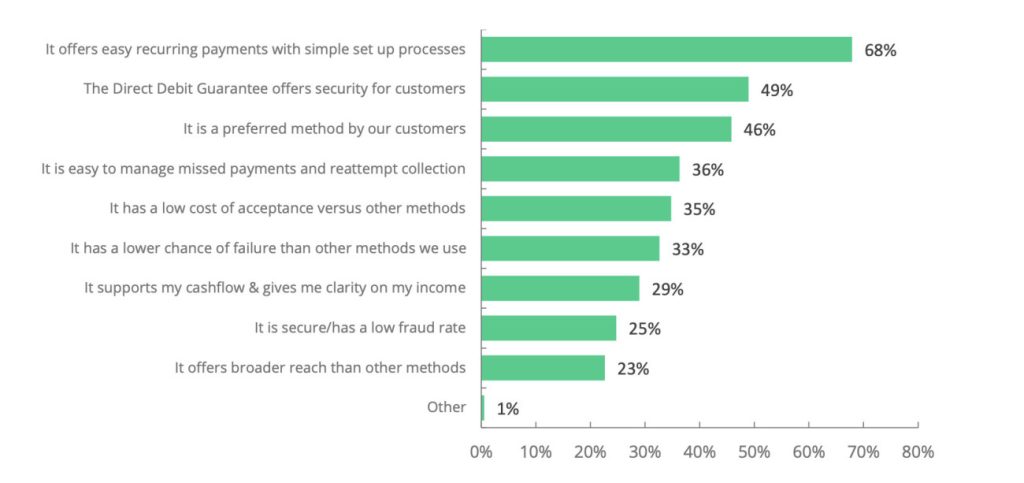
This was emphasised further when 60% of consumers stated Direct Debit helps them manage monthly bills, personal finance and budgets. By enabling payments to be taken out potentially all on the same day, consumers then have the knowledge of what money that they have for the rest of the month.
This is a shared sentiment on the provider side, with 96% of merchants and financial institutions reporting high satisfaction with the scheme. Currently, 62% of UK merchants accept Direct Debit, which encompasses digital subscriptions, memberships, and gaming passes.
Direct Debit’s adoption can also be pointed to 94% of UK banks and fintech firms offering it as a service to their customers.
“The findings show that Direct Debit continues to hold a distinctive and valuable role in the UK payments landscape,” continued Crawford. “It is widely adopted, strongly trusted, and closely associated with reliability, choice and consumer protection.
“The research further identifies areas where improvement could support the experience of users and providers, while highlighting an opportunity to better understand how recurring payment experiences and expectations may differ across end user groups.”
Still room for more payment methods
While Direct Debit remains one of the most popular payment methods in the UK, this has not deterred the country’s payments sector to find new, digital, alternative methods.
As Direct Debits take up to three working days to process and settle, consumers and businesses are seeking faster ways of paying out and receiving payments.

Variable Recurring Payments (VRPs) have been touted to serve as a competitor to Direct Debit in the UK as it offers quicker, same-day settlement by transferring funds from account-to-account.
VRPs also offer flexibility for consumers to select minimum and maximum amounts, how frequent the payment is sent and can be managed in the backend of banking apps.
The UK Payments Initiative (UKPI) has been pushing to get commercial VRPs off the ground. Richard Mould from UKPI was a guest on the Payment Expert podcast in June to discuss what sets them apart from direct debits and card-on-file.
Crawford also agrees that whilst Direct Debits continue to be popular amongst consumers, VRPs also have a role to play in modernising the system.
“While Direct Debit continues to play an important and trusted role, it is one part of the payment mix and will not meet every user need or circumstance,” added Crawford.
“Supporting the development of complementary payment options, including commercial variable recurring payments (cVRPs), will therefore be important in ensuring that recurring payment solutions remain inclusive, accessible and responsive to the changing needs of consumers and businesses.”