
A report from Visa Consulting & Analytics and Equals has found that there are significant gaps in the expectations of businesses when applying embedded finance, against the service support that has been provided.
There are service and support gaps slowing the $116bn embedded finance industry as companies are missing out on valuable revenue.
This is according to a recent report from Visa Consulting & Analytics and Equals, which revealed 60% of 150 senior leader respondents have lost revenue due to insufficient embedded finance support from their provider.
The Visa and Equals study interviewed senior leaders across banks, fintechs, trading portals and digital asset exchanges in the UK and Western Europe.
While 82% of respondents stated embedded finance providers play a significant role in helping them scale their business, two in five respondents have seen global expansion delayed by poor service.
Embedded finance has become a highly valuable service to non-payments companies looking to facilitate transactions for their customers without the need for third parties, which can add friction to the customer experience.
However, the report found even with embedded payment services being integrated into business infrastructure, more than 60% of chief financial officers (CFOs) believe providers are either “too big to care” or “too small to deliver” to support them when problems arise.
These issues can be attributed to business operational and regulatory teams not understanding the compliance elements that come with processing and settling payments, expertise that embedded finance providers have.
Regulatory complexities
The report found 71% of all respondents agree that internal teams alone cannot manage the operational and regulatory complexity of embedded finance.
Operational and education gaps can be apparent when businesses are attempting to scale globally, but when it comes to understanding the fragmented payment regulations that exist in multiple jurisdictions, business leaders are arguing their teams can be on hand to solve this in-house.
Some of the respondents raised concerns with compliance gaps which could have been caught earlier.
Four in five CFOs stated internal teams cannot manage the operational and regulatory complexity of embedded finance, which leaves gaps in business’ payments delivery outcomes.
Ed Chandler, Senior Executive Leader of Equals, said: “These findings suggest that many businesses are underserved because their payment environments are too complex for off-the-rack solutions.”
Onboarding issues and is AI the answer?
Onboarding issues were one of the primary issues business leaders raised concerning the quality of their embedded finance service.
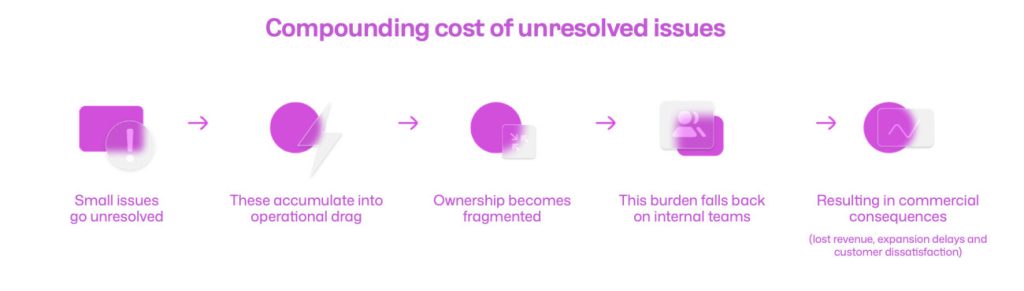
Respondents revealed delays as part of the integration process with a slow issue resolution. Over half of respondents said servicing challenges are a constant operational burden rather than occasional incidents.
What’s more, many respondents believe AI holds the key to unlocking many of the onboarding friction challenges associated with embedded finance integration.
Of the 150 respondents, 60% of businesses agree that increasing automation or AI-driven servicing from providers risks reducing the level of human expertise and relationship support their organisation relies on.
Payments technology companies have deployed AI in their onboarding process, and when facilitating embedded payment services to their merchant clients, as explored in a report by Capgemini in September 2025.
Speaking to Payment Expert last year, Capgemini Global Head of Research Institute for Financial Services, Elias Ghanem, revealed why AI is making the embedded payment onboarding process much faster and cheaper for merchants.
“In order for a merchant to be able to accept your payment, they need to be onboarded. So the fastest, cheapest, and easiest way to do this is to put it all together,” said Ghanem.