During Sibos 2025, Payment Expert spoke to Elias Ghanem and Gareth Wilson of Capgemini on how banks are being beaten by fintechs with AI, but how they can use the technology to close the innovation gap.
The exhibition halls at Sibos this year buzzed with discussions around digital assets, instant cross-border settlement and the next frontier for AI.
If 2024 was the year AI, and its Generative offspring, seized the consciousness of the financial services industry, its 2025 sequel would be how companies can apply these models to specific needs.
This has resulted in producing more nuanced conversations as the technology becomes equally sophisticated; no more is the industry speaking about AI in broad strokes.
What has been evident since the start of the year, is AI is finally being leveraged by all forms of institutions, from banks to even small businesses, for a wide variety of means. These cover KYC and AML checks, customer assistance, and, crucially for payment technology firms (PayTechs), onboarding merchants.
While banks, for the most part, are utilising large language models (LLMs) to assist the tens of thousands customer queries per month, paytechs have been afforded a gap in the market where they can use AI to capture the needs of merchants.
Speaking to Payment Expert on the sidelines of Sibos 2025, Capgemini Global Banking Industry Leader Gareth Wilson, and Global Head of Research Institute for Financial Services Elias Ghanem, revealed why AI can be a double edged sword for banks looking to for the holy grail in a quest to finally modernise and catch up to their fintech competitors.

Paytechs have taken over the merchant market
“There is a takeover happening as we speak, where new age payment providers are slowly taking over the banks in their relationship with the merchants,” says Ghanem.
But before he provides a deep dive into why these technology firms have begun to infiltrate the merchant market, it is important to understand what merchants need from their service providers.
Above all, merchants trade on trust. SMBs spend most of their time chasing growth, so payments rarely top the to-do list. What they do care about is fast, reliable payment processing which speeds checkout, keeps customers happy, and reduces cart abandonment.
Yet the first hurdle comes before the first transaction – onboarding.
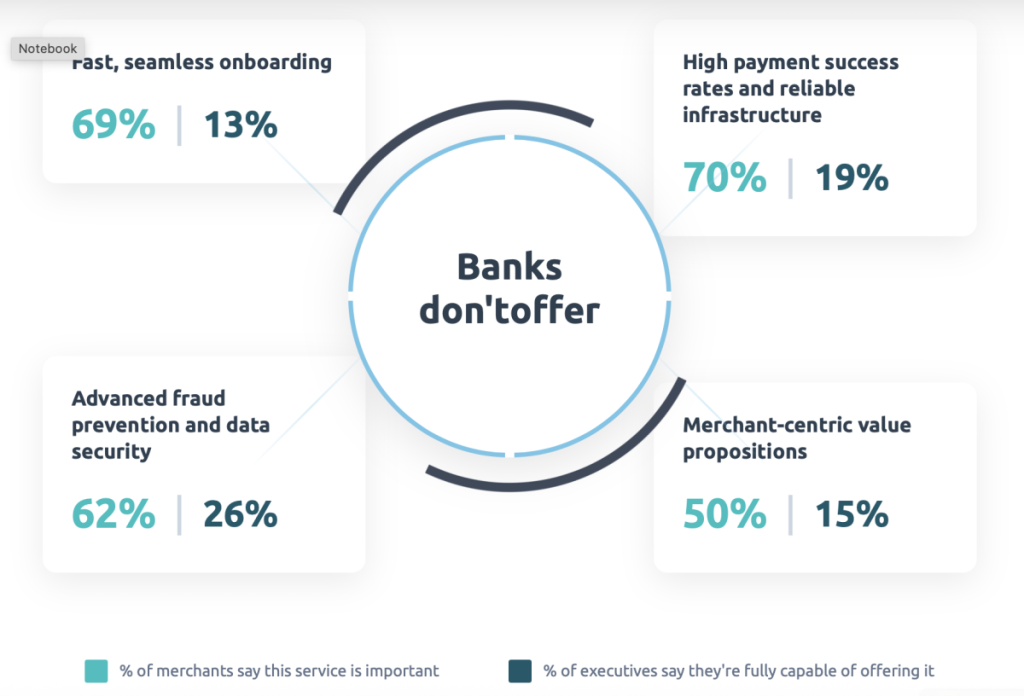
The merchant payment onboarding process to integrate a payment service provider’s infrastructure can be long, strenuous and often costly. It is here how PayTech’s have been able to find a gap in the market.
“In order for a merchant to be able to accept your payment, they need to be onboarded. So the fastest, cheapest, and easiest way to do this is to put it all together,” says Ghanem, who reveals some eye-opening figures as to how PayTech’s have leapfrogged banks in the small-to-medium merchant market.
“To put some numbers into context, it takes up to seven days for a bank to onboard a merchant. It takes less than 60 minutes for a PayTech to do it. It costs up to $500 for a bank to onboard a merchant. It costs $200 from a PayTech.”
This almost seems like a no brainer for merchants. Why onboard with a bank when a paytech can make this process quicker and cheaper, by leveraging next-generation technologies to strip out friction?
PayTech’s not-so-secret weapon. Do banks need to wake up?
The majority of banks have dipped a toe rather than dived into using AI.

NatWest’s partnership with OpenAI aims to deepen insight and drive personalisation through the use of generative models, while Lloyd’s are working alongside Microsoft to reduce backoffice workloads and free colleagues for more “face-to-face” time.
Useful first steps, but they still only scratch the surface when it comes to integrating AI throughout their entire system.
“We see the demand for greater customer experience, we see the demand for leveraging data and technology in a more insightful and impactful way, and potentially with the agility of some of those PayTech organisations, they’ve been able to both respond and capture the market,” says Wilson.
He explains that while paytechs are focusing on enhancing customer personalisation and the experience that comes with it, they are also looking at company data and automating risk assessment checks to onboard merchants at vastly quicker rates.
Fintechs—PayTechs included—will inevitably spend time catching up to banks on reputation. To win customers and merchants, they have gone the other way on technology by deploying AI across the full stack rather than in isolated pockets. That breadth is their edge.
Ghanem explains: “A lot of information from a merchant, before I onboard and start receiving your payments, most of that information is already available somewhere, such as through Open Banking, Open Finance, etc.
“If I am able to capture this information from different channels and convert it into action, I only need to configure a price. And that’s why PayTechs are able to do this so efficiently.”
If banks are merely scratching the surface of AI’s potential, fintech firms are digging beneath it. There is, however, a sibling of AI that has caught the eye across finance, and it could yet be the banks’ best chance to close the innovation gap with fintechs for the long term.

Agentic AI – banks’ next innovative frontier
There were many key talking points and themes from the Sibos event in Frankfurt. Digital assets, particularly stablecoins, dominated conversations, but Agentic AI also stood out in the crowded Messe halls as a natural next-gen piece of tech which could significantly accelerate how financial institutions operate.
In a day-one keynote, James Maxfield, Chief Product Officer at Duco, likened Generative AI the financial sector’s “iPhone moment”, with Agentic AI “being at the forefront of this innovation”.
The appeal of agentic AI is autonomy and speed. While institutions focus on scaling, agentic systems can run KYC, onboard customers and merchants, and manage risk in parallel.
These multiple AI agents can also identify future risks and process them in real-time, providing a future-proofed outlook on potential fraud cases and money laundering attempts.
For banks, Agentic AI represents a shift in how to automate ordinarily manually processed jobs, and adds value to the customer experience without the need of tirelessly manually updating their systems.
“Our view is that Agentic AI can create significant value and impact across the industry.”
“There is definitely a challenge in terms of taking Agentic from the experimentation stage that we see across many organisations, as there are lots of concepts and pilots into AI that are at scale,” says Wilson. “The best way to do that in our experience is to have a very specific use case or a very specific topic that creates value on a broad basis.
“We talked about onboarding, as an example. KYC is another great example. All of these use cases, all of these processes will lend themselves to bringing AI to bear, provided you’ve got the data on which you can act on that, and then of course, in a regulated environment, you also need to ensure that you’ve got the explainability and the oneness ability of the agent.”
Agentic AI may help close the innovation gap between banks and fintechs, but integration is not simple. It demands work on legacy systems, large-scale data reorganisation, and strict attention to emerging rules such as the EU AI Act.
Regulation is also not new territory for banks, and many are already moving to cloud-native infrastructure to modernise their data.
The bigger challenge, therefore, is to answer the question, “Why do we need AI?” before deciding where and how to deploy it.
Don’t use AI for the sake of using AI
“To do AI at scale, you have to have the right data, the right channels, challenges and the right ecosystem,” says Ghanem, who aptly addresses this choice decision head-on for banks.
There’s been no shortage of AI hype: lots of promise on faster payments, not enough proof in live use cases.
A bank intent on reclaiming SMBs would start where it hurts most, onboarding. Apply AI to automate checks, standardise data, and clear merchants faster. Fraud needs the same treatment. Use LLMs to spot anomalies in real-time and act earlier; JP Morgan’s work over the last two years shows the direction of travel.
“We must make sure that we understand how (AI) is being implemented and how it’s deployed’, concludes Wilson. “We must understand that we’re always in a position to audit, explain, and then attribute the decision that’s being generated by AI.”
Adopting AI can feel like table stakes – a way to tell customers and clients ‘hey look, we’re modernised and innovating’.
The real test comes when institutions look at how AI is being applied to tackle today’s problems and pre-empt tomorrow’s, and which models (agentic or generative) are best suited to each task.
Banks are acclimatising to a new AI shaped world. The question is how they use it not only to close the gap with fintechs, but to help set the course of finance for years ahead.