Payment Expert is on the ground at Money20/20 Europe. Expect real-time insights from leading industry leaders engaging in conversations about fintech, payments, banking, digital currencies, and much more.
To read what happened on Day 1, click HERE.
17:30 – That brings an end to Day 2
As the tannoy sounds and the show floor winds down, the Payment Expert team is gearing up for tomorrow, the final day of Money20/20 Europe.
Final days tend to be quieter, but this one isn’t looking that way. We’ve got more voxpop interviews lined up, sessions about deepfake‑driven fraud and conversations with industry leaders such as Global Payments.
Plenty still to come before the lights go out in Amsterdam.
17:00 – Old vs New rails
Electric vehicles are perhaps not the first topic you would expect to hear discussed at a payments conference, but the infrastructure behind them provides a useful comparison.
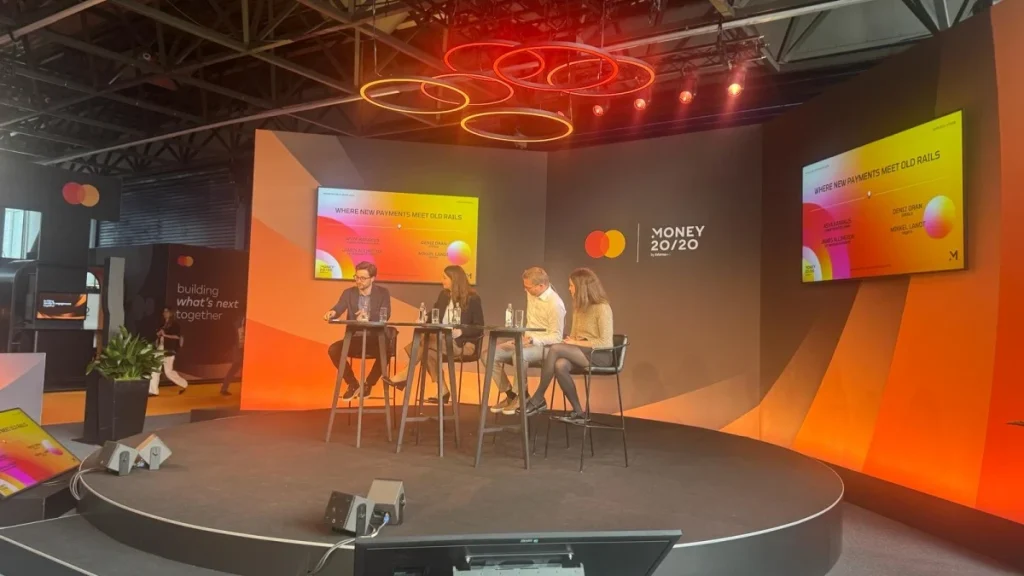
That tension between the frictionless experiences users now expect and the legacy infrastructure still powering them was the discussion point for “When New Payments Meet Old Rails” at Money20/20 Europe in Amsterdam.
Panellists from Google, SumUp, Monta and JPMorgan Payments looked at where progress is being made in payments and where existing rails continue to limit what is possible.
Asya Karakus, Global Head of Payment Partnerships at SumUp, explained that a growing part of a fintech’s role in the SMB space is hiding complexity from merchants.
Businesses expect consumer-grade experiences, whether that is instant onboarding, near-instant settlement or one-click payments. However, much of the infrastructure supporting those experiences hasn’t changed.
16:30 – GoCardless brings Recurring Pay by Bank to market with new UK scheme
GoCardless used Money20/20 Europe to announce the launch of ‘Recurring Pay by Bank’, backed by a new industry-led scheme operated by UK Payments Initiative (UKPI).
The scheme has been a long time coming. Cards still account for 84% of UK retail payment spending, costing businesses £1.5bn in fees through Visa and Mastercard’s near-duopoly.
Recurring open banking payments are the most credible alternative to emerge so far, and UKPI’s go-live gives GoCardless the infrastructure to bring it to market properly.
GoCardless completed the first recurring open banking transaction back in March, processed on behalf of Jellyfish Energy.
The full product builds on that with intelligent routing – defaulting to Direct Debit where open banking isn’t available – and a bank identification feature drawing on 15 years of UK payer data.
16:00 – Checkout.com makes its stablecoin move in Amsterdam
Checkout.com arrived at Money20/20 Europe with two stablecoin announcements.
First, it announced a stablecoin acceptance capability built with Coinbase Payments, giving enterprise merchants the option to take stablecoin payments alongside cards, wallets and bank transfers.
McKinsey and Artemis put real-world stablecoin payment volumes at $390bn in 2025, double the previous year.

Its second announcement extended the logic into settlement – a Fireblocks partnership giving US merchants the ability to receive funds into a stablecoin wallet on a 24/7 rail, removing the cut-off times and delays that come with traditional banking infrastructure.
Meron Colbeci, Chief Product Officer at Checkout.com, said: “Merchants want faster, more predictable access to their funds, and stablecoin settlement gives them exactly that: money that moves 24/7, without the constraints of fixed banking hours or multi-day transfers.”
15:00 – Wallester UK gains FCA approval as an EMI
Wallester has announced on the Money20/20 Europe show floor that Wallester UK is now authorised by the FCA as an Electronic Money Institution, a huge step in its plan to scale embedded finance and card‑issuing infrastructure in the UK.
The licence allows Wallester to expand its Wallester Business and White‑Label products in the market.
“Despite the fundamental revolution we are seeing in financial services, one thing remains supreme: Trust. Services are, by definition, about helping people and businesses store and use their money,” said CEO Julian Brand.
“Because of this, trust is the most important factor. We invested heavily in setting up a strong business in the UK because we didn’t just want the FCA to grant a licence; we wanted them to see a business fundamentally committed to helping UK companies in a highly compliant and responsible manner, sharing the goal of fostering innovative, secure, and resilient financial solutions for the UK market.”
14:30 – What are fintechs getting wrong about entering the Middle East?
The Middle East is one of the most attractive emerging markets for fintechs due to its push away from cash, digital‑payments adoption and governments modernising financial infrastructure.
However, it’s also one of the hardest markets to enter and get right.

This was the message from George Davies, Co‑Founder and CEO at Lorum Finance, who warned that too many international fintechs underestimate the depth of local execution required.
“You really want a local business that builds,” he said, pointing out that some firms secure a licence, hire a small team, and assume the job is done.
In reality, success in the region demands deep local presence, cultural fluency and long‑term investment in market‑specific product design.
14:40 – Sneak peak: Enfuce’s Denise Johansson on the real barrier to payments innovation
Speaking on the Money20/20 Europe floor, Enfuce co-CEO Denise Johansson offered her take on what is truly holding the payments industry back.
For Johansson, neither technology nor regulation deserves the blame – the real bottleneck is simpler and, arguably, harder to fix. “It’s willingness to adapt and kind of take the burden of complex projects to get new features out to market,” she said.
With the tools largely in place and regulatory frameworks – however complex – well established, Johansson’s view places the onus squarely on the industry itself: the appetite to do the hard work of implementation is what separates those pushing payments forward from those waiting for conditions to be perfect.

13:45 – Is the US stance on CBDCs holding it back?
In recent years, senior US figures, including President Donald Trump, have been vocal in their opposition to a central bank digital currency, describing it as a potential threat to financial privacy.
The panel explored whether the US risks falling behind as other regions push ahead with digital currency frameworks.
Markova argued that the global race for digital payments isn’t a single sprint but “more like an Olympiad across lots of disciplines.”
The US, she said, has “decided not to back that horse” when it comes to CBDCs, but that doesn’t stop it from winning in other areas.
13:30 – Is the UK falling behind on crypto regulation?
As the US and EU race ahead on crypto regulation, today’s session asks if the UK is at risk of being left behind.
Iana Dimitrova, CEO of OpenPayd, said that four years ago, she was invited by the Bank of England to a small roundtable on the digital pound, where the timeline discussed was five to seven years. She responded, stating that in payments, five to seven years is a lifetime.
However, she stressed this isn’t procrastination, the UK is finally moving, deadlines are upcoming and the direction of travel is clearer than it has been in the past.
Dea Markova of Fireblocks pushed back on the idea that the UK is “slow”, arguing instead that policymakers are being deliberately cautious. Introducing pound‑backed stablecoins into the financial system, she said, carries real systemic implications and getting it wrong would be far more damaging than moving carefully.
13:00 – Mastercard makes its mark at Money20/20 Europe
Mastercard arrived in Amsterdam with a flurry of announcements spanning cross-border infrastructure, tokenisation and checkout innovation.
On the payments rails front, the company confirmed its participation in a Eurosystem-led pilot testing instant cross-currency settlement via the TIPS platform, with Mastercard Move processing atomic settlements between euros and Danish kroner – both currency legs completing simultaneously, reducing settlement risk and cutting the need for intermediaries.
For checkout, Mastercard revealed that three in five of its European e-commerce transactions are now tokenised, with Click to Pay live across 32 markets and returning customers making up over 70% of checkouts.
Payment passkeys, leveraging biometrics for frictionless authentication, are also gaining ground. Rounding things out, payments technology firm Juspay joined the Mastercard Engage partner network as a certified Click to Pay partner, bringing the one-click checkout solution to merchants globally off the back of an earlier rollout in Brazil.
Brice van de Walle, EVP of Core Payments Europe at Mastercard, captured the mood: “What we’re seeing across Europe is not just continued adoption, but growing alignment across the ecosystem around token-first, authenticated checkout.”
12:45 – Agentic commerce: The rules haven’t caught up with the technology
Payment Expert caught up with Robert Kraal, Co-founder of Silverflow, on the Money20/20 Europe floor to talk all things agentic commerce. Kraal’s view was that while the technology is largely figured out, the legal and liability frameworks are nowhere near ready.

Who is responsible when an agent makes a wrong purchase? Who pays when fraud occurs at the agent layer? And critically, how neutral can any agent truly be when someone, somewhere, is paying for it to exist?
Kraal also raised the trust problem: an agent tasked with finding the cheapest pair of shoes can only search where inventory is made available – meaning the “best deal” it finds may simply be the best deal among those who invested in agentic infrastructure.
More details from our chat with Kraal will be live on Payment Expert in the coming weeks.
11:20 – A sneak peek: Agentic commerce with James Simcox, Equals
Payment Expert caught up with James Simcox, CPO at Equals at Money20/20 Europe to talk agentic commerce – and what the industry still needs to get right before it can scale.
His view is that identity and authorisation are the critical unsolved problems. Until agents can hold their own verified identity and operate within pre-approved parameters – spend limits, merchant types, transaction values – they can’t function independently without constantly looping back to the human.
There’s also the emerging risk of authorised agentic fraud – where consumers legitimately approve an agent, but intermediary platforms make mistakes or act maliciously. Solve identity and authorisation first, he argued, and the rest becomes manageable.
A feature piece on the future of agentic commerce will be live on Payment Expert in the coming weeks. Stay tuned.
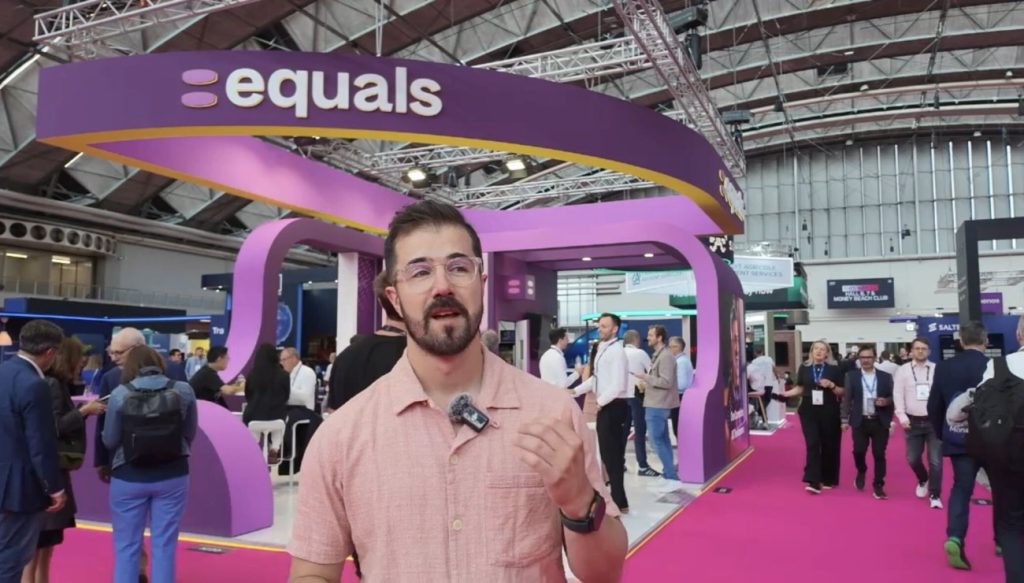
10:20 – What are the biggest bottlenecks in B2B payments?
This was the question put to Breno Oliveira, CPO at payabl., as part of one of Payment Expert’s voxpop interviews on the show floor.

Oliveira pointed to the structural hurdles slowing B2B payments, but also didn’t shy away from calling AI one of the most overhyped technologies in the space right now. At the same time, he argued that digital IDs may prove the most transformative piece of tech.
Stay tuned for his full answers, with the video set to hit your LinkedIn timeline in the coming days.
10:00 – Day 2 is underway
It’s a slightly later start here at Money20/20 Europe, with the first panels kicking off at 10:00, but the momentum from yesterday is carrying straight through.
Payment Expert News Editor Louis Thompsett picked out his standout session from Day 1, where Klarna and Fiserv debated about whether Europe has the ambition to compete globally in payments. Sebastian Siemiatkowski and Takis Georgakopoulos challenged whether the region can match the capital, scale and commercial firepower of the US and China.
Elsewhere across the RAI, Day 1 delivered other major developments, including Europe’s first agentic payment going live, Google’s deep dive on the eIDAS 2.0 identity stack, OpenPayd’s Nasdaq move and banks stating they’re finally ready for public‑blockchain use cases.
Day 2 promises to be just as packed. Expect insights from the stages, announcements from the floor and a look behind the scenes at what the Payment Expert team is working on throughout the day.