The UK amps up sanctions on Russia as the FCDO adds 18 companies and individuals alleged to have participated in delivering Russia funds using crypto services
The UK has imposed sanctions on Russian-linked payment firms and crypto exchanges accused of helping Moscow work around restrictions on its financial system.
In an update to the UK Sanctions List on 26 May, the Foreign, Commonwealth and Development Office (FCDO) added 18 companies and individuals alleged to have provided financial services, technology or resources to people supporting the Russian government.
Several of the sanctioned entities are tied to the A7 network, according to blockchain analytics firm Chainalysis. The group previously claimed to have moved $90bn into the Russian economy using cryptocurrency infrastructure.
Some of the companies targeted by the UK are also alleged to have worked with A7-linked businesses or exchanges previously sanctioned because of Russia-related financial activity.
The latest measures reinforce sanctions introduced earlier this month against A7 LLC, the company behind the ruble-backed A7A5 stablecoin, which reportedly generated $93bn (£69.2bn) in trading volume during its first year.
In its filing, the UK government said there are “reasonable grounds to suspect” those on the list have benefited from or supported the Russian government through activity in the country’s financial services sector, including services linked to endeavours that could help destabilise Ukraine.
Bans target cross-border payments
As part of the measures, UK credit and financial institutions are banned from starting or maintaining correspondent banking relationships with the listed firms, as well as processing payments “to, from or via” them. The restrictions also apply to businesses owned or controlled by sanctioned persons.
Among the most notable names on the list is EXMO Exchange, which has been hit with an asset freeze, director disqualification, trust services sanctions, internet services sanctions and a correspondent banking ban.
The UK government said it has “reasonable grounds to suspect” the company has supported or benefited the Russian government through activity in the country’s financial sector. Authorities also published several crypto wallet addresses linked to EXMO.
Georgian-registered companies Arvix, Rapira Group, and Aifory all face asset freezes and banking restrictions. Rapira Group was further accused of providing financial services to parties linked to activity that could threaten Ukraine’s territorial integrity.
The sanctions package also includes the Kyrgyz bank Open Joint Stock Company Eurasian Savings Bank, which the UK claims helped support the Russian government by providing financial services to businesses operating in key sectors of the economy.
Internet sanctions put pressure on crypto platforms
In addition to financial restrictions, many of the firms have also been hit with internet service sanctions. The measures require app stores, internet providers and social media platforms to take “reasonable steps” to block UK users from accessing content or applications linked to the companies.
The internet restrictions apply to EXMO, ABCEX, Arvix, Rapira Group, Aifory and UAE-based crypto platform Bitpapa IC FZC.
The UK also named several individuals allegedly connected to Russia-linked financial infrastructure, including Liran Cohen, accused of making economic resources or technology available to A7 LLC; Igor Olegovich Gorin, identified as a manager at A7 LLC; and Sergey Mendeleev, linked to EXVED and the Independent Decentralised Finance Smartbank and Ecosystem.
How payments became a tool for Ukraine’s allies
Since Russia invaded Ukraine in 2022, the UK, EU and other allies have used payment systems and financial infrastructure as a way to apply pressure on Moscow.
In 2022, the US and other partners kicked Russian banks from SWIFT, the global financial messaging network that handles most international money transfers, cutting them off from mainstream global payments.
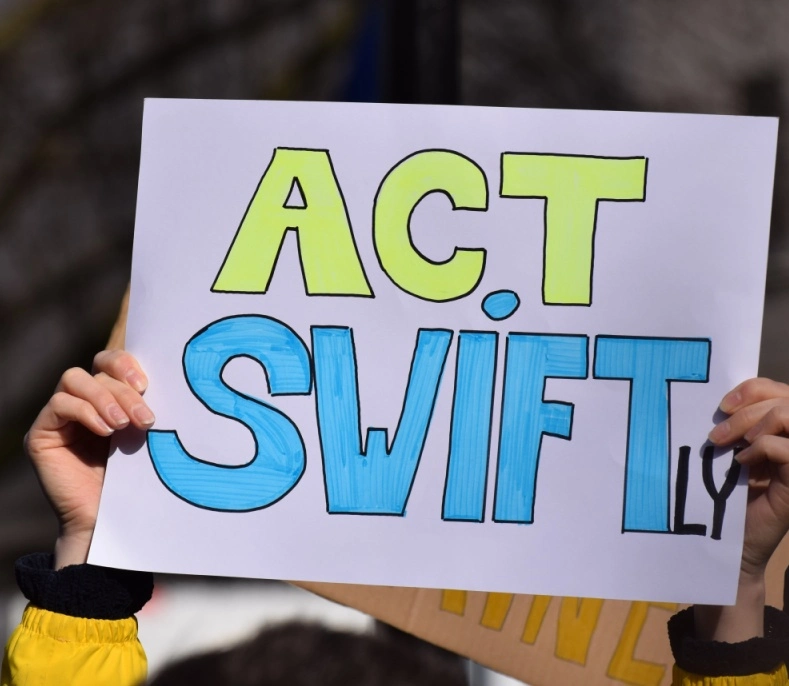
Russia reacted to this by leaning more on its own alternative system, the System for Transfer of Financial Messages (SPFS), developed in 2014 after the annexation of Crimea. While its use has grown since the war began, it is still very localised.
As the conflict continued, Europe tightened restrictions further in 2024, banning financial institutions from using SPFS or similar Russian messaging systems and prohibiting transactions with entities that rely on them outside Russia.
In the last couple of years, crypto has become one of the main battlegrounds. In 2024, the EU restricted banks and crypto-asset providers from enabling transactions that could support Russia’s defence sector, including flows linked to dual-use goods and sensitive technologies.
Despite these actions, Russia appears to still be using digital assets because pseudonymous transfers, offshore exchanges and fragmented oversight have created potential channels for sanctions evasion.