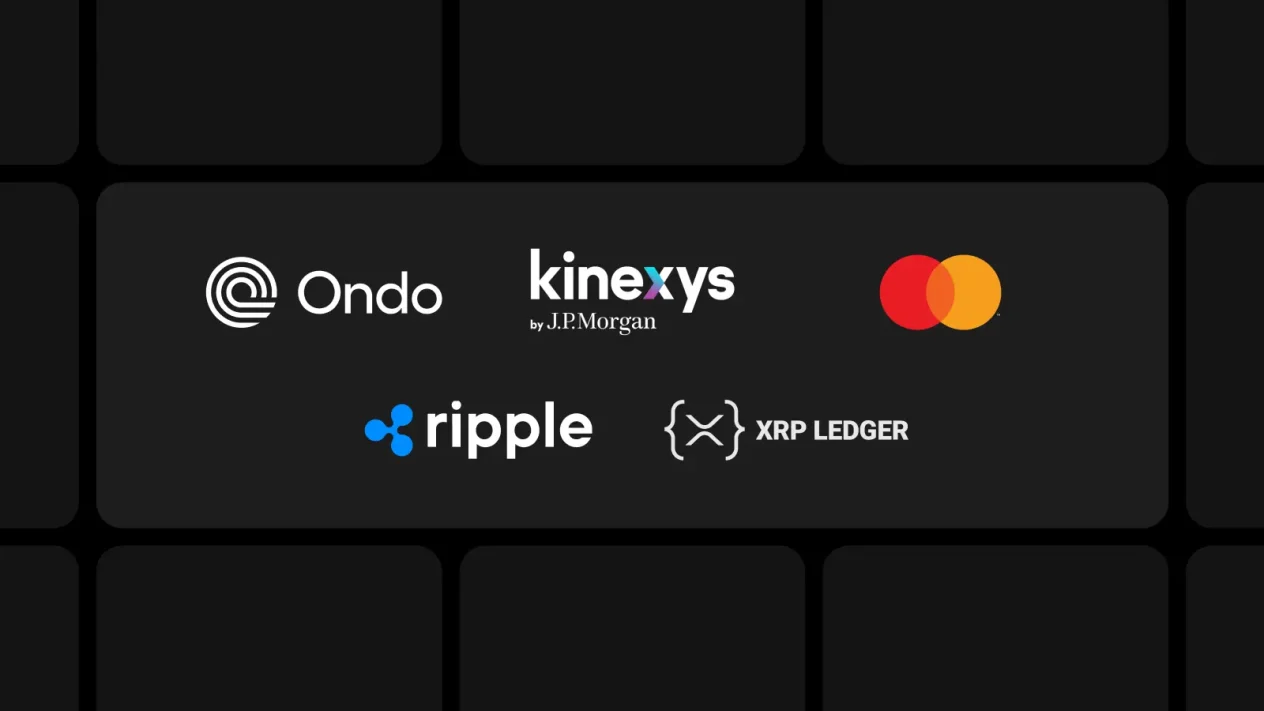
Ondo Finance, Kinexys by JPMorgan, Mastercard, and Ripple have completed the first near real-time cross-border redemption of a tokenised treasury fund, connecting public blockchain rails to global interbank settlement infrastructure.
Four of the biggest names in global finance and blockchain infrastructure have completed what they are calling the first near real-time, cross-border redemption of a tokenised US Treasury fund.

The pilot marks a “milestone” for the tokenised asset market as it potentially solves a persistent structural issue: getting money out.
Ian De Bode, President of Ondo Finance, said: “This milestone represents the first time tokenised U.S. Treasuries have settled across borders and banks in near real time and outside traditional banking windows.
“By connecting public blockchain infrastructure with interbank settlement rails, Ondo, Kinexys by JPMorgan, Mastercard, and Ripple are laying the groundwork for 24/7 global markets that never close.”
Tokenised treasury: Bridging blockchain and bank
The pilot connected public blockchain infrastructure directly to interbank settlement rails in a single, integrated transaction flow. The result was a cross-border delivery of funds which settled outside traditional banking windows, without manual intervention between the asset and payment legs.
This is how the pilot worked:

Ripple redeemed a portion of its holdings in Ondo’s short-term US government treasuries fund – known as OUSG – on the XRP ledger, a public blockchain. This ‘asset leg’ of the transaction was completed in under five seconds.
Ondo then processed the redemption and issued a fiat payout instruction through Mastercard’s Multi-Token Network, a layer designed to let traditional financial institutions transact with on-chain commerce across different forms of value.
The instruction was then routed to Kinexys by JPMorgan, which debited Ondo’s blockchain deposit account and delivered US dollar proceeds to Ripple’s bank account in Singapore through JP Morgan’s correspondent banking network.

“This marks a meaningful step forward in demonstrating that tokenised assets can move seamlessly between public blockchain infrastructure and the global financial system,” said Markus Infanger, SVP of RippleX.
“The XRP Ledger enables real-time asset movement, and when paired with global banking infrastructure, this pilot shows how institutions can execute cross-border transactions as a single, integrated flow.”
The key architectural point is that neither leg required a separate manual instruction. The blockchain execution and the bank settlement ran as a single coordinated flow – something the parties say has not been done before between global financial institutions in this way.
Why settlement infrastructure has stilted tokenisation
Tokenised real-world assets have grown rapidly in recent years, with US Treasury funds among the most actively issued categories, but redemption has long remained a sticking point. Most processes have continued to rely on traditional wire systems, manual steps, and cut-off windows which have made 24/7 liquidity on tokenised assets something of a theoretical proposition.

Zack Chestnut, Global Head of Commercialisation at Kinexys by JP Morgan, said: “This pilot is an important step towards establishing a framework for institutional-scale tokenised asset markets. To see widespread adoption of tokenised financial products, we need wholesale cross-industry collaboration across geographies, global banking infrastructure and public blockchains.”
This pilot is positioned as a proof of concept for a different model, one in which an investor can redeem a tokenised asset on a public blockchain and receive fiat proceeds via bank infrastructure without the two systems needing to be independently instructed.
Raj Dhamodharan, Executive Vice President of Blockchain and Digital Assets at Mastercard, added: “As tokenised assets continue to see strong institutional momentum and engagement, the focus is quickly shifting to how tokenised commerce can operate at scale in real time.
“With the Mastercard Multi-Token Network, we’re enabling near real-time, cross-border settlement using existing bank accounts – bringing coordination, trust, and interoperability to institutional on-chain flows.”