New rules introduce mandatory interest and expanded powers for the Small Business Commissioner as ministers seek to curb a practice costing the UK economy £11bn annually.
The UK government has unveiled what it describes as the most significant overhaul of late payment rules in more than 25 years, introducing a 60-day cap on payment terms and new enforcement powers aimed at large firms.
Announced on 24 March by the Department for Business and Trade, the reforms are positioned as a direct response to the impact of delayed payments on small businesses, which policymakers say is costing the UK economy £11bn each year.
Under the proposals, large companies will be required to pay smaller suppliers within a maximum of 60 days, with all commercial contracts also mandated to include statutory interest on overdue invoices. This interest will be set at 8% above the Bank of England base rate.
The government also plans to strengthen the role of the Small Business Commissioner, granting it powers to investigate poor payment practices, adjudicate disputes and issue fines worth “tens of millions” for persistent offenders.
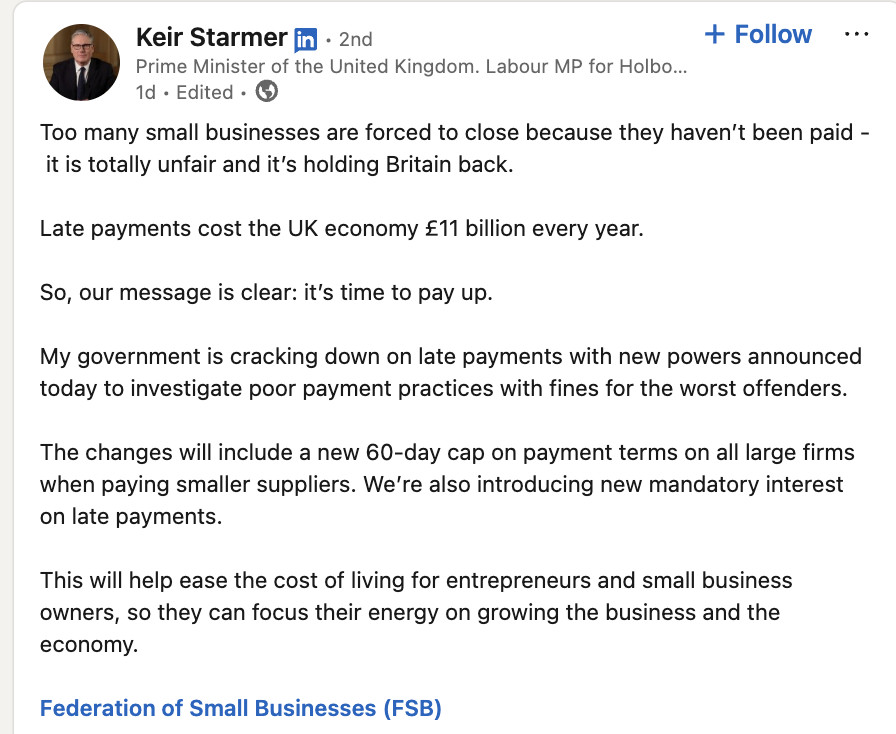
In a statement accompanying the measures, ministers framed late payments as a systemic issue across UK supply chains. “Small businesses will be paid on time – that’s the clear message from government today,” the release stated, describing the reforms as “the largest set of reforms in over a generation.”
The scale of the problem was underlined by government data, which found that 38 businesses close each day due to delayed payments, equating to more than 1,000 closures per month.
Business Secretary Peter Kyle said the reforms are intended to address a longstanding imbalance between large corporates and their suppliers. “Far too many businesses are forced to shut down because they have not been paid – that is simply unacceptable,” he said.
Alongside the payment cap and interest requirements, the government will require boards and audit committees of large firms with poor payment records to publish explanations of their performance and outline corrective actions.
The reforms also extend to sector-specific practices, with proposals to ban the withholding of retention payments in construction contracts. The government said this aims to prevent smaller firms from losing funds due to insolvency or non-payment further up the supply chain.
Support for payment rules builds
Industry groups have broadly welcomed the measures. The Federation of Small Businesses, which worked with the government on the proposals, said the legislation would address the use of small suppliers as a source of “free credit” for larger firms.
Emma Jones, Small Business Commissioner, said the changes would expand the reach of enforcement activity. “These reforms will reduce the hours spent chasing debt allowing small businesses to focus on more productive and enjoyable growth,” she said.
The announcement builds on existing legislation dating back to the Late Payment of Commercial Debts Act 1998, but the government argues the new measures go further by introducing both stricter timelines and stronger enforcement mechanisms.
Ministers also linked the reforms to broader economic policy, positioning faster payment flows as a means of improving cashflow across the SME sector and supporting business resilience.
While the measures are yet to be implemented, the government said they would form part of a wider push to ensure “money [moves] faster through the economy” and reduce the administrative burden associated with chasing unpaid invoices.