A card tap or wallet click may take seconds. The infrastructure that moves money from customer to merchant is more layered – and more consequential – than it appears.
To the average consumer, a digital payment feels like a single, seamless action. A card number is entered, a button is pressed, and the purchase is complete. But anyone working inside the payments industry knows that this apparent simplicity is an illusion.
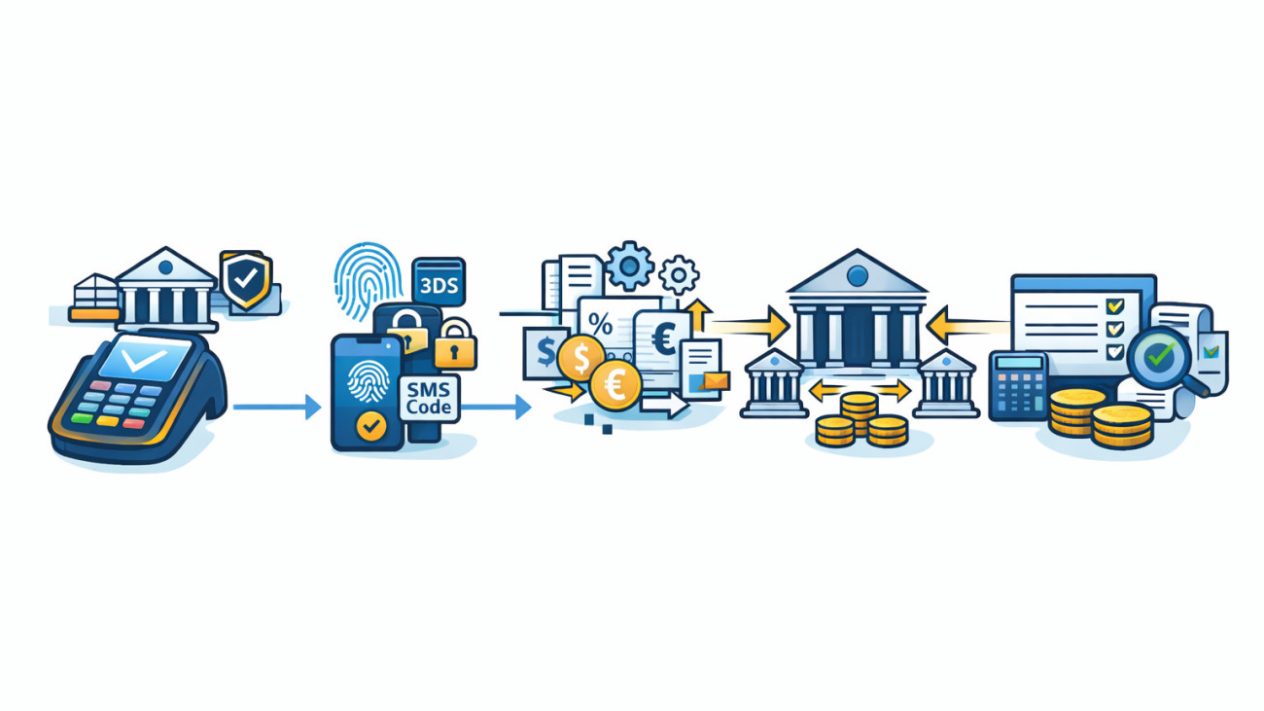
Beneath every transaction lies a multi‑stage process involving banks, schemes, gateways, fraud engines, risk models, and operational teams – each playing a role in determining whether a payment succeeds, how quickly funds move, and what it ultimately costs a business to get paid.
Understanding this lifecycle shapes approval rates, fraud exposure, liquidity, reconciliation workload, and the economics of accepting payments. Yet even seasoned professionals sometimes blur key distinctions: authentication is mistaken for authorisation, real‑time authorisation is assumed to mean real‑time settlement, and clearing is treated as an afterthought.
This explainer walks through each stage of the lifecycle, clarifying what happens, why it matters, and where things often go wrong.
Stage 1: Authorisation
Every card transaction begins with a question: should this payment be allowed to proceed?
That question is answered in the authorisation stage, where the issuer evaluates the request in real time. When a customer initiates a payment, the merchant’s gateway packages the transaction details and sends them to the acquirer, who passes them to the card network. The network routes the request to the issuer, who must make a decision in a matter of milliseconds.
The issuer’s checks are extensive. They confirm the card is valid, the account is in good standing, and the customer has sufficient funds or credit. They run the transaction through fraud models, velocity checks, and behavioural analytics. They consider the merchant category, the device used, the tokenisation status, and whether authentication is required. Only once these checks are complete does the issuer return an approval or decline code.
For merchants, this stage is where revenue is won or lost. A small improvement in approval rates can translate into significant uplift. But achieving that improvement requires understanding issuer behaviour, managing soft declines intelligently, and avoiding retry strategies that irritate banks and inflate costs.
It also means handling edge cases – pre‑authorisations in travel and hospitality, subscription renewals, merchant‑initiated transactions – with precision.
Stage 2: Authentication
If authorisation answers the question “should this transaction proceed?”, authentication answers a different one: “is the person making this payment who they claim to be?”
Despite their distinct purposes, these two steps are still frequently conflated. Authentication is not authorisation, and it certainly isn’t settlement. It is a security layer that sits alongside the payment flow, not a substitute for it.
In many regions – most notably Europe under PSD2 – authentication is performed through 3D Secure. Sometimes the issuer is satisfied without customer interaction, allowing a frictionless flow. Other times, the customer must complete a challenge, such as entering a one‑time passcode or approving the transaction in their banking app. In some cases, authentication can be skipped entirely through exemptions, such as low‑value payments, trusted beneficiaries, or merchant‑initiated transactions.
Poorly implemented authentication can derail a checkout experience, while well‑optimised flows can reduce friction and shift liability away from the merchant. Authentication also influences issuer decisioning: a successfully authenticated transaction is often viewed more favourably at the authorisation stage.
Stage 3: Clearing
If authorisation is the decision and authentication is the identity check, clearing is the paperwork. It is the stage where the transaction is formally recorded and prepared for settlement. Despite its importance, clearing is one of the least understood parts of the lifecycle – largely because it happens out of sight, typically in batch files processed at the end of the day.
During clearing, the acquirer compiles the day’s transactions and sends them to the card network, which calculates the fees associated with each one. Interchange, scheme fees, assessments, and cross‑border charges are all determined at this point. The issuer receives the clearing file and prepares to settle funds based on the instructions it contains.
Clearing is also where mismatches can emerge. If a merchant captures a different amount from the original authorisation (common in retail, travel, and marketplaces) the clearing file must reflect that accurately. If an authorisation expires before clearing occurs, the transaction may fail. Cross‑border transactions introduce FX considerations that can complicate reconciliation. And acquirers differ in how they batch and process transactions, which can affect both timing and fees.
Stage 4: Settlement
Settlement is the moment money actually moves. It is the stage most intuitively associated with “getting paid”, yet it is also one of the most misunderstood. Many assume that because authorisation happens in real time, settlement must too. In reality, card settlement remains a batch‑based process, even as other payment rails move towards instant transfers.
Once the issuer receives the clearing instructions, it sends funds to the card network. The network nets the positions of all issuers and acquirers, ensuring that only the net amount needs to be transferred. The acquirer receives the funds through its central bank accounts and then pays the merchant, deducting fees along the way.
Settlement timelines vary. Some merchants receive funds the next day; others wait two or three days, depending on region, scheme rules, acquirer policies, and perceived risk. For businesses operating across borders, FX timing adds another layer of complexity.
Liquidity planning hinges on understanding these timelines. So does risk management. Settlement does not eliminate exposure to chargebacks, which can arise weeks or months later. High‑risk merchants may face delayed settlement or rolling reserves, where the acquirer withholds a portion of funds to cover potential losses. And as real‑time payment systems grow, the distinction between real‑time authorisation and real‑time settlement becomes increasingly important.
Stage 5: Reconciliation
Reconciliation is the process of ensuring that what was authorised matches what was cleared, what was cleared matches what was settled, and what was settled matches what the merchant actually received.
For finance and operations teams, reconciliation is often the most labour‑intensive part of the lifecycle. It involves matching authorisations to captures, handling partial payments, linking refunds to original transactions, and ensuring that accounting entries reflect the correct amounts. It also requires reconciling fees, which may be deducted at different points in the process.
This is where discrepancies surface. A pre‑authorisation at a hotel that was never cleared. A marketplace order split into multiple captures that don’t align with the original authorisation. A cross‑border transaction where FX fees differ from expectations. A refund that appears in the settlement file but not in the merchant’s internal systems.
How different payment types alter the lifecycle
While the lifecycle described above is rooted in the four‑party card model, other payment methods follow similar patterns with important variations.
- Card payments involve every stage – authorisation, authentication, clearing, settlement, reconciliation – along with interchange, scheme fees, and the possibility of chargebacks.
- Account‑to‑account payments compress the flow: there is no interchange, settlement is typically faster, and irrevocability becomes a central concern.
- Wallets often mirror the underlying rail, whether card or A2A, but add an additional layer of wallet‑level risk and KYC.
- Real‑time payment systems collapse authorisation and settlement into a single step, moving funds instantly, but they do not eliminate the need for reconciliation — nor do they remove fraud or irrevocability risks.
Each rail reshapes the lifecycle, but none escape it entirely.