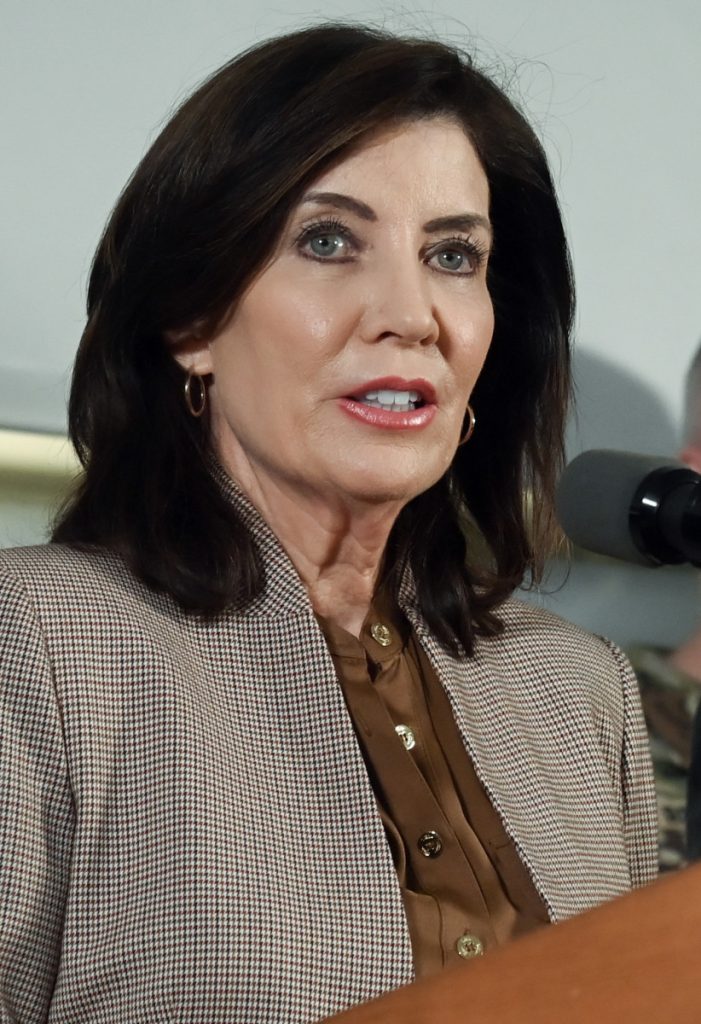
Governor Kathy Hochul has announced proposed regulations establishing a dedicated licensing and supervision framework for Buy Now, Pay Later lenders in New York
The New York State Department of Financial Services (DFS) has published proposed rules creating a new regulatory framework for Buy Now, Pay Later (BNPL) lenders operating in the state.
Announced by Governor Kathy Hochul on 23 February, the proposal implements legislation signed as part of the state’s FY26 Budget, which establishes a licensing and supervisory regime for entities engaged in BNPL activity in New York.
The rules would add a new Part 423 to Title 3 of the New York Codes, Rules and Regulations, specifically governing “Buy-Now-Pay-Later Lenders”.
Governor Hochul said the measures are intended to ensure “clear disclosures, limits on fees and real oversight” for BNPL providers operating in the state.
DFS Acting Superintendent Kaitlin Asrow added the regulation will govern how BNPL companies operate in New York, “protecting New Yorkers from excessive fees and the misuse of personal data, while ensuring transparent loan terms and a fair process for resolving disputes.”
The proposal is currently subject to a 10-day pre-proposal comment period. A 60-day public comment period will begin upon publication in the State Register. The law and final regulation will take effect 180 days after adoption, with a transitional period for firms already offering BNPL loans in the state.
Licensing and supervisory framework
Under proposed Part 423, any person offering BNPL loans in New York would be required to obtain a specific BNPL licence unless otherwise exempt.
The regulation defines a BNPL loan as closed-end credit provided to a consumer in connection with a particular purchase of goods or services for personal, family or household use. Both interest-free and interest-bearing BNPL loans fall within scope.
Licensed entities would be required to:
- Obtain category permission for interest-free, interest-bearing, or both types of BNPL loans
- Post licence information clearly and conspicuously on mobile applications, websites and other consumer interfaces
- Seek prior approval for any change of control
- Notify the superintendent of changes in directors or officers
The proposal also introduces ongoing reporting obligations. Licensees would be required to file quarterly unaudited financial statements and annual audited financial statements prepared in accordance with generally accepted accounting principles.
DFS would retain authority to examine books and records, including loan-level account information and collection activity documentation.
Fee limitations and payment rules
The draft rules place specific limits on penalty and ancillary fees.
A BNPL lender would not be permitted to:
- Impose a fee exceeding the dollar amount associated with a violation of the loan agreement
- Charge more than one fee based on a single event or transaction
- Charge aggregate penalty fees exceeding the original amount financed
Late fees would be restricted if periodic statements were not delivered within the prescribed timeframe.
The regulation also limits payment-related charges. Lenders would be prohibited from imposing separate fees for allowing payment by mail, electronic or telephone methods, unless the method involves an expedited service provided by a customer service representative.
Consumers would be permitted to prepay principal and accrued interest at any time without additional charge.
The rules also address the solicitation of “tips” or other voluntary payments. Such payments would be allowed only if clearly disclosed as voluntary, not tied to loan terms and not structured in a way that makes non-payment difficult.
Disclosure and reporting requirements
The proposal introduces detailed disclosure requirements aligned with existing federal consumer credit standards.
Pre-transaction disclosures would include, where applicable:
- The finance charge and annual percentage rate
- A payment schedule
- The total sale price
- A description of any fees
- Statements regarding default consequences and credit reporting practices
BNPL lenders would be required to deliver post-transaction confirmations within one business day of consummation and provide periodic statements for each billing cycle where a balance or finance charge exists.
The regulation also requires lenders to clearly state whether loan performance information will be furnished to consumer reporting agencies and to outline consumer rights relating to disputes, refunds and unauthorized use.
Dispute resolution standards
The proposed rules establish procedures for resolving billing errors and consumer disputes.
While a billing error investigation is pending, a BNPL lender would be prohibited from:
- Attempting to collect disputed amounts
- Reporting the disputed amount as delinquent
- Accelerating the debt solely because a consumer exercised dispute rights
If an error is confirmed, the lender must correct the account and issue a correction notice. If the lender determines no error occurred, it must provide a written explanation and notify the consumer of their right to file a complaint with DFS.
BNPL lenders would also be required to maintain written complaint-handling procedures and prominently display contact details for both the lender and DFS on digital interfaces.
Data privacy and consent requirements
Part 423 introduces specific restrictions on the use, sale and sharing of consumer data.
Under the proposal, a BNPL lender may use, sell or share covered data for purposes other than those reasonably necessary to provide a particular BNPL loan only with the consumer’s affirmative consent.
The regulation would:
- Prohibit pre-selected consent options
- Require separate consent for each disclosed use case
- Limit consent validity to one year
- Require lenders to provide an easy method to withdraw consent
- Prohibit conditioning loan approval on data-sharing consent
If consent expires or is withdrawn, lenders must cease the relevant data use and delete the data within 30 days, including requiring deletion by third parties where applicable.
State by state
New York’s proposed rules would place it among a small group of states which have taken formal steps to regulate BNPL providers, but its approach differs in structure and scope.
Several states currently address BNPL through existing lending frameworks rather than dedicated rulemaking. In jurisdictions such as Texas and Florida, BNPL providers often operate under installment lending or credit access models without BNPL-specific conduct rules. Regulatory oversight is typically limited to licensing requirements and general unfair or deceptive practices statutes.
California has taken a more active stance through the Department of Financial Protection and Innovation (DFPI), requiring certain BNPL providers to obtain lending licences where products fall within existing consumer loan definitions. However, California has not adopted a standalone BNPL rulebook establishing product-specific disclosure standards, data usage restrictions or billing dispute procedures comparable to those proposed in New York.
Other states have issued supervisory guidance or initiated reviews of BNPL fee structures and underwriting practices, but have not enacted detailed product-level regulations.
The proposal forms part of a broader consumer protection agenda advanced by Governor Hochul, which has also included legislation addressing overdraft fees, online subscription cancellation and retail refund standards.
If finalised, Part 423 would establish one of the most detailed state-level regulatory frameworks for BNPL providers in the US.