New data shows MiCA has doubled euro stablecoin market cap, boosted volumes and pushed issuers toward fully backed, regulated tokens across the EU.
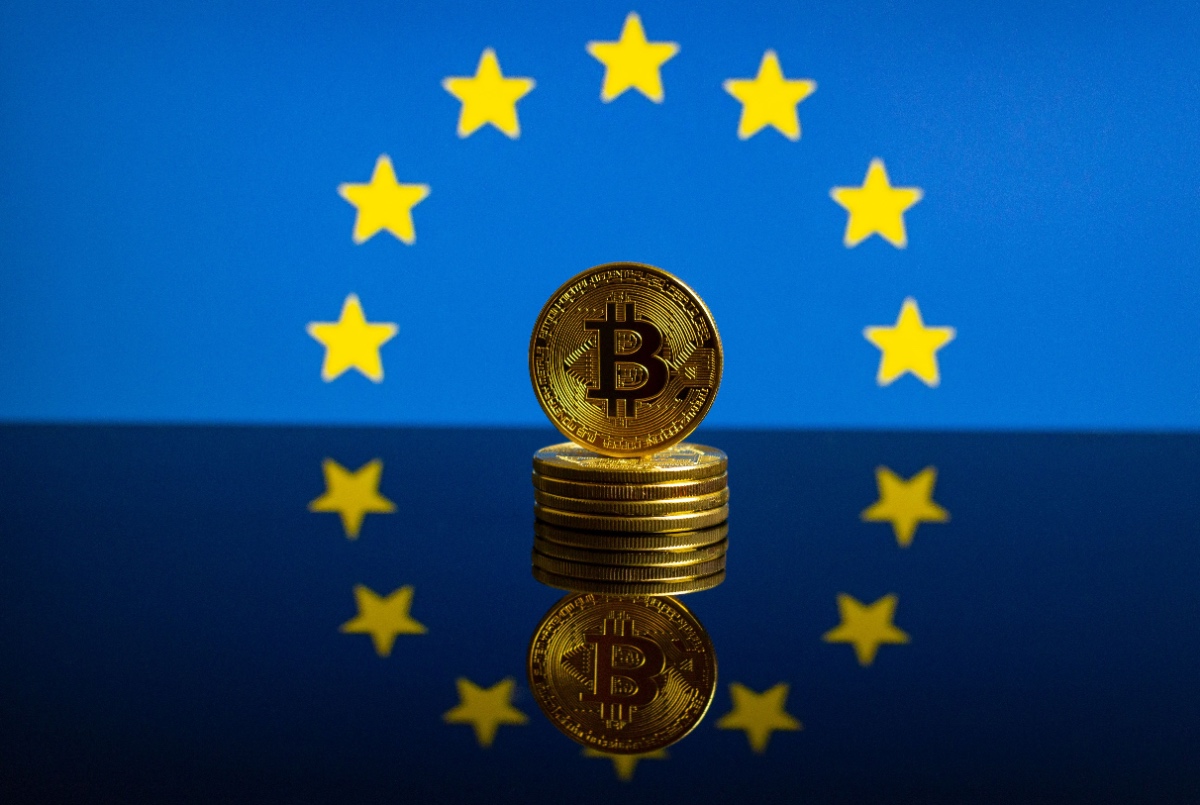
The EU’s flagship Markets in Crypto-Assets (MiCA) regime turned one this summer, and the first full year of data shows regulatory clarity has stopped the drift in euro stablecoins and started to pull the market into a more mature, institution-led phase.
But beneath the headline growth, MiCA’s impact is uneven. Euro-denominated tokens are gaining traction in capital markets and institutional payment flows, yet they remain a niche choice at checkout. And the geography of demand looks anything but harmonised.
These are the key takeaways from the Euro Stablecoin Trends Report 2025, which tracks market capitalisation, transaction volumes, consumer payments behaviour and search interest across EU member states in the first year after MiCA’s stablecoin rules took effect on June 30, 2024.
Regulatory clarity ends the waiting game
In the 12 months before MiCA, the euro stablecoin market was shrinking. Aggregate peak monthly market capitalisation across the main euro-pegged tokens fell by 48% in the year leading up to June 2024, reflecting uncertainty around how far the new regime would bite.
Once MiCA landed, that trend reversed.
In the first post-MiCA year, total market capitalisation rose by 102%, with growth stabilising at lower levels through summer 2024 before building momentum in late 2024 and accelerating into 2025. By October 2025, aggregate market cap had climbed back to roughly pre-MiCA levels – but with a very different mix of assets under the surface.
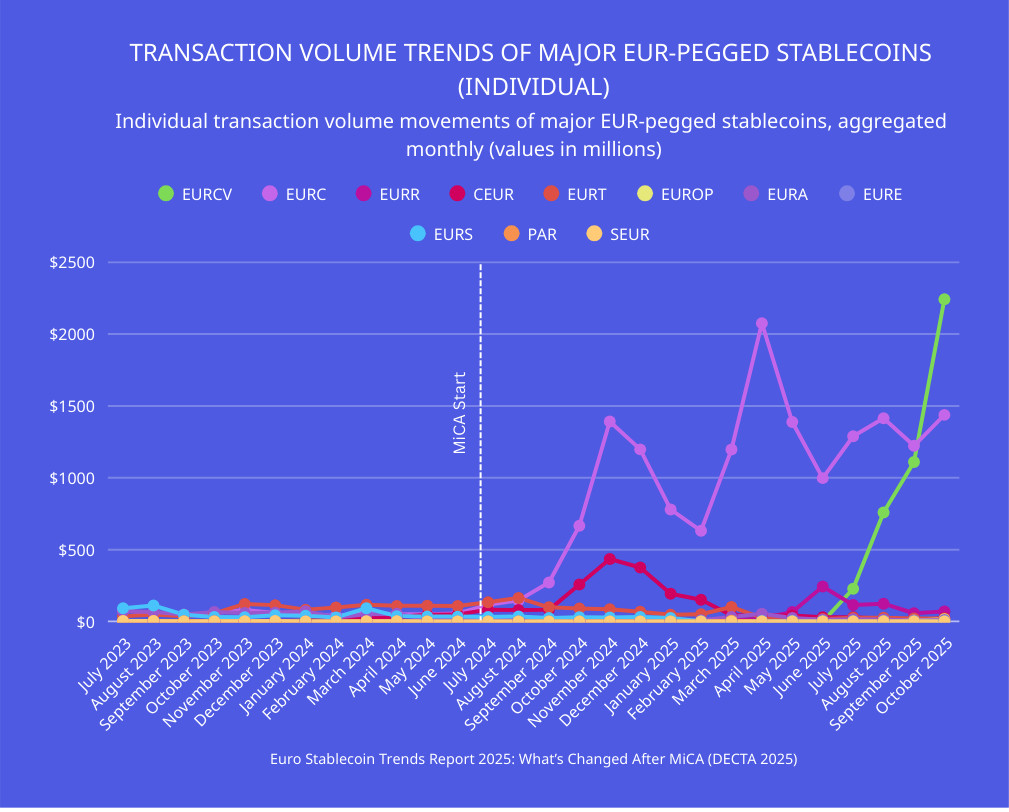
Transaction data tells an even more dramatic story. Monthly transaction volumes for the monitored euro stablecoins grew 899.3% after MiCA, from $383m to $3.83bn.
MiCA picks its winners – and exposes legacy laggards
One of the clearest MiCA effects is the emergence of a new hierarchy among euro stablecoin issuers.
EURS, the Stasis Euro token, stands out as the biggest individual gainer, with market cap up 643.86% from $38.2m to $283.9m between late 2023 and October 2025.
The report also highlights a cluster of MiCA-aligned issuers benefitting from the shift:
- EUROe (Membrane Finance) – one of the earliest officially MiCA-compliant euro stablecoins, issued by a Finnish e-money institution and targeting both institutional and DeFi use cases.
- EURC (Circle) – a fully-reserved, multi-chain euro stablecoin which has seen some of the strongest post-MiCA transaction growth.
- StablR Euro – MiCA-compliant and fully backed by cash reserves, focusing on exchanges and institutional flows.
- EUR CoinVertible (EURCV) (Société Générale) – a fully-backed institutional token, positioned squarely for tokenised securities and wholesale payments.
At the other end of the spectrum, legacy and synthetic designs are clearly under pressure. Euro Tether (EURT) remains widely used on exchanges, but its non-MiCA status means it now sits outside EU authorisation lists, facing “adoption limits and regulatory scrutiny” in the bloc.
Algorithmic and synthetic structures such as Angle Euro, Synthetix EUR, Parallel and Celo Euro continue to operate, but their non-compliant or derivative-like nature pushes them away from MiCA’s preferred model of fully-backed, redeemable e-money tokens.
Euro stablecoins that look like money, with bank-style reserves and redemption promises, are being pulled into the mainstream. Everything else is being nudged to the margins.
Institutions lean in – but euro stablecoins still niche at checkout
Perhaps the most striking tension in the report is between institutional and retail behaviour.
On the institutional side, adoption appears robust with 58% of European institutions already using or planning to use stablecoins in payment flows. Similarly, only 18% cite regulation as a barrier, suggesting MiCA is now seen more as an implementation framework than a deterrent.
Across the EU, 53 MiCA licences have been granted, including 14 to e-money token issuers and 39 to crypto-asset service providers, with Germany, the Netherlands and Malta emerging as key licensing hubs.
Yet when you look at how consumers actually pay online, euro stablecoins barely register. In the survey of 1,160 EU-based crypto users, Bitcoin remains the dominant asset for recent online payments at 55.17%, followed by US dollar stablecoins at 21.21%. Euro-denominated stablecoins account for just 3.62% of respondents’ most recent online transactions.
Usage is also heavily skewed by vertical. Crypto is most commonly spent on: e-commerce/retail (26.55%), software and technology services (18.88%), gambling and betting sites (16.47%) and online entertainment (16.03%).
A fragmented map of EU demand
MiCA was meant to harmonise rules but the geography of demand for euro stablecoins is anything but uniform.
Using Google search data as a proxy for public interest, the report finds that queries related to acquiring euro-pegged stablecoins have jumped sharply in some markets and barely moved in others.
For generic “how to get/buy” euro stablecoin searches: Finland recorded the strongest increase in interest at +400%; Italy and Romania followed at +313.3% and +300%; and Sweden, Germany, the Netherlands, Austria, Belgium and Ireland all posted gains of around 250–280%.
When zooming in on three named tokens – cEUR, EURC and EURT – a different set of frontrunners emerges. Cyprus saw the highest rise in related searches at +133.3%, followed by Slovakia at +100%. Austria, Czechia and Sweden recorded increases between 80% and 87.5%, while the Netherlands and Italy grew by 64.3% and 58.3% respectively.
Several markets recorded flat or falling interest, with Malta showing the largest decline in these token-specific searches at –50%.
Where next for MiCA and euro stablecoins?
The report’s outlook section expects euro-pegged stablecoins to “play a more defined role” in the EU’s digital asset ecosystem by 2026, anchored i tokenised securities and programmable settlement, cross-border payment use cases, and deeper integration with banking and payment systems.
But the data also hints at the work still to do. Euro stablecoins are growing fast from a small base, especially compared to dollar-backed rivals. Meanwhile, retail usage is rising, yet still heavily overshadowed by BTC and USD stablecoins in online payments. Furthermore, adoption remains highly uneven across EU member states, suggesting local market frictions could blunt some of MiCA’s harmonisation benefits.