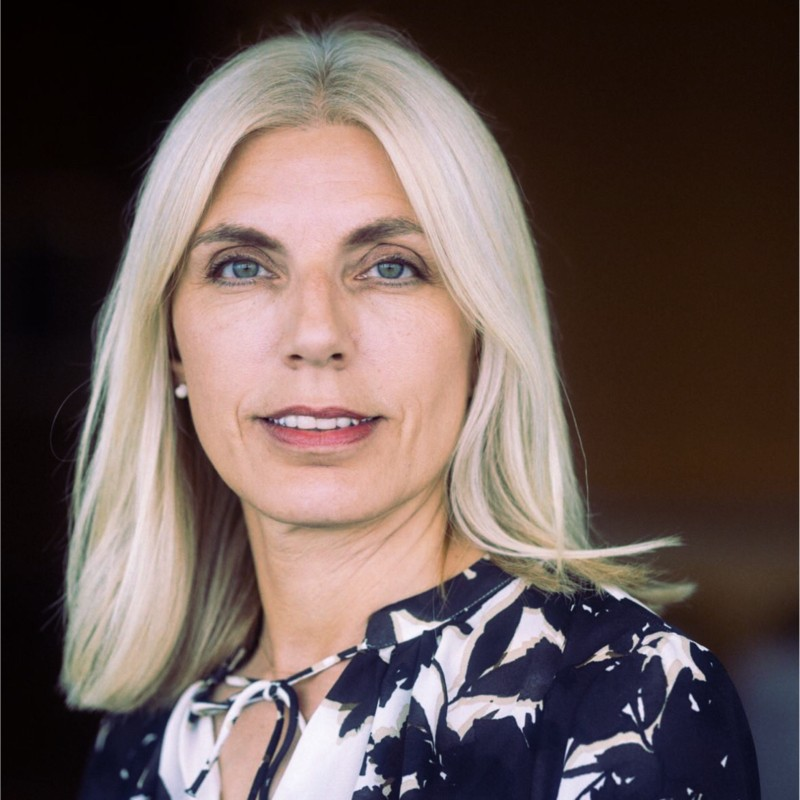
It was a suitably Nordic backdrop. On one side of the screen, London was overcast and grey; on the other, Ann Magnusson appeared sharply dressed in SEB’s Stockholm office, a watercolour abstract by Madeleine Pyk of the city hanging neatly behind her.
The setting seemed to capture the spirit of the discussion – tradition and clarity on one side, change and imagination on the other.
Magnusson heads SEB’s Investor Services division, part of the bank’s corporate and investment banking arm. Her remit spans post-trade, which in general terms encompasses the systems and processes which ensure financial markets run as intended. “Plumbing” is the word often used.
Yet, as Magnusson makes clear, post-trade is no longer a passive utility. It has become a focal point for innovation and competition, from the cloud to settlement harmonisation.
SEB, founded in 1856 and active in custody since 1888, holds roughly SEK 19.5 trillion of assets. This history is one reason why Magnusson emphasises the weight of recent change. Earlier this year, SEB signed a deal with S&P Global to adopt a cloud-based custody platform.
It was the conclusion of a four-year process, she says, and a deliberate move away from legacy systems.
“We saw the opportunity to exit some of these legacy systems to the benefit of the clients and the way we operate,” Magnusson explains. Legacy bespoke builds had long been a source of rigidity: efficient at first, but costly to adapt. The S&P deal, structured as a SaaS platform, allows SEB to share foundations, investment and strategy with others, accelerating product delivery and reducing the need for tailor-made code.
The immediate beneficiaries will be the bank’s retail and wealth clients, along with its sub-custody operations. Consolidating flows, Magnusson argues, brings both scale and resilience. Faster delivery of services and closer alignment with regulatory requirements are early priorities.
But the emphasis is also on longevity, with a planned gradual rollout on the cards, beginning with sub-custody, and carefully calibrated to avoid market disruption.
Resilience, regulation and harmonisation
Regulation looms large over the future of post-trade. Magnusson sees the recent shift from the European Commission’s Capital Markets Union to the new Savings Investment Union as part of a broader drive to create a more accessible market for end-investors. But she is wary of overreach.
“Sometimes we don’t need more regulations, we need more harmonisation,” she says. “Otherwise we might end up in a space of over regulations.” Initiatives such as MiCAR, which sets out clearer rules for new technologies, are welcomed as enablers rather than constraints.
The move to T+1 settlement in October 2027, meanwhile, illustrates the challenge. Shortening cycles promises greater efficiency, yet demands more of clients and service providers alike. Harmonisation can ease that burden, but only if applied judiciously.
Bridging cash and securities
The boundary between capital markets and payments is also shifting. For Magnusson, the two worlds are likely to converge. “Today, we have two rails that we need to meet at the station,” she says. “But going forward, I actually think maybe we could have one rail.”
Such integration would embed payments more deeply into securities settlement, reducing friction across markets. ISO 20022 standards and central bank infrastructure upgrades are already nudging in that direction.
The prize, Magnusson suggests, lies in transparency, accessibility and speed; attributes prized by corporate treasurers as much as institutional investors.

Growth in sub-custody and private wealth
SEB has also expanded its role in sub-custody, filling space vacated when Nordic peers withdrew from the market.
“With the local knowledge we had, and the history and the legacy, we actually won a large part of that business,” Magnusson notes. The responsibility is not lost on her. Investments in infrastructure are intended to ensure flexibility and accuracy in services that are increasingly central to client portfolios.
Private wealth is another area of growth, both in the Nordics and across Europe. Competition has intensified in recent years, with international players moving in. For SEB, infrastructure once again plays a decisive role, with apps, data and round-the-clock access underpinning the value of advice.
Clients, Magnusson observes, expect speed, accuracy and trust.
She offers a fitting analogy:
“We are more like a daycare for their [the clients] kids. It’s their core investment that we are looking after as a custodian.”
Geopolitical shifts and Europe’s role
Looking further ahead, Magnusson sees regulatory change intertwined with geopolitics.
CSDR and T+1 are already reshaping the practicalities of custody. At the same time, global uncertainty is changing investor flows.
“We have actually seen clients being increasingly interested in investing inEurope… but it has to actually bring some value to the table,” she says.
Trust in the US equity market remains strong, but questions over political stability and regulatory direction have prompted investors to seek alternatives. For Europe, the challenge is to make its markets not just safer, but more attractive.
Tradition and transformation
For a bank with custody in its DNA, SEB is positioning itself between continuity and reinvention. Magnusson’s words underline that balance: moving from legacy systems to the cloud, pushing for harmonisation over regulation, and seeing cash and securities converge into a single rail.
As Sibos gathers its usual crowd of bankers, regulators and technologists, her perspective hints at the longer arc.
Post-trade may remain the plumbing of the system. But in Magnusson’s Stockholm office – with its blend of Nordic stability and artistic colour – it looks every bit like a space where the future of finance is being sketched.