Chancellor sets out post-election vision for financial services, with reforms to payments, stablecoins and digital infrastructure front and centre
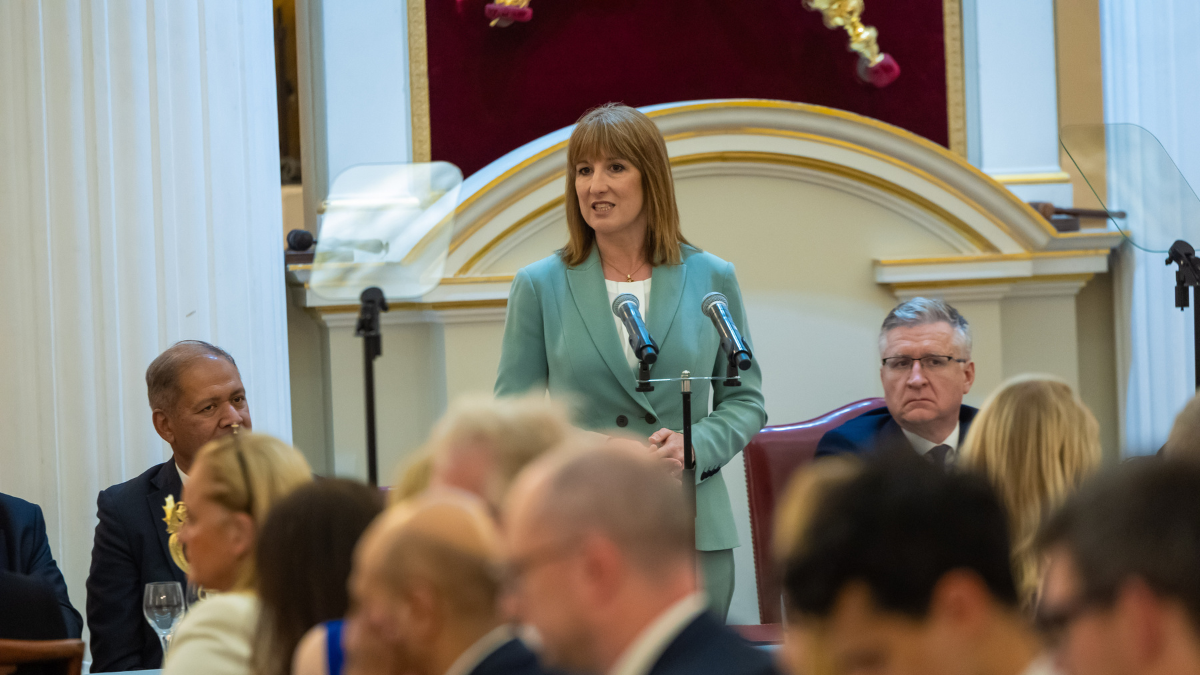
Chancellor Rachel Reeves delivered her first Mansion House speech since taking office, and it was anything but cautious.
Promising to “regulate for growth” and overhaul the UK’s financial architecture, the Chancellor placed financial services – and payments in particular – at the centre of her government’s economic vision.
Here’s what you might have missed if you weren’t in the room.
1. Stablecoins and digital gilts to drive settlement innovation
Reeves reiterated her ambition for the UK to lead on digital assets infrastructure, confirming:
- A framework for the regulation of fiat-backed stablecoins, with rules around authorisation, safeguarding and market integrity
- Further development of tokenised securities
- Government support for the design of a new digital gilt instrument, aiming to place the UK “at the forefront of digital asset innovation”
- This positions the Treasury firmly behind tokenisation as part of its wholesale settlement strategy, aligning with the Bank of England’s DLT experimentation and potentially paving the way for regulated tokenised payments rails.
2. Fintech and payments scale-up unit on the way
Reeves announced the PRA and FCA will jointly launch a dedicated scale-up unit to support high-growth fintech firms, explicitly including those operating in payments.
The move aims to address longstanding concerns about the regulatory burden on firms transitioning from sandbox to full authorisation — and provide a clearer pathway to domestic scaling.
3. New “concierge service” for inward investment
A new concierge service for international financial services firms, to be launched by October via the Office for Investment, was announced as part of a wider inward investment push.
This tailored support aims to attract global payments firms and fintechs looking to establish or grow operations in the UK, particularly in hubs like London, Manchester, and Leeds.
4. Reforms to the Financial Ombudsman Service
In a nod to the compliance cost of redress processes, Reeves unveiled major changes to the Financial Ombudsman Service (FOS), including:
- A proposed 10-year limit on complaints
- A shift back to the FOS’s original purpose as a “simple, impartial arbitration service”
- A reduction in the pre-decision interest rate from 8% to base rate plus 1%
These reforms are likely to be welcomed by payments firms concerned with the FOS’s expanding remit and the financial unpredictability of retrospective redress claims
5. Regulators to be benchmarked for speed
Both the FCA and PRA have been tasked with cutting authorisation and approval timelines. In particular, Reeves instructed the FCA to assess whether Consumer Duty rules are having an unintended impact on wholesale market activity, including capital and liquidity for financial institutions.
The Chancellor also pledged to streamline the Senior Managers and Certification Regime (SMCR) — a major compliance burden for payments institutions scaling executive teams.
6. Capital reform to support SME and fintech lending
Changes to capital rules included:
- Raising the MREL asset threshold to between £25bn–£40bn to support challenger bank lending
- A Basel 3.1 implementation with lower capital requirements for domestically focused banks
- An FPC-led review into optimal capital levels for UK banks, due by the end of 2025
This could free up balance sheet capacity for payments and fintech lenders that have struggled under tighter liquidity constraints.
7. ISA reforms and support for retail investment
Reeves confirmed that Long-Term Asset Funds can now be included in stocks and shares ISAs; a small but symbolic move toward improving access to UK-based growth investment.
She also hinted at future reforms to ISAs and retail advice regulation, including targeted financial support tools for consumers, set to launch before the next financial year.
This year’s Mansion House address was a signal that payments policy is now economic policy.
While the speech didn’t unveil every technical detail, the overall message was one of urgency and directional clarity.
For the payments sector, the challenge is now to ensure Reeves’ pro-growth rhetoric is backed by practical delivery, and that the new scale-up and investment strategies don’t replicate the bottlenecks of previous regimes.