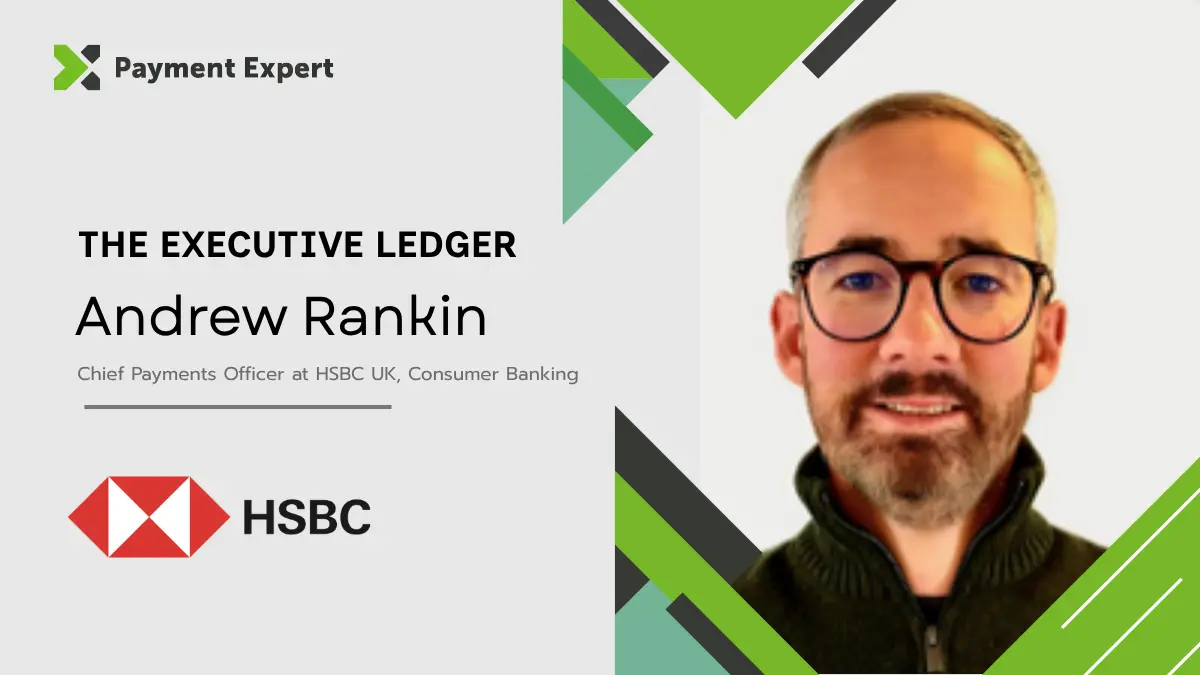
Andrew Rankin, Chief Payments Officer at HSBC UK, Consumer Banking, explains what is needed for the National Payments Vision to be successful.
The UK’s National Payments Vision (NPV) aims to modernise core infrastructure, strengthen competition and improve security and user experience across the entire ecosystem.
Although the UK has a history of leadership through Faster Payments and open banking, this vision requires deeper collaboration across the industry and a focus on designing customer journeys that outperform what people use today.
Consumers and merchants expect reliability, simplicity and meaningful choice, yet the industry must also respond to rising fraud and the slow shift of account‑to‑account payments from early adoption to commercial reality.
Andrew Rankin, Chief Payments Officer at HSBC UK, Consumer Banking, believes the UK has a strong foundation to build on, supported by international experience and early momentum in initiatives such as UK Payments Initiative (UKPI).
Rankin says that for NPV to be a success, it will require effective decision‑making and an emphasis on results for customers.
Read the full interview below.
The UK has set out its national payments vision. From where you sit, what’s the single biggest change the industry needs to make to deliver on that ambition?
It is a very big ambition, and HSBC is fully engaged and supportive. From an HSBC perspective, it’s one we can add a lot of value to.
The UK will go through a huge amount of change over the next few years, but other geographies have done this already. India and Brazil are good examples, and HSBC’s international connectivity and presence in those markets means we can bring back real‑life experience and learnings from how others have delivered it. That puts us in a unique position to support.
Trying to boil it down to one thing is difficult, but given the private‑public partnership we’ve set up, the key is decisiveness, clarity and a bias towards action. We tried to do this before under the NPA and it didn’t work. If we can bias towards action and decision‑making, we’ll start to make progress.
We also cannot think about this as a tech programme. It has to deliver better customer outcomes. We have to enable new competition and new ways of paying. We can deliver the best tech system in the world, but if it doesn’t improve customer outcomes, we won’t have hit what we set out to achieve.
Open banking has laid strong foundations, but adoption has slowed. What needs to happen for A2A payments to become a mainstream choice for UK consumers and merchants?
We’ve started to see some large merchants adopt A2A at point of sale, particularly in e-commerce. Within the NPV, A2A, especially at point of sale, is a real priority. That gives us momentum and a good base to work from.
There are three things we need to solve to enable further growth and innovation.
The first is the commercial model that underpins how A2A will work. For people, firms and fintechs to continue investing, there has to be a return. If there’s an equitable return across the market, the innovation cycle will continue.
The second is consumer protection. One reason customers use cards so much is the ability to use chargebacks, disputes and Section 75. We need to work out what that looks like in A2A and how it’s proportionately managed.
The third, and probably the most important for growth and adoption, is the customer journey. It needs to be better than the alternatives already out there. Contactless and wallets have made journeys much simpler, and A2A needs to be built in a way that enables those journeys. That’s when customers will really use it. If we get those three things right, we’ll be in a good position.
Consumers seem happy with cards. Is that a hurdle for A2A adoption?
It comes down to the customer journeys. Customers don’t choose a card over A2A because of the payment method; they choose whatever is simplest at checkout or in the ecosystem they’re in.
The challenge is building end‑to‑end journeys that make A2A as simple, or simpler, more efficient and easier to use than cards. That will generate more competition. It has nothing to do with whether it’s a card or a faster payment.
We’ve got a lot of good minds around the table in the NPV, with a balance between financial institutions and fintechs. I think we’ve got the right people to tackle that problem.
Fraud, especially APP fraud, is a huge problem. How are the new reimbursement rules changing responsibility across the industry, and are they working?
APP fraud is a huge problem. Fraud in general is a huge problem, but APP fraud in particular. HSBC continues to invest in fraud protection, prevention, friction in journeys, monitoring and detection to protect customers as the threat evolves.
Under PSR, industry‑wide reimbursement has increased under the shared liability model, but fraud is an end‑to‑end journey. It doesn’t just manifest in the payment part. It needs to be a shared responsibility, with the right friction throughout the end‑to‑end journey, so we can stop fraud in its tracks rather than wait until the payment stage.
We continue to educate customers, raise red flags and support them if they’ve been a victim of APP fraud, but we need to tackle it as an end‑to‑end ecosystem, not just in the payment space.
When you look at the vision as a whole, what gives you the most confidence, and what will be the hardest part to get right?
The UK is starting from a really good position, and we’ve got momentum in certain aspects already. The UKPI launch last week is a good example of not just waiting for the NPV. We’ve got a good grounding and momentum, which gives me confidence.
The hardest thing to get right is simplifying the surrounding ecosystem. I’m always told the technology part is the easy bit. The build won’t be the hardest part; the challenge is getting out of our own way to make sure the architecture delivers for customers.
That comes down partly to modernising payment regulation and partly to how we set ourselves up as an industry through the NPV. If we achieve both, we’ll have good tech and a good ecosystem that delivers great outcomes. If we only get one, we won’t achieve what we’re trying to. That will be the hardest part, finding the right solutions in the non‑tech side of things.