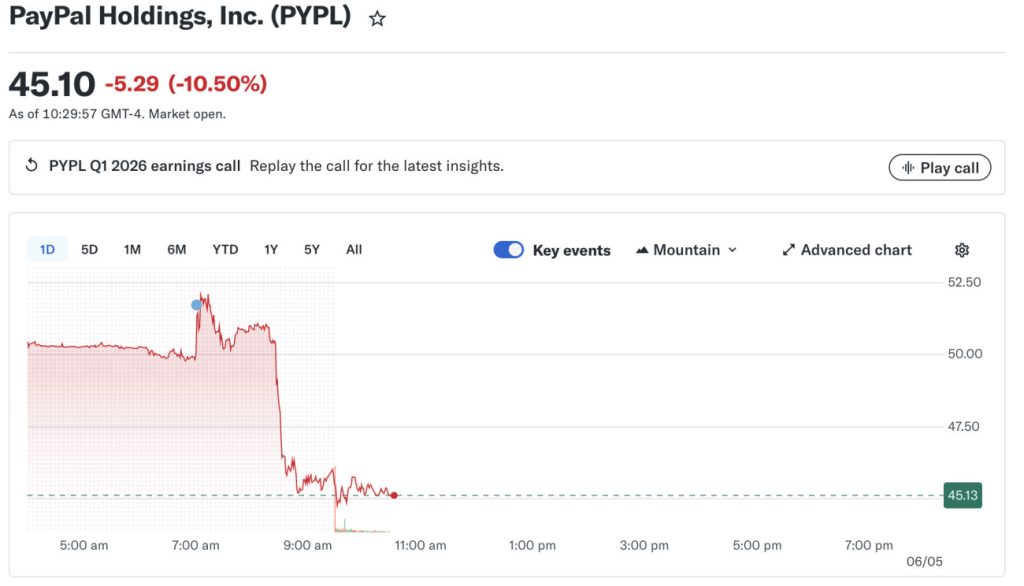
Enrique Lores used his first earnings call to outline a major overhaul of PayPal’s strategy, prioritising AI, cost reduction and a renewed focus on consumers after continued weakness in branded checkout.
“We need to become a technology company again.”
With that, Enrique Lores set the tone for his first earnings call as CEO of PayPal, using the company’s Q1 2026 results to outline a broad strategic reset as growth in its core checkout business continues to lag.
Reporting its first quarter 2026 results, PayPal posted revenue of $8.4bn, up 7% year-on-year, while total payment volume (TPV) rose 11% to $464bn. Non-GAAP earnings per share increased 1% to $1.34, with transaction margin dollars growing 3% to $3.8bn.
However, alongside these results, Lores stated that while the company has “a strong foundation”, it must make “significant changes to improve the strategic and operational issues the company has faced”
Central to Lores’ message was a return to what he described as PayPal’s core identity.
“We need to recommit to the fundamentals,” he said. “That includes becoming a technology company again, sharpening our focus on consumers, aligning the company around three strong businesses and simplifying how we work with clear accountability and a stronger emphasis on execution.”
The same themes were echoed in a statement shared following the results, where Lores highlighted PayPal’s “deep customer trust, leading brands and global scale” while stressing the need to move “with urgency”.
His early assessment of the business, formed during his first two months in the role, pointed to a company with scale and assets, but one that has struggled to translate these into consistent execution.
New structure built around three core businesses
As part of the reset, PayPal is reorganising its operations into three distinct business units:
- Checkout
- Consumer financial services, including Venmo
- Payment services and crypto
The company said the previous structure, organised around customer segments, had created “organizational complexity with multiple dependencies and handoffs that slowed decision making and weakened execution”.
By contrast, the new model is designed to simplify accountability and allow each business to focus on specific growth priorities. Lores noted that bringing together the consumer and merchant sides of the platform under unified leadership is intended to “maximize our competitive advantage”.
Despite the broader restructuring, PayPal’s core checkout business remains under pressure. Branded checkout TPV grew 2% on a currency-neutral basis in the first quarter, a slight improvement from 1% in the previous quarter, but still below the company’s overall growth rate.
Executives pointed to continued softness in Europe. CFO Jamie Miller said the region is experiencing “a combination of macro softness, competitive intensity, some natural normalisation”, adding that “we’re still under pressure in places like the UK”.
Lores suggested the issue is not solely external, going so far as to reflect on recent product launches: “We have launched a lot of great innovation to market, but we haven’t had enough effort, enough investment in the countries to make it real.”
He added PayPal has often moved on too quickly: “We have moved to launch the next version before really maximising the value that we got from what we were launching.”
The company is now placing greater emphasis on execution at a local level, with Lores noting he has spent time in key markets including the UK and Germany, to assess performance.
Rebalancing focus towards consumers

A key element of PayPal’s revised strategy is a renewed focus on the consumer side of its network. “In recent years, PayPal has put more energy into the merchant side of the network,” Lores said. “Strengthening the value we offer to the hundreds of millions of consumers… is a key priority.”
The company believes increasing consumer engagement will ultimately improve outcomes for merchants, reinforcing the dynamics of its two-sided network.
As part of this approach, PayPal is expanding its consumer financial services offering, aiming to enable users to “send, spend, save, invest and borrow seamlessly”. Venmo is expected to play a central role, supported by its strong position among younger users.
A loyalty programme, already launched in the UK, is also being positioned as a tool to drive engagement and repeat usage.
Alongside structural changes, PayPal is placing significant emphasis on cost reduction and operational efficiency, with artificial intelligence at the centre of both efforts. The company expects to generate at least $1.5bn in gross run-rate savings over the next two to three years.
These savings will come from two main areas: organisational simplification and the broader deployment of AI and automation.
Lores described the approach as more fundamental than incremental technology adoption. “This is not about adopting AI as a technology… it is really about understanding how we can redesign the key processes,” he said.
He identified technology development and customer support as areas where AI could deliver both cost reductions and improved performance, noting that customer support represents “a large cost for us today”.
The company has also created a dedicated AI Transformation and Simplification team to oversee these efforts.
Venmo and enterprise payments drive growth
While checkout remains subdued, PayPal continues to see stronger performance in other parts of its business. Venmo and its payment service provider (PSP) operations both delivered mid-teens TPV growth during the quarter, providing a key source of momentum.
Executives also pointed to growth in value-added services, including fraud management and payment optimisation tools, as part of a broader effort to improve monetisation.
This strategy reflects a shift away from competing primarily on price in more commoditised areas of payments. Instead, Lores said the company aims to “offer additional services that will help us from a margin perspective and to compensate potential price pressure”.
PayPal’s crypto and stablecoin activities were also highlighted as part of its future growth plans. Lores said the company’s stablecoin, PYUSD, had become “the largest federally regulated stablecoin” and noted its recent expansion to 70 markets.
He added that stablecoins could enable “faster, lower cost transactions”, positioning them as part of PayPal’s broader payment services and infrastructure offering.
However, crypto was presented as one component within a wider platform strategy, rather than a primary driver of current financial performance.
Outlook reflects investment and near-term pressure
Despite a “solid” start to the year, PayPal’s outlook points to continued pressure in the near term.
For the second quarter, the company expects low single-digit revenue growth and a high single-digit decline in non-GAAP earnings per share, driven by tougher comparisons and the timing of investments.
Full-year guidance remains unchanged, with transaction margin dollars expected to be broadly flat and earnings ranging from slightly negative to slightly positive growth.
Miller described the current environment as “complex”, noting that PayPal is operating “in a dynamic, highly competitive industry” while undertaking a multi-year transformation.