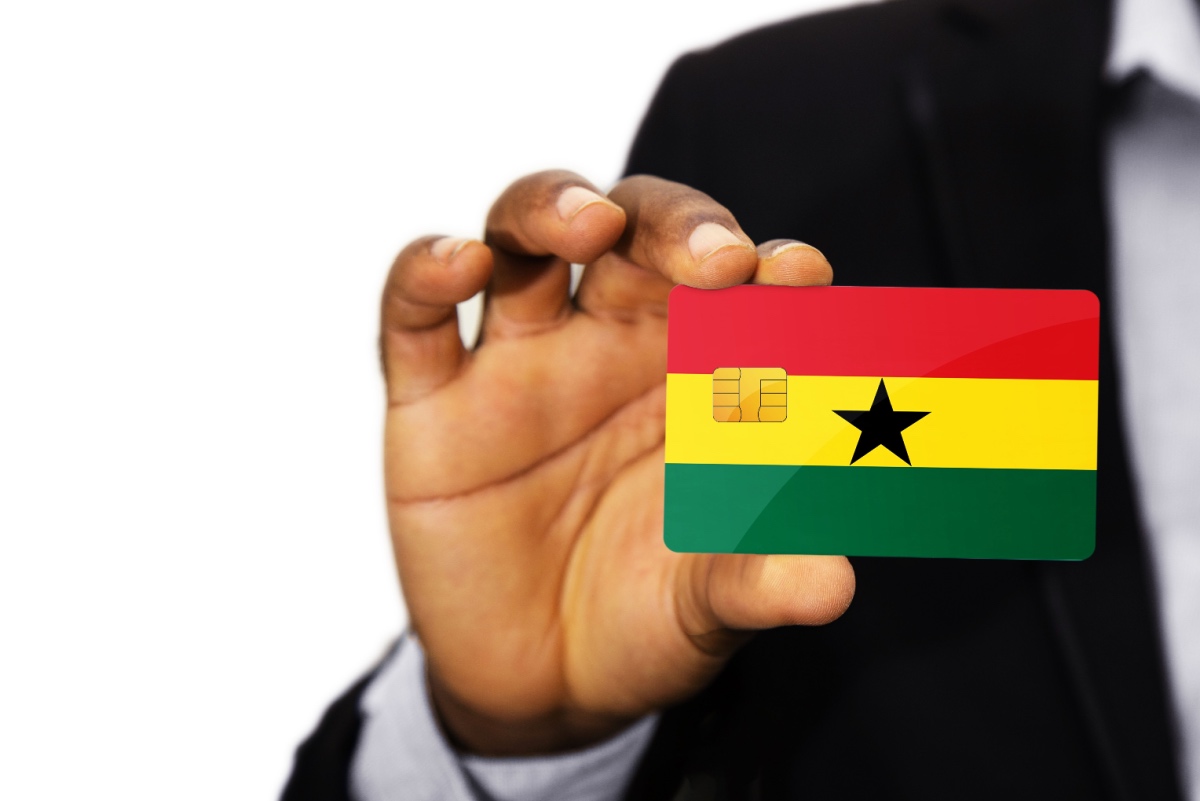
Ghana has enabled payments for its national ID, the Ghana Card, as it looks to consolidate digital payments, passports and essential documents.
Ghana has become the first African country to integrate payments into its national identity infrastructure, enabling citizens to transact using the Ghana Card, the country’s mandated digital ID.
The National Identification Authority (NIA) has added a digital wallet to the card, building on payment integration plans first outlined in September 2025. The update allows cardholders to use the ID as a payment instrument across multiple channels.
According to reporting by African tech publication TechCabal, the wallet is supported by the MyCitizens app, enabling in-store and online payments, ATM withdrawals and cross-border transactions to more than 200 countries.
The Ghana Card already functions as a centralised identity tool, incorporating SIM registration and passport-linked data alongside other personal information used for travel and security verification.
Established in 2003, the NIA oversees Ghana’s national identification system under the National Identity Register Act of 2008, which governs the collection of citizens’ biometric and personal data. The expansion into payments extends the card’s role beyond identification, following the introduction of the e-passport in 2022 as part of a broader effort to consolidate access to official documents.
The move aligns with the authority’s stated ambition to position the Ghana Card as a “triple-purpose” platform spanning identity, passport and payments, a framework first outlined in 2025.
How Ghana compares globally
Ghana now joins the ranks of a small group of markets exploring the intersection of digital identity and payments, though most have taken a more incremental approach.
In India, the Aadhaar system underpins large parts of the financial ecosystem, enabling users to authenticate transactions and access services through biometric verification. This has supported the rollout of the Aadhaar-enabled Payment System, which allows basic banking transactions such as cash withdrawals and balance checks using fingerprint identification. However, Aadhaar primarily functions as an authentication layer rather than a standalone payment instrument.
A similar model can be seen in Estonia, where the national e-ID provides access to a wide range of digital services, including banking and bill payments. The system is widely regarded as one of the most advanced digital identity frameworks globally, but payments are facilitated through linked services rather than embedded directly into the ID itself.
Elsewhere, countries such as Nigeria have focused on financial identity. The Bank Verification Number (BVN) system connects biometric identity to bank accounts, strengthening fraud controls and enabling transaction monitoring across institutions. As with India and Estonia, the ID layer supports payments infrastructure but does not operate as a payment mechanism in its own right.
In Singapore, the Singpass digital identity platform enables users to securely access financial services and share verified data with banks and fintechs, streamlining onboarding and authentication. Meanwhile, Sri Lanka has introduced GovPay, a centralised platform for government-related payments, though it is not directly tied to a biometric national ID in the same way.
Ditching Visa and Mastercard?
Ghana’s NIA has framed the expansion as part of a broader effort to extend the Ghana Card’s financial capabilities over time, with potential future use cases including tokenised transactions and gold-backed trading, while supporting wider financial inclusion objectives.
Ghana was the number one mobile money adopter in the world, according to the 2024 GSMA Mobile Money Regulatory Index, with a score of 95.06; the score takes into account authorisation, consumer protection, agent networks, etc.
As many African countries have mass rural populations, financial inclusion is a challenge for many consumers who may suffer from weaker internet connections and access to brick-and-mortar bank branches.
Mobile payments enable financial inclusion to access financial services, like cross-border payments, without the need to manually set up traditional banking accounts, which can be long and strenuous. They also help reduce the dependency on Visa and Mastercard.
Many payment service providers and merchants have been searching for alternatives to Visa and Mastercard as interchange fees continue to remain a friction point.
Pay-by-bank has been one of the alternative payment methods that has surged in interest and adoption, particularly in markets such as the UK, which bypasses the card networks for the sender and receiver to make bank-to-bank payments.
If a mandated digital ID held by a population of 35 million in Ghana can drop the dependency of Visa and Mastercard, it may be an avenue the UK and Europe look into as both regions have looked to improve their homegrown payment solutions and sovereignty in recent years.