Visa’s latest earnings highlight resilient consumer spending and its push to make stablecoins a mainstream part of cross-border and B2B payments.
Visa has reported $10.9 bn in revenue for its first quarter fiscal earnings of 2026, and remains confident in the future despite ongoing economic uncertainty.
On January 29, the payments giant revealed earnings per share of $3.17 on revenue of $10.9 bn, surpassing analyst expectations on both fronts.
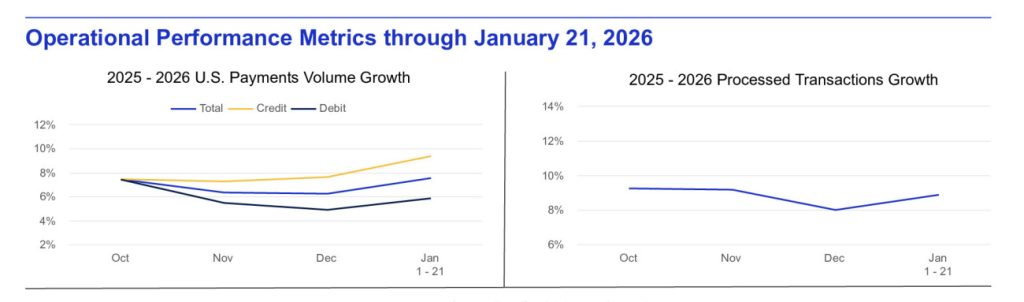
It was a strong quarter for the company, with net revenue rising 15% year-on-year, while payments volume climbed 8% to nearly $4trn.
Processed transactions also increased 9% to $69 bn, which Visa said demonstrated resilience in consumer spending despite ongoing economic uncertainty. However, the company noted this level of resilience may not necessarily carry into future quarters.
As Visa CFO Chris Suh explained: “We’re not economic forecasters, so we’re assuming the macroeconomic environment stays generally where it has been.”
Nevertheless, Visa can enjoy the rewards of the successful quarter, with shares rising 1.47% in aftermarket trading.
Stablecoins – a not so secret weapon
In a statement alongside the results, CEO Ryan McInerney said: “Visa is delivering breakthrough innovations that redefine what’s possible in payments.”
One area where innovation is particularly visible is stablecoins, an area Visa has been actively developing and was happy to discuss during the company’s earnings call.
Visa executives used the call to highlight growing momentum in stablecoin settlement and payouts, presenting the technology as a backbone for banks, fintechs and platforms while complementing rather than replacing traditional cards.
The company disclosed stablecoin settlement volumes on its network have reached an annualised run rate of $4.6 bn, attributed to demand for faster settlement, improved liquidity and always-on treasury operations.
“Visa’s goal remains clear: build the secure and seamless interoperable layer between stablecoins and traditional fiat payments at scale across the world,” McInerney said.
Visa has now expanded stablecoin card issuance into more than 50 countries and recently extended USDC settlement capabilities into the US, enabling seven-day-a-week settlement for clients.
The company has also started piloting stablecoin payouts through Visa Direct, allowing platforms and businesses to send funds directly to users’ wallets, particularly in markets with currency volatility or limited banking infrastructure.
However, McInerney emphasised stablecoins are not intended to replace traditional payments in developed consumer markets.
“We don’t see a lot of product-market fit in developed digital payment markets like the US or Europe for stablecoin payments,” he said. “But we see strong opportunities in cross-border, remittances, and B2B money movement.”
Visa warns against Credit Card Competition Act
It didn’t take long for questions about the Credit Card Competition Act, a bill aimed at increasing competition in the credit card market and challenging the dominance of Visa and Mastercard, to occur.
The legislation has support from both sides, with Republican Senator Roger Marshall and Democratic Senator Dick Durbin reintroducing the bill after President Donald Trump publicly voiced support for reducing credit card fees.
Supporters argue the legislation would benefit consumers and merchants. Marshall called out “Big Banks” for profiting from swipe fees while American families shoulder the cost, estimating the average household pays nearly $1,200 annually.
Durbin stressed high fees inflate everyday expenses like groceries and gas, and that introducing more competition could lower costs for Main Street merchants and their customers.
Speaking on the call, McInerney said the company is actively engaging lawmakers and warned the proposals would harm consumers, merchants and innovation.
“It’s very harmful, and it’s just simply not needed,” he said. “Consumers and small businesses would see reduced access to credit. Rewards would be eliminated entirely. There’d be fewer credit card options. And by the way, weaker security protections and less innovation.”
He went on to say that Visa is working to educate policymakers on the competitive dynamics of the payments ecosystem, including the rise of wallets, BNPL, crypto and account-to-account payments.
Low double digit growth forecast

Visa reconfirmed its guidance for low double digit adjusted net revenue growth for the full fiscal year, supported by continued momentum in payments volume, commercial solutions and value-added services.
CFO Suh said the company is assuming stable macroeconomic conditions for the remainder of the year, but admitted “we’re not economic forecasters.”
Visa also expects operating expense growth to remain in the low double digits as it continues investing in innovation and platform expansion.