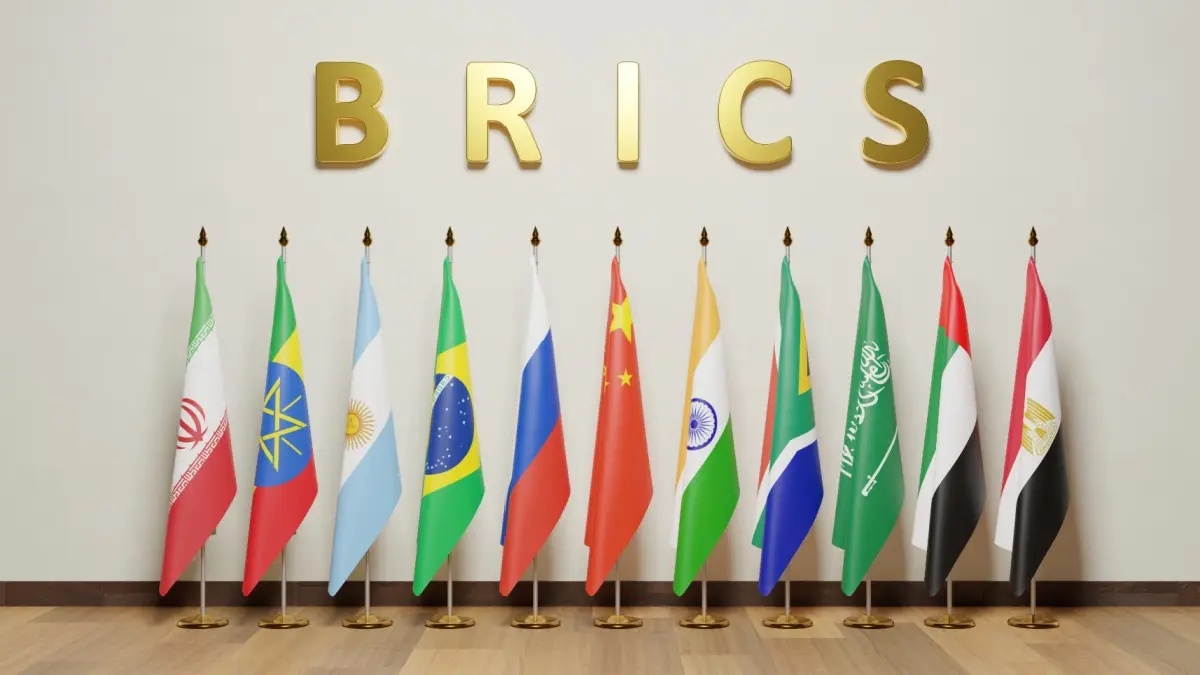
India wants BRICS nations to link their CBDCs to speed up cross-border payments.
India’s central bank has reportedly put forward a new framework which would allow BRICS nations to connect their central bank digital currencies (CBDCs).
The Reserve Bank of India (RBI) is aiming to make cross-border trade and tourism payments faster and cheaper and wants the proposal placed on the agenda for the 2026 BRICS summit, which India will host.
First reported by Reuters, the plan would focus on areas such as trade finance, remittances and tourism, where high fees, slow settlement times and currency conversion costs remain major challenges.
By enabling interoperability between national CBDC systems, RBI hopes businesses could transact directly in domestic currencies without relying on correspondent banking networks or dollar clearing.
All five core BRICS members, Brazil, Russia, India, China and South Africa, are running pilots for retail CBDCs, with China currently in the most advanced stages of development.
CBDCs hold the key
The RBI’s proposal is the latest chapter in a much longer effort by BRICS nations to improve cross-border payments and reduce reliance on the US dollar.
At the 2023 BRICS summit in South Africa, Brazilian President Luiz Inácio Lula da Silva floated the idea of a shared BRICS currency, arguing dollar dependence left member states exposed to exchange-rate volatility and geopolitical pressure.
While the proposal failed to gain serious traction, with India and others quickly playing down the idea, it highlighted growing frustration within the group over the structure of the global financial system.
Russia, facing financial isolation following its invasion of Ukraine, was seen as particularly receptive to alternatives to dollar settlement, while China continued to push quietly for broader use of the yuan in trade and investment flows.
However, ideas such as a common currency ultimately proved too politically complex and economically difficult to implement. Yet, In recent years the focus has moved toward smaller and practical steps.
In July 2025, China and Egypt signed a series of financial agreements aimed at settling trade in yuan and expanding local digital payments infrastructure. The deals focused on trade finance, card payments and merchant acceptance.
This strategy of using technical payment links rather than overhauling the monetary system looks to be the way forward and CBDCs now appear to be emerging as a potential bridge between these two approaches.
Earlier this week, China’s central bank announced upgrades to the operational rails of its digital yuan, as new data revealed the e-CNY has already processed more than 3.4 billion transactions since its pilot began.
The People’s Bank of China is putting the currency forward as infrastructure for cross-border settlement, particularly through its involvement in the BIS-led mBridge project.
With e-CNY accounting for the vast majority of CBDC transaction volume on mBridge, and China investing heavily in international CBDC rails, digital currencies are beginning to look like the most realistic path yet.
It won’t be straightforward
The use of CBDCs to improve BRICS connection may be more subtle but it’s not expected to be without several challenges along the way.
On the geopolitical front, US officials have repeatedly warned against efforts to weaken the dollar’s role in global trade. Any move by BRICS to create alternative settlement rails, even if efficiency-driven rather than ideological, risks triggering political pushback and potential trade consequences.
There are also internal challenges within BRICS which may be even harder to overcome. Member states differ significantly in regulatory frameworks, technology stacks and privacy standards, complicating the creation of shared infrastructure. Not to mention sensitivities around adopting platforms developed by other countries, particularly where data sovereignty and financial surveillance concerns arise.