Goldman Sachs says the US’ new federal framework for stablecoins could accelerate adoption while leaving traditional payment rails with a central role in distribution, fraud prevention and compliance.
In its latest Top of Mind report published earlier this month, the bank characterises 2025 as a ‘stablecoin summer’, citing the passage of the GENIUS Act and Circle’s IPO as watershed moments.
Former Acting Comptroller of the Currency Brian Brooks argues the law will give consumers and institutions a stronger sense of safety, while Berkeley economist Barry Eichengreen warns of financial stability risks if multiple coins trade at different prices.
What the GENIUS Act does
Signed on July 18 after bipartisan votes in both chambers, the Act creates the first federal regime for “payment stablecoins” and sets out who can issue them and on what terms.
Issuers can be bank subsidiaries, federally-licensed non-banks via a new OCC licence, or capped state charter holders; coins must be backed 1:1 by specified “safe assets” such as short-dated Treasuries, repos, money market funds and bank deposits.
The law requires monthly reserve disclosures (and annual audited financials above $50bn outstanding), prohibits paying interest directly to coin holders, applies full BSA/AML obligations and stays neutral on access to Federal Reserve master accounts.
With the GENIUS Act’s passage, I expect the future state [of stablecoins] to become reality in two years and exist at scale in five years. So, the next three years will be the gold rush. – brian brooks
Market size and composition
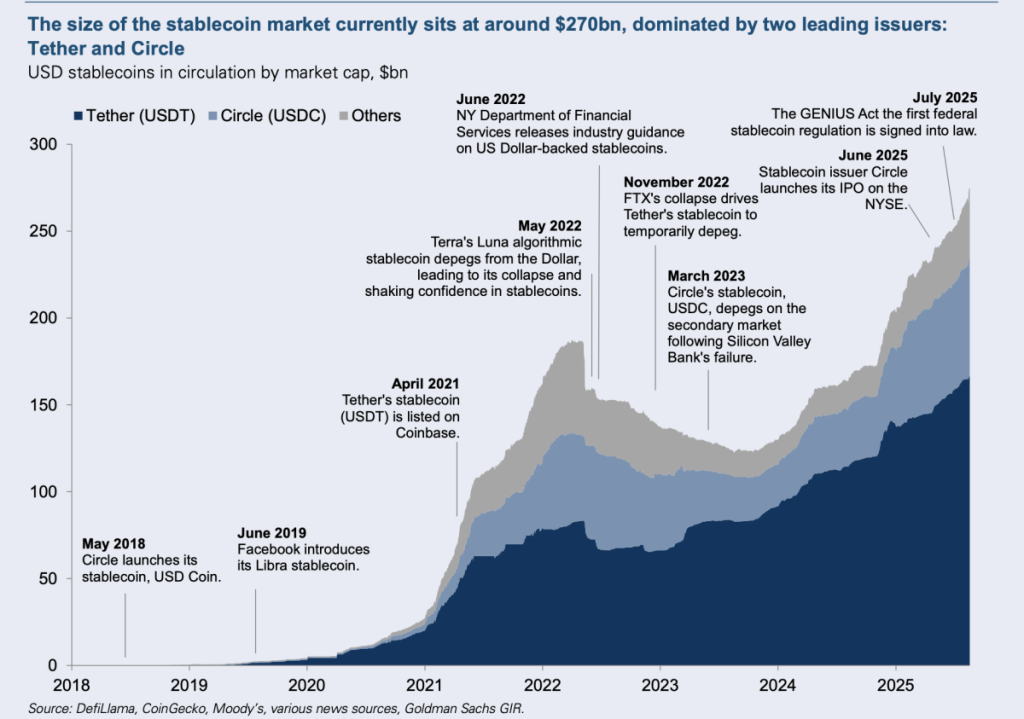
Goldman puts the stablecoin market at roughly $268–270 billion today, with two issuers accounting for the lion’s share: Tether’s USDT at about $166 billion outstanding and Circle’s USDC at about $68 billion. The remainder is spread across much smaller dollar coins.
A timeline in the report underlines how concentration and confidence have been shaped by a series of shocks and policy moves: Circle launched USDC in May 2018; Facebook unveiled Libra in June 2019; USDT listed on Coinbase in April 2021; Terra’s algorithmic stablecoin blew up in May 2022; the New York DFS set guidance for dollar-backed coins in June 2022; FTX’s collapse triggered a temporary USDT de-peg in November 2022; USDC briefly de-pegged in March 2023 amid Silicon Valley Bank’s failure; Circle listed on the NYSE in June 2025; and the GENIUS Act was signed into US law in July 2025.
On the asset side, reserves are overwhelmingly parked in US “safe assets”. The latest disclosures the report collates show US Treasury securities, repos and money market funds alongside cash and bank deposits at large institutions. Smaller residual buckets include items such as corporate bonds, precious metals, crypto and foreign Treasuries. The chart notes the reference dates as 1Q25 for Tether and May 2025 for Circle.
The report also flags that, following a grace period, the GENIUS Act tightens this composition further by requiring payment stablecoins to be fully backed by permitted reserves, primarily short-dated, high-quality dollar assets. That codifies current practice for the largest issuers and hardens disclosures and oversight going forward.
Goldman also highlights that while market cap has grown steadily since 2018, turnover relative to supply remains modest for some coins, implying a large standing stock of reserves against which usage can scale as payment use cases expand beyond crypto trading. That dynamic is one reason stablecoin growth matters for US money markets.
Payments: evolution, not revolution
Goldman’s payments team says fears of a ‘wipe-out’ in remittances are misplaced because the real costs aren’t in the blockchain hop itself but in the plumbing around it. On a true like-for-like basis by corridor, you have to add on-/off-ramp fees, FX conversion, licensing, KYC/AML, and fraud losses and prevention; stablecoins do not remove these costs.
In higher-cost, less-liquid corridors there may be savings if stablecoins deepen liquidity and infrastructure, but those routes are not the bulk of global flows and local rules could cap scale. Where analysts do see stablecoins helping is in the back-office: 24/7 on-chain settlement can trim pre-funding needs (including weekends), improving working-capital turns for remittance operators without changing the end-user price much.
On consumer payments, Goldman argues card networks are already in the flow – building on early crypto partnerships – and Visa expects to settle over $1bn of stablecoin transaction volume in the next 12–18 months. But scaling a new tender still runs into acceptance, fraud, chargeback standards and consumer protections where the carded ecosystem has entrenched network effects.
Zooming out, the bank frames stablecoins as infrastructure-layer rails that will sit alongside ACH and correspondent banking. Most payment companies monetise at the services layer so incumbents remain central even if the base rail is on-chain.
Barry Eichengreen — the historian’s warning on stablecoins
Who he is: Barry Eichengreen is the George C. Pardee and Helen N. Pardee Chair and Distinguished Professor of Economics and Political Science at UC Berkeley, best known for his work on financial crises and the history of money. An interview with him is featured within Goldman Sach’s report.
Core thesis: Stablecoins risk undermining the “singleness of money” – the idea that every dollar should trade at the same price and be accepted everywhere – by creating multiple privately issued dollar lookalikes that could trade at different values. That, he argues, echoes the 19th-century Free Banking Era when competing banknotes traded at discounts and bank runs were common.
Why the GENIUS Act doesn’t settle it: Although the Act mandates high-quality, liquid reserves, Eichengreen says “high quality” is not immutable in practice, and supervisory reliance on monthly self-reporting plus annual audits is too lax for a novel, complex system. Fragmented issuance by big techs and retailers could leave regulators stretched and consumers facing coins of varying reliability.
Banks still hold the cards: He sees limited threat to the banking model. If demand for digital dollars grows, incumbent banks can issue their own tokens and will likely dominate via distribution and bundled services such as insured deposits, credit, and dispute protections that stablecoin issuers cannot easily match.
Treasuries and market stability: Stablecoins may add some demand for US Treasuries if the market scales, but Eichengreen expects the overall impact to be modest. The bigger risk, in his view, is amplified volatility if doubts spark rapid redemptions and issuers must liquidate Treasury holdings at speed.
Dollar dominance: He expects little effect on the dollar’s international role. Stablecoin capitalisation is small relative to FX markets, and existing rails like correspondent banking and SWIFT already incorporate encryption and efficiency upgrades that reduce the incentive to switch.
Where stablecoins might help: Benefits look marginal in the US, where only a small share of people are unbanked and consumer protections tied to cards and insured deposits are valuable. There may be clearer use cases in cross-border payments where fees are high.
Preferred design choice: A retail CBDC would better preserve the singleness of money because there is no question about par convertibility with central bank liabilities. But he views a US CBDC as politically unlikely given longstanding mistrust of concentrated monetary powe
Tokenisation as the flywheel
Goldman frames tokenisation as the demand engine behind stablecoins’ next leg. Robinhood and Kraken have begun offering tokenised equities, opening US stocks to European investors, enabling 24/7 trading, and extending access where brokerage infrastructure is thin.
As more real-world assets move on-chain, stablecoins become the “natural” settlement asset for buying and selling them.
The report also sketches two commercial routes which can accelerate this flywheel: a direct-issuer model, where the stablecoin company mints and redeems for its own brand, and a white-label model, where the issuer sits behind a consumer platform such as a broker or wallet.
Bank deposits and Treasuries
On deposits, Goldman sets out four conditions for a meaningful migration of bank deposits into stablecoins:
- stablecoins must deliver better economics than deposits, for example a higher effective yield;
- they must offer lower payment frictions for everyday spending;
- they need safety and protections comparable to insured deposits; and
- policymakers must be comfortable with more non-bank credit intermediation.
In the near term, these are hard to meet. The GENIUS Act prohibits issuers from paying interest, while banks retain the ability to raise deposit rates and offer FDIC insurance, reducing customers’ incentive to switch. Goldman also points out that, so far, USDC growth has been positively correlated with large-bank deposits, suggesting expansion has not come at deposits’ expense.

For treasuries, on safe-asset demand, the impact “depends”. If stablecoin growth pulls from money market funds, the net effect is largely a wash because both vehicles already hold short-dated safe assets, although differences in portfolio mix could nudge relative pricing between bills, repo and funds.
If inflows come from bank deposits, physical cash or foreign dollar demand, aggregate demand for Treasuries and related instruments rises. The direction of travel matters in stress, too: forced redemptions could amplify volatility if issuers must liquidate reserves quickly.
CBDC vs stablecoin
The report places the US at a private-issuer juncture. Alongside the GENIUS Act, the House passed an Anti-CBDC Surveillance State Act that would limit a retail central bank digital currency (CBDC) issued by the Fed, even as other jurisdictions continue to explore public options.
“I don’t want the government to have the power to review my transactions.” — Brian Brooks.
With stablecoins, public borrowing costs become more sensitive to private demand for stablecoin liquidity, since reserves are funded in the bill and repo complex. In a CBDC system, the central bank can smooth liquidity by adjusting the cost of its own liabilities without changing the asset mix, which can be cleaner for debt management and the “singleness of money”.