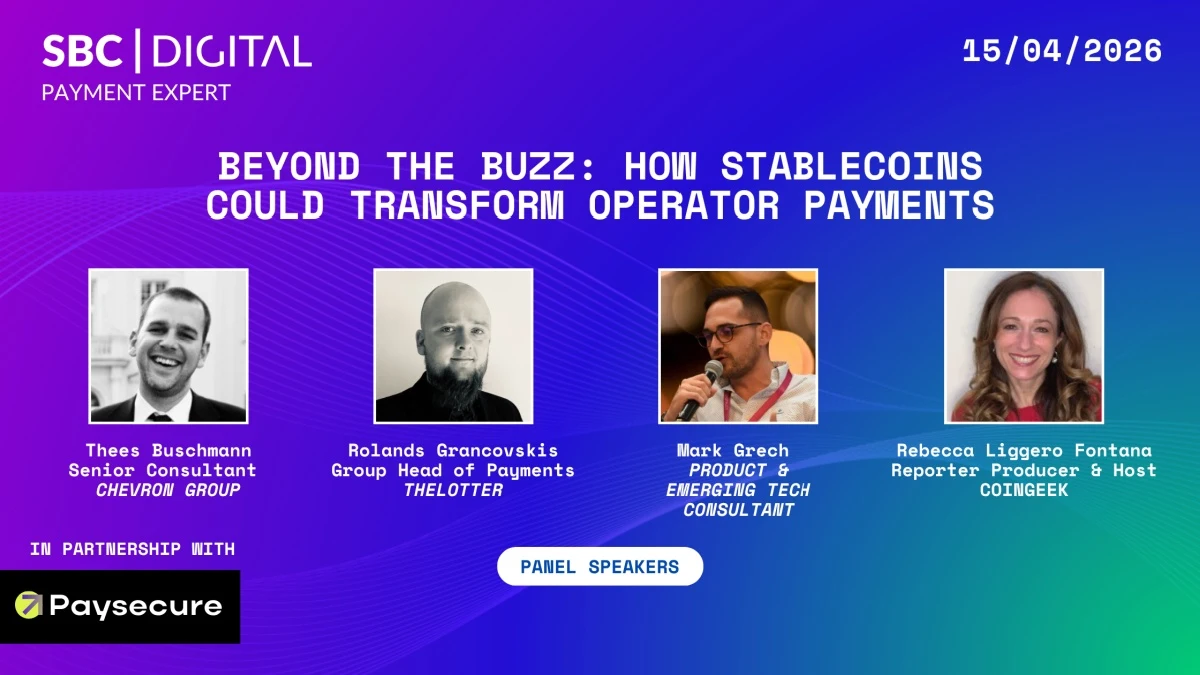
Panellists at Payment Expert’s Digital Day looked past the hype of stablecoins, discussing the impact on operations, compliance and treasury.
Stablecoins have surged in popularity across a range of industries, with giants including Mastercard and Visa both referencing them in recent financial reports. Much of the discussion in these reports, as elsewhere, has focused on their advantages, including faster and more seamless cross-border payments between businesses.
The gambling industry is one of several sectors beginning to adopt the technology following an initial wave of hype.
However, operators speaking during Payment Expert’s Digital Day on 15 April suggested that the reality is less about frictionless payments and more about where that friction relocates within the system.
During the panel, moderated by Coingeek’s Rebecca Liggero Fontana, the discussion repeatedly came back to the gap between how stablecoins are perceived externally and how they function inside regulated payment environments.
A ‘Pandora’s box’ for payments operations
From the start, Liggero Fontana described stablecoins as something already being used at scale in parts of the industry, noting that crypto-based payments are “already leading in transaction volumes” in certain sectors such as iGaming.

She also raised the question of what is happening behind the scenes, particularly around treasury and liquidity management.
Mark Grech, Product and Emerging Tech Consultant, said stablecoins have opened a “Pandora’s box” in financial operations, with adoption accelerating as regulatory frameworks such as the Genius Act in the US and Europe’s MiCA come into effect.
He pointed to reduced banking friction and faster settlement as key reasons for this, noting that operators are seeing “higher approval rates” and improved access for users who prefer crypto-based payments.
Grech added that the impact is not limited to the transaction itself, as stablecoins are becoming embedded in how global payment operations are run, not just in how payments are received.
Speed at the front, friction around it
One of the most lauded advantages of stablecoins is the speed they offer compared with traditional payment rails. This faster settlement can help with challenges like reducing exposure to foreign exchange (FX) risk, as shorter timeframes between agreement and payment leave less opportunity for exchange rates to change.

Rolands Grancovskis, Group Head of Payments at TheLotter, said that while stablecoins do offer speed advantages, particularly in cross-border transfers, the wider payment flow is anything but simplified.
He said that “transactions are fast”, but stressed that regulated operators still face the same underlying obligations around AML, travel rule compliance and transaction monitoring.
Even if the transfer itself happens in minutes, he noted that payments “can still be delayed, still be queued and still can be blocked”, depending on compliance checks and operational processes around the transaction.
“The technology is fast, but the process around it is still the same or similar to what we expect around Fiat,” he explained.
The cost of stablecoins sits outside the transaction.
Grancovskis also challenged the assumption that stablecoins automatically reduce cost. While gas fees on blockchain networks are often low, he said these only represent one part of the payment flow.
In practice, operators still face on- and off-ramp costs, foreign exchange spreads and liquidity charges, particularly when converting funds back into fiat currencies.
“Even when vendors accept stablecoins,” he explained, “they often charge a fee because they still need to convert them to fiat.”
Grech agreed that off-ramp fees and conversion costs are one of the biggest operational challenges for operators, noting that businesses often need to decide whether to hold, convert or reinvest digital assets, particularly in volatile market conditions, which introduces additional treasury complexity.
He also highlighted reconciliation challenges, pointing out that transactions can sometimes appear completed on-chain while internal accounting systems still require verification and alignment.
Another factor to consider around costs was brought up by Thees Buschman, Senior Consultant at Chevron Group, who emphasised that stablecoins should not be viewed as fundamentally separate from traditional cryptocurrencies in a regulatory sense.
He shared that the complexity is not removed by using stablecoins, but moves into surrounding processes such as compliance checks, internal risk controls and operational requirements.
He argued that while transaction fees may be lower, the overall cost of operating a stablecoin-based system includes compliance obligations such as AML procedures, travel rule adherence and internal governance frameworks.
Understanding is still catching up
Demand for stablecoins continues to grow across the payments ecosystem, with usage expanding in addition to a market that has already reached multi-billion-dollar scale in circulating supply.
However, despite this momentum, there are several barriers in place. The panel mentioned inconsistent regulatory approaches across different regions, with operators required to adapt to multiple frameworks depending on where they are licensed and active.
For instance, the Central Bank of Brazil has recently announced a ban on the use of cryptoassets for the settlement of cross-border payments, as part of an update to its regulatory framework for international transfers.
Additionally, internal understanding within organisations is also still developing, particularly as firms transition from traditional fiat-only models into hybrid systems.
Grech suggested that part of the challenge is education, stating that many operators are still adapting to what digital finance requires at an operational level.
He said that businesses often underestimate the shift involved, where payment flows, treasury management and compliance structures must be developed together.
The panellists treated stablecoins as improving the underlying ‘plumbing’ of payments while leaving many operational and regulatory structures still in place.
As Liggero Fontana concluded: “Stablecoins are the gateway drug to blockchain technology. There’s so much that we can do with this. This is just the beginning.”