
The UK government states it knows the gaps to fill to disrupt black market gambling as a new economic threat.

The UK government has signalled a shift in how it intends to tackle illegal gambling, placing banks, payment providers and crypto infrastructure at the centre of enforcement strategy.
Speaking at the Annual General Meeting of the Betting and Gaming Council, Gambling Minister Baroness Fiona Twycross confirmed a new £26m Illegal Gambling Taskforce will prioritise collaboration with financial institutions and big tech platforms to disrupt the pipelines directing UK consumers to offshore operators.
At the same time, the Gambling Commission has opened the door to exploring a regulated pathway for crypto payments in licensed British gambling – acknowledging digital assets are already one of the two biggest search terms driving traffic to unlicensed sites.
SBC’s Ted Menmuir was present at the AGM. Here is his full report:
Perhaps it was a change of venue, or simply better coffee and catering. Annual General Meeting of the Betting and Gaming Council (BGC) held on 26 February unfolded in notably serene surroundings.
Gone was the defensive posture which has characterised UK gambling over the past year, following the government’s overdrawn tax judgment on Remote Gambling Duties (RGD), sanctioned in the Chancellor’s Autumn Statement. Though clearly irked by the decision and still adjusting to its implications, members in attendance recognise the industry is now firmly living in the “40% era” — so why continue posturing?
Instead, the AGM adopted a new rallying theme: “The Illegal Market, Real Risks and Real Harms.” The focus shifted away from the technicalities of the Gambling Review — compliance tweaks, policy reforms, and taxation.
From the opening keynote by Baroness Twycross, followed by BGC Chief Executive Grainne Hurst, the message was that dismantling black market threats is now regarded as “UK gambling’s new generational challenge”.
Taskforce to hold every party accountable
Pushback against illegal operators will be led by a new £26m-funded Illegal Gambling Taskforce. Reporting to Twycross, the taskforce will be largely focused on increasing prosecutions of illegal platforms, enhancing early prevention activity, and undertaking further research into what remains an opaque and difficult-to-measure market.
The UK’s Department for Culture, Media and Sport did not shy away from the scale of the challenge, noting industry and regulators alike are at “ground zero” in confronting a new and evolving criminality. Estimates of black market exposure remain contested; panels referenced figures ranging from under £1bn in wagers to as much as 12% of total market activity.
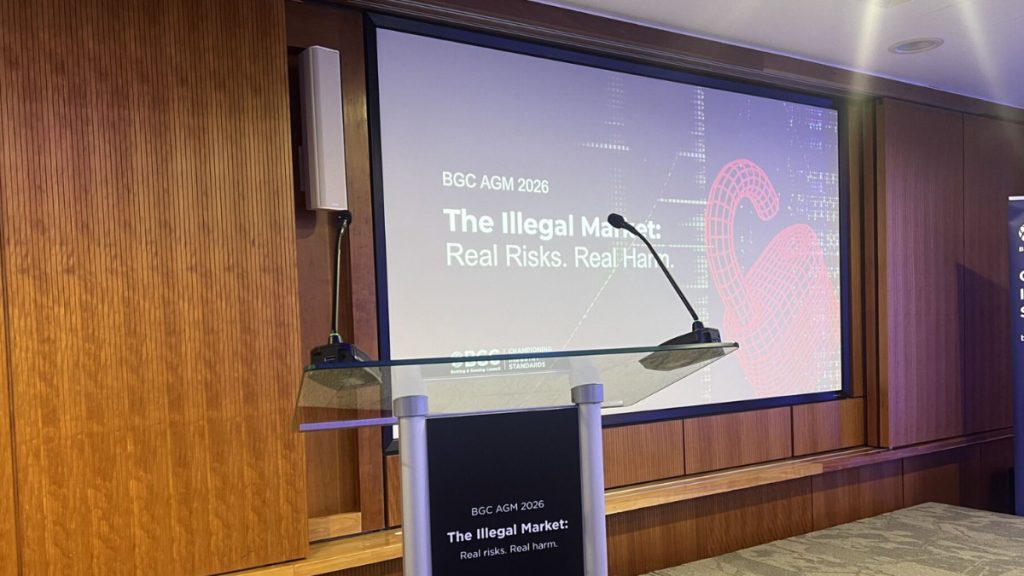
Twycross ended her address by stating the first point of call will be with big tech and banks, to “ensure they play their part in enforcement and upholding rules”.
The platforms of Meta (Facebook/Instagram) and search engine of Google were lambasted for allowing the brazen promotion of “non-Gamstop casinos”. Tech must explain to DCMS, why rogue advertisers can escape protections placed on the campaigns of licensed operators (age-gating and audience targeting).
Yet it was the speech of Gambling Commission Executive Director Tim Miller which provided the clearest signal of where enforcement is heading as the Gambling Act Review implementation phase draws to a close.
Miller acknowledged the Commission is entering a transitional period. With proposed white paper measures now largely embedded, the regulator is keen to move away from what he has previously described as an “endless treadmill of reform” and towards a period of evaluation and regulatory stability.
“The days of weekly multi-million pound penalties do appear to be behind us,” he noted, pointing to improved baseline compliance across the sector. “That is not a signal for anyone to lose focus. But it does allow us to have more sensible conversations about how we enhance the offer within the licensing objectives.”
UKGC: Enforcement is evolving not softening
The £26m Treasury allocation to combat illegal gambling was welcomed as a vote of confidence. But Miller was explicit that the Commission cannot tackle the supply side alone. Social media firms, big tech platforms and affiliates must play their part in disrupting the pipelines that channel consumers to offshore sites.
At the same time, he used the platform to justify the Commission’s consultation on increased licence fees – the first review in five years. Should DCMS approve the uplift, the regulator’s income (excluding the National Lottery) would rise from 0.21% to 0.28% of industry GGY.
The rationale, Miller explained, lies in growing case complexity, increasingly layered corporate structures and the additional demands of illegal market enforcement. Without additional income, the Commission has already begun contingency planning on what activity may need to be slowed, scaled back or stopped.
But perhaps the most strategically significant element of Miller’s address came when he turned to innovation – and specifically cryptoassets.
Could a crypto payment pathway be on the cards?
“We want a competitive and innovative licensed market that keeps customers within a safe, fair and well-regulated environment,” he told delegates. “Innovation should not be seen as something that sits in tension with consumer protection. Done properly, it can be one of our most effective consumer protection tools.”
Referencing the Financial Services and Markets Act 2000 (Cryptoassets) Regulations 2025 – expected to bring cryptoassets under FCA oversight Miller confirmed the Commission is now prepared to explore what a regulated pathway for crypto payments in UK gambling might look like.
“The new crypto asset regime is then expected to come into force on 25th October 2027,” he said,” “I think these steps, progressing the FCA’s own roadmap around cryptocurrency, start to change the picture for this industry,” he continued.
“Our illegal market research shows that crypto is one of the two biggest search terms directing British consumers to unlicensed sites,” he said. “We cannot ignore that reality.”
However, he tempered enthusiasm with caution “There are significant risks and operational challenges associated with cryptoassets around volatility, AML controls and consumer understanding,” Miller warned. “So this is not about rushing toward a predetermined outcome. It is about exploring the art of the possible.”
“As well as the growing appetite that we see from punters, we do now want to start looking at what the potential path forward would be to create a way for crypto assets to be used as a consumer payment option for licensed and regulated gambling here in Great Britain.”
He revealed that the Commission’s Industry Forum has been asked to examine how crypto could be introduced “sensibly and in line with the licensing objectives,” without arbitrary timelines.
“I’m not setting deadlines today,” he added. “But we recognise that demand exists. The question is whether we can design a framework that mitigates risk while strengthening channelisation.”
The underlying logic is clear: if regulated operators are prevented from adapting to consumer behaviour, offshore platforms will fill the gap.
Miller was keen to dispel any suggestion that openness to innovation signals a retreat from enforcement.
“Supporting innovation does not mean weakening standards,” he stated. “We will continue to take robust enforcement action where required. But it must be possible to enforce the rules”.
For operators adjusting to the 40% era, the message from Miller was measured as enforcement remains uncompromising yet opportunities to cooperate on innovation have never been this visible.