Payment Expert is on the ground at Sibos 2025 in Frankfurt, giving you live coverage from all four days. Expect insights from some of the leading industry leaders engaging in conversations around fintech, payments, banking, digital currencies and much more.
16:00 – Day 3 of Sibos is coming to an end, and it was a day largely dominated by regulatory discussions on a whole host of sectors. Digital assets are maturing but there appears to be continued friction with overlapping regulations pertaining to traditional finance. Cross-border appears to be at a crossroads in how it needs to be redefined. ISO20022 has certainly set the standards, but is it becoming more of a hindrance than a solution?
I’m Callum Williams signing out, as we prepare for the 4th and final day of Sibos tomorrow.
15:15 – Banks are awake to stablecoins… what now?
One of the core themes of discussion at Sibos so far this week has undoubtedly been digital assets, particularly stablecoins.
Paul Li of Banking Circle, was on hand to tell the audience this multi-billion dollar market is only growing and is why Banking Circle launched its own stablecoin following the adoption of the rulings designed for stablecoins under the Markets in Crypto Assets (MiCA) in Europe.
It took just two months for Banking Circle to launch its own stablecoin, which now is valued at more than $50m. Li believes stablecoins “will be a new business model in payment industry”.

Why banks like Banking Circle are gearing towards creating native stablecoins is primarily due to the ease of issuance. Issuers such as Paxos are able to launch these digital currencies to market fast due to the blockchain technology it runs off. Banks are also interested as they provide benefits such as real-time settlement, are cost effective, and provide 24×7 availability.
However, Li was also cautious of the surging stablecoin market, particularly if more banks begin to launch native stablecoins of their own. He warned this could lead to a “glass ceiling” effect of the global stablecoin and financial markets, as there is no multiplying effect and the market would not grow.
14:00 – Why cross-border payments needs redefining
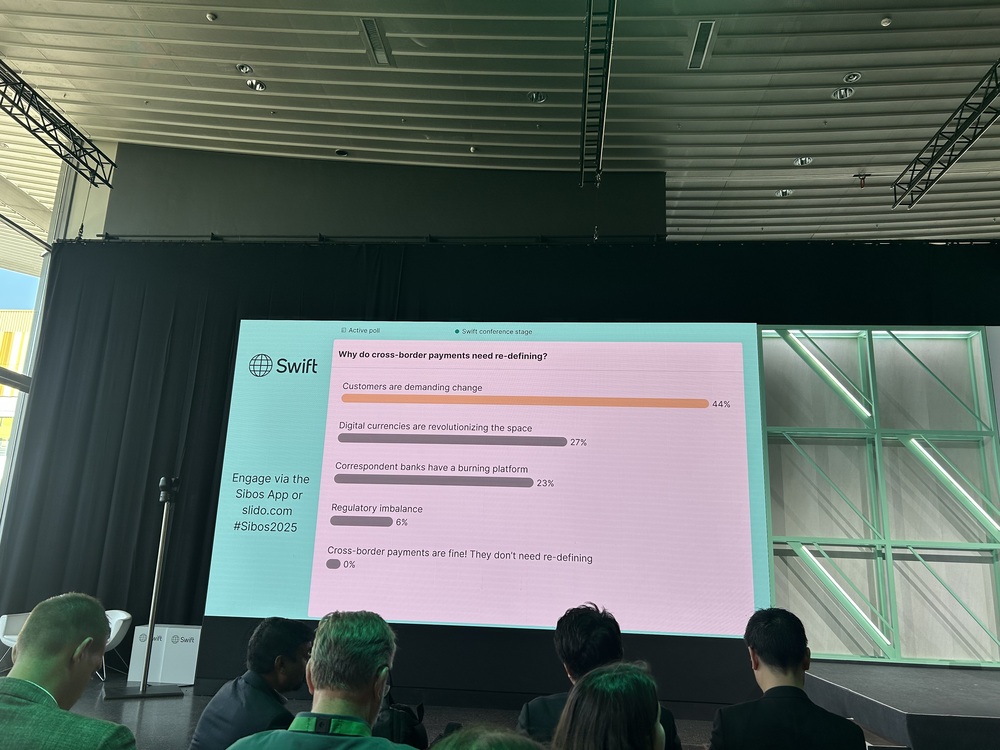
At the start of the post-lunch Sibos conferences, a question was posed to the audience at the Swift stage; “Why do cross-border payments need redefining”.
Customers demanding change, the rise of digital currencies, and regulatory imbalances were all cited as possible answers, and while consumer demand for change came out as the audiences, the conversation focused on why the financial industry has entered this crossroads.
“We have failed to create a platform that is cheaper for users to use”.
UniCredit’s Raphael Barisaac believes the industry has failed to provide the adequate platforms to enable cross-border payments to continually evolve. He also called on larger institutions to stop withholding their own platforms and being to apply global standards for all to follow.
Barisaac said the consumer demand problem is a large issue, as consumer preferences vary across multiple jurisdictions. He also reiterated the same issue, only this time for institutional clients. He said remittances remain a source of concern for clients. “We see cross-border payments of correspondent banking is not suitable”, said Barisaac.
“(UniCredit) is taking a different view, combining banking platforms with other partnerships to offer cross-border to bring new meaning of how we get here with the payment.”
Giving a view from a central bank perspective, John Jackson from the Bank of England revealed they are working on finding and investing in “foundational” solutions to eliminate cross-border friction for retail and wholesale customers.
He admitted technology is moving rapidly, and the speed of penetration in cross-border payments is not aligning with the corresponding banks, calling for more synchronisation.
Jackson cited ISO20022 as an example of a “really key foundational element” in a bid to enable assistants to “always be on”, unblocking friction in settlement hours to provide final settlement.
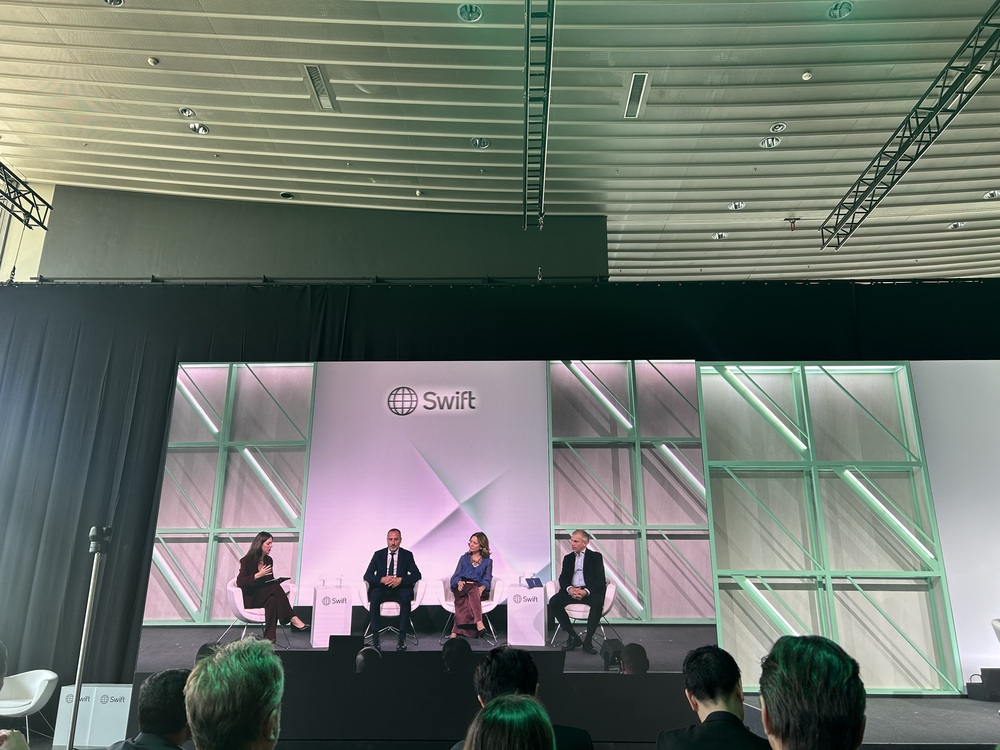
Pertaining to changing consumer demands, Emanuela Saccarola from CITI believes there isn’t much difference between this and the rise of digital currencies.
She said global market needs difference while also holding some form of commonality, bringing it back to basics. “You want cross-border to be cheap, transparent with no hidden fees, safe and secure,” said Saccarola.
13:10 – Lunch at Sibos, but cross-border payments news keeps coming
Even as delegates take a break at Sibos, announcements keep coming. Nium and Emirates NBD have revealed an expansion of their real-time cross-border payments network. The partnership now covers Emirates Islamic Bank in the UAE, with a rollout in Saudi Arabia underway, aiming to make international payouts faster, cheaper and more accessible across the MENAT region.
Anupam Pahuja, Chief Revenue Officer at Nium, said: “Over the past year, our partnership with Emirates NBD has continued to scale, enabling real-time money movement from the Middle East to the world. With the addition of Emirates Islamic Bank and preparations in Saudi Arabia, we are delivering on our vision to make global payments instantaneous, accessible, and cost-efficient for all.”
12:15 – Form3 Chief Revenue Officer, Mark Fieldhouse: We’re seeing AI being deployed on “multiple levels”
Speaking to Payment Expert, Fieldhouse believes the financial industry is beginning to deploy AI, and multiple models such as Agentic, to begin a new cycle of clean data to be optimised.
Fieldhouse’s views will be shared in full on video this week

11:20 – The opportunity for a US Real-Time Payment embracement
Renata Fracaroli Vilanova Lobo of JP Morgan has experienced first-hand the success of Pix in Brazil, and she is now at task of helping build an adoption of real-time, instant payment rails across the US.
Speaking to David Scola of Form3, Vilanova Lobo believes the migration to ISO20022 was a “critical initiative” for US banks in its bid to adopt real-time payment rails, such as FedNow and CHIPs. She believed there is a real demand for real-time settlement and in order for this to flourish, there must be mandatory guidelines and standards in place from regulators.
Vilanova Lobo revealed there is a great demand from the US retail sector for real-time payments, but there is a growing demand stemming from the wholesale sector. The gig economy and mortgage sector in particular are seeking faster ways to settle payments from a B2B and B2C perspective.
The US may be a long way away from a full embracement of real-time payments though however, with Scola admitting the US is still in its “first faster payment phase”, whereas the UK is embarking on its second. Brazil with Pix and India with UPI are even further along, as Vilanova Lobo stated both countries are now experimenting with value-added services, such as buy now, pay later with Pix, to create more options with real-time payments than ever before.
“That’s our vision”, said Vilanova Lobo, who capped off her conversation with Scola who finalised by stating “(ISO) is helping the adoption of RT payments, but it is not critical”. That comes from retail, wholesale, and consumer demand.
10:35 – There is no excuse now to get started in Digital Assets
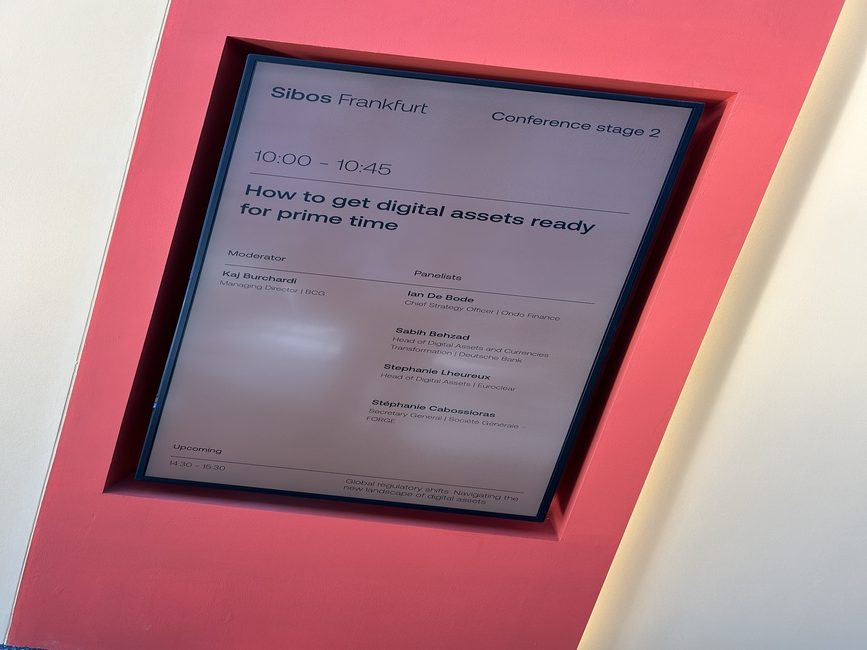
“We are very rapidly moving to a point where regulation is no longer an excuse to enter the space”, said Ian De Bode of Ondo Finance.
The starting point for traditional finance firms to enter the digital space is becoming more and more expansive, with new regulations and digital sandboxes established to provide a secure entry point.
However, while regulations such as Europe’s Markets in Crypto Assets (MiCA) and US’ GENIUS Act provide the bedrock for this safe entry, Stephanie Cabossioras from Société Généralé, called on European regulators to address the competitive balance in stablecoin rules on interest.
Currently, MiCA forbids any interest yield on listed stablecoins across the European Union for issuers, third-parties and crypto exchanges. While the same rule applies for issuers in the US under the GENIUS Act, crypto exchanges and third-parties do have the opportunity to earn interest on listed US stablecoins.
Cabossioras believes this causes a “huge disadvantage for European competitors”, and revealed the French bank has been advocating for more competitive balance.
On the subject as sandboxes as another avenue for TradFi companies to enter the space, Cabossioras believes these digital sandboxes, while a good option, “do not work for large scale market infrastructures”. For DeFi companies and digital asset’s to grow at scale, she believes there needs to be amendments to regulations pertaining to sandbox caps on issuance, funding, etc., in order to tap into the true potential of these environments and grow digital assets further.
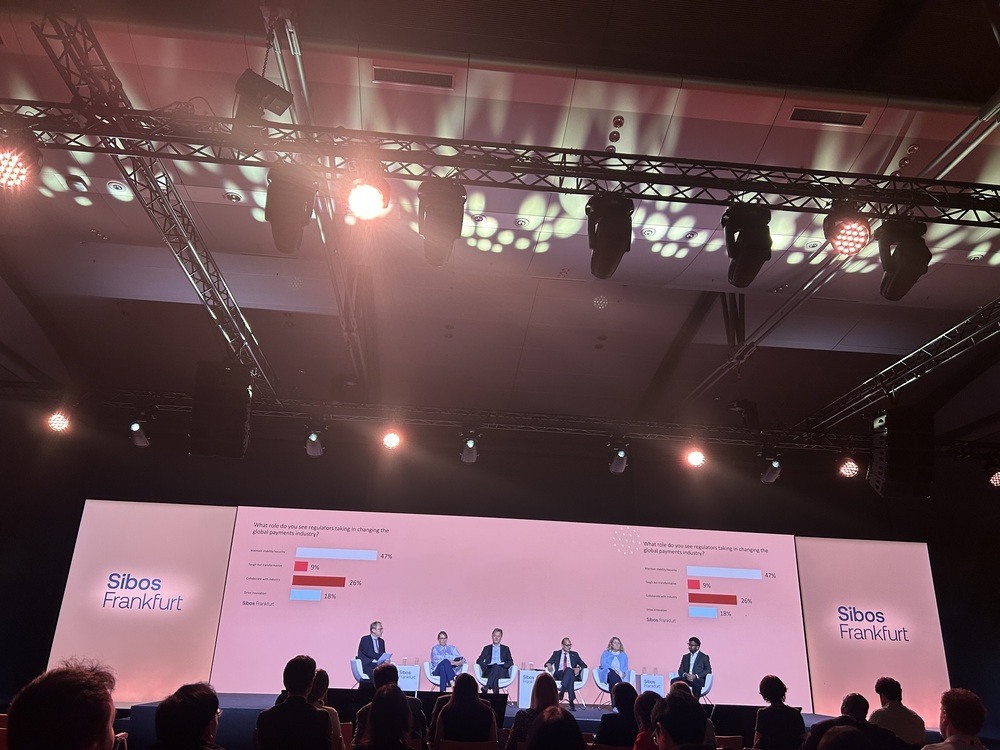
10:00 – Is more evidence-based regulation needed?
Fiona van Echelpoel from the European Central Bank opened a panel reiterating some of the rhetoric Europe has continued to “regulate things into existence”, but institutions are beginning to ask questions around evidence-based approaches to implementing new rules and updates.
JP Morgan’s Katja Lehr called on regulators to collaborate or provide accurate data during the consultation and research processes into embedding new regulations into their new or existing frameworks. She also believes cross-border regulations provide the perfect backdrop for this collaboration and dialogue, as there are many players involved in the process of settling payments cross-border.
“if you’re asking for change and players to implement new rules, and spend a lot of money on this, explain it to us, show us the hard facts so there is a reason for this”.
Thomas Egner from the European Banking Association (EBA), provided clarity on the regulatory journey agencies like his embark on. He stated for regulation to be fit-for-purpose, it must start due to the ending lifecycle of a regulation or rule and the EBA don’t just collaborate on specific rules or requirements, but towards an “overall goal”. He also revealed not to rule out the importance of self-regulation, particularly for cross-border payments as this takes a method of approach of “not innovating for the sake of innovating”.
09:40 – Saudi fintech ties take centre stage at Sibos
While the payments world gathers in Frankfurt, the announcements are spanning the globe, with Saudi Arabia once again emerging as one of fintech’s most attractive markets.
Today, Thunes revealed a new partnership with Banque Saudi Fransi (BSF) to expand international money transfers from the Kingdom, enabling faster, more secure access to accounts and wallets worldwide.
Simon Nelson, Chief Commercial Officer at Thunes, said: “Banque Saudi Fransi is a key player in Saudi Arabia’s banking sector. Together, we are reshaping how money moves out of the Kingdom, making transfers simpler, instant and more cost effective. This collaboration reinforces our deep commitment to Saudi Arabia, where we continue to build strong relationships with banks, fintechs and wallets, and the trust we have earned to support the country’s remarkable digital journey.”
09:25 – Is now the time for a “hybrid” model for TradFi and DeFi?
Decentralised Finance (DeFi) has exploded in viability and usability this decade, having even loaned its anagram to Traditional Finance (TradFi).
But as DeFi continues to develop in its still relevant infancy, financial services and institutions continue to ponder the question of how to properly embrace both fields in a bid to gain “the best of both worlds”. This was highlighted by Donna Milrod of State Street on the opening panel of Day 3 at Sibos.
She said the core value of custodial in TradFi is trust at scale, with trust in capital markets “absolutely key”. The question arises how to match the trust and reliability of TradFi with the daring innovation DeFi promises.
“DeFi is super exciting, but how do we get the best of both worlds?”, said Milrod.

Jens Hachmeister of Clearstream, believes the convergence of TradFi and DeFi will see this move into a “hybrid world”. He believes incumbents will need to move into this world and integrate market infrastructure to scale capabilities across traditional while at the same time embracing new asset classes and technologies. It’s a “new type of thinking” said Hachmeister. “Right now we operate in monolithic cycles, new perspective is along the line of moving along with the securities, your infrastructure needs to comply with the old world, while embracing the new capabilities. You want to be ready for tokenisation, CBDCs, stablecoins & crypto”
So, what should TradFi companies know about the benefits of integrating DeFi technology such as blockchain and distributed ledger technology (DLT)? Brian Steele of DTCC reveals the three key benefits:
- 1st: synchronisation of data & actors to a “golden source of truth” said Steele, that doesn’t exist today in financial services. He believes transactions have too many actors on one single trade.
- 2nd: distribution nature of tech enables 24 by 7 trade for many different asset classes. We’re hearing immediate value in tokenisation and collateral management. Breaking down barriers of operating hours that currently constrain those assets.
- 3rd: “probably the biggest” said Steele, is programmability of DLT that allows services to be programmed at the asset level, no longer consolidated, and now at the smart contract level that allows efficiency “that haven’t been experienced before in the past”.
09:00 – Vyntra and Clearstream extend partnership
Clearstream, part of Deutsche Börse Group, and Vyntra, formed from the union of Intix and NetGuardians, announced today the signing of an extended agreement to invest in next-generation technology to enable growth while enhancing the customer experience.
Through the extended partnership, Vyntra will provide Clearstream with advanced telemetry and business activity monitoring, strengthening visibility across its multiple transaction flows and increased transparency across the full lifecycle. This will deliver real-time insights into operational performance, while powerful anomaly detection and dynamic alerting capabilities help to identify and mitigate potential risks before they impact clients. Together, these capabilities support Clearstream’s objective of maintaining resilience and enhancing the customer experience in an increasingly demanding marketplace.
“This agreement with Clearstream demonstrates our shared focus for excellence in transaction observability and client experience,” said Joël Winteregg, CEO at Vyntra. With real time visibility and intelligent monitoring, Vyntra gives institutions like Clearstream the confidence to manage complex transaction flows while enhancing customer trust in an increasingly demanding marketplace.”

08:40 – Callum Williams here again checking in for Day 3 at Sibos. It’s set to be another action-packed day of engaging debates, conversations and discussions around how to smartly navigate varying regulations, preparing for digital assets, how to redefine cross-border payments and much more. But first, coffee.