Payment Expert is on the ground at Sibos 2025 in Frankfurt, giving you live coverage from all four days. Expect insights from some of the leading industry leaders engaging in conversations around fintech, payments, banking, digital currencies and much more.
16:00 – Day 2 is now in the books here at Sibos and what a day it has been. From broad discussions around the capabilities autonomous payments can have on growing Real-Time, Instant payment adoption, to the continued debates around digital currencies standing in a dominant fiat world, and insights into European competitiveness in a time of US growth.
I’ve been Callum Williams, and come back to Payment Expert tomorrow for regulatory standards opinions and cross-border discussions on Day 3.
15:30 – Finastra unveils new interoperable supply chain
Finastra showcased its Trade Innovation Nexus integration layer, designed to streamline and accelerate the adoption of its Trade Innovation software to simplify interoperability between bank systems and fintechs for trade and supply chain workflow automation.
The cloud-native solution aims to deliver a unified set of REST APIs, integration tools, and services that enable connectivity with Finastra’s Trade Innovation software and other third-party platforms and solutions, including core banking applications. It intends to reduce time to market for new services and supports banks’ integration needs across four capabilities:
- Maintain: Static data management – automates static or reference data maintenance, ingesting additional information needed to run the bank’s trade solution, e.g. system tailoring information
- Transact: Lifecycle management – automates workflow processing so users can act on transactions in their Trade Innovation software
- Build: Onboarding – simplifies onboarding by ingesting data from any upstream system, to create new transactions
- Connect: Pre-defined adapters – integration adapters connect to other platforms in the trade ecosystem
“This offering highlights our commitment to modernizing trade finance, supporting digital trade, and enabling secure and scalable integration,” said Rob Downs, VP of Product Management, Lending at Finastra.
“We’re proud of the scalability and resilience benefits it brings and are excited to empower banks to innovate, reduce integration complexity and costs, as well as enhancing agility and accelerating migration from legacy systems.”
14:45 – Is European confidence in competition dwindling?
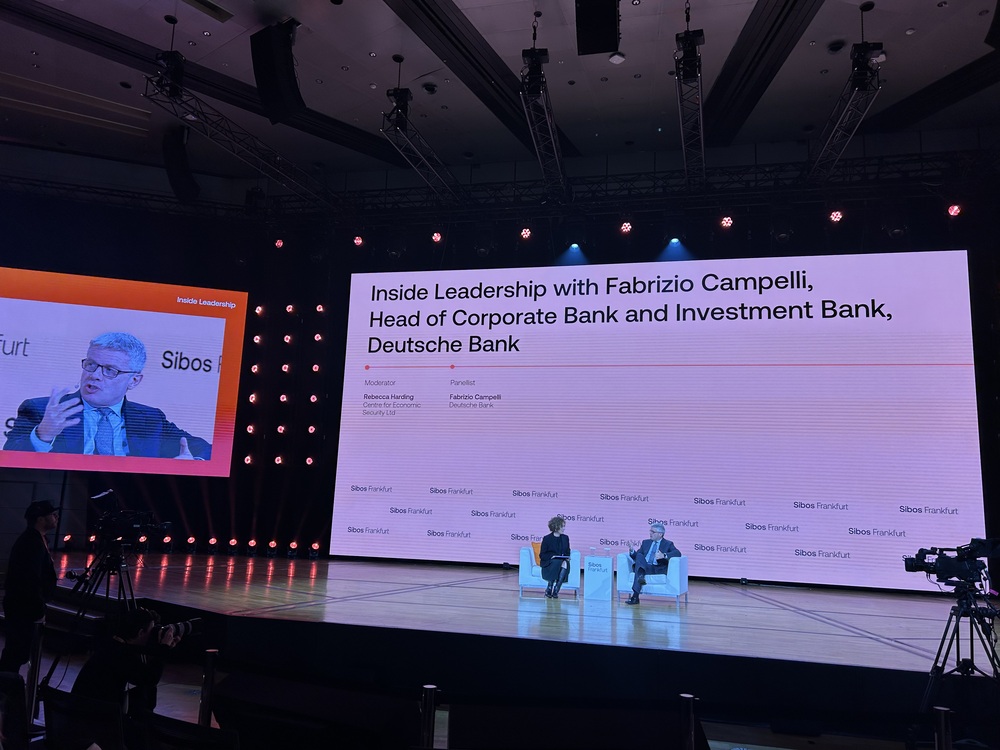
High energy costs, labour shortages and weaknesses in supply chains were some of the initial concerns raised by Fabrizio Campelli from Deutsche Bank at Conference Stage 1.
Campelli harkened back to the 2012 sovereignty crisis and why this made competition worse for Europe as the Euro began to be impacted and began a decade-long battle for it to compete against the US dollar for global trade.
His attention then turned to the current political and financial environment, where Campelli stated: ““Europe was not designed for the current environment. Not a union not structurally designed for power concentration, and AI developments.”
How to address this? Campelli noted two key aspects:
- Energy costs: Europe is struggling with, and will continue if EU imports more and pays more.
- The single market: EU has this superpower, said Campelli with 15% global GDP coming from the continent. But he admitted it is fragmented and does not trade within itself, with EU infringements by intervening between EU countries is 10% higher than previous years.
Is European regulatory focus hurting companies and competitiveness?
Europe is one of, if not the single largest regulatory power, enabling companies to operate in Europe as long as they comply with relevant regulations and guidelines.
However, this can also be seen as a deterrent for innovation and competition, in particularly as the US under President Donald Trump’s ‘deregulation’ strategy has seen multi-billion dollar investments into the country’s AI infrastructure and companies.
Campelli noted US’ AI regulatory easiness, highlighting the EU AI Act and why this may hurt AI startups in the long-run if it continues to hamstring these companies by complying with a myriad of rules.
14:00 – OpenPayd Director of Banking, Barry O’Sullivan, shares how consumers can grow their understanding of stablecoins
Speaking to Payment Expert, O’Sullivan highlighted the surging stablecoin market, expected to reach $2trn by 2030, as a means for financial service providers and issuers to begin educating everyday consumers on their ability to speed up their payments.
O’Sullivan’s views will be shared in full on video this week

13:45 – Stablecoins vs. CBDC’s: Round Three or interoperability?
Digital currencies, perhaps unsurprisingly, have dominated conversations at Sibos so far this week, and this intensified during a panel conversation around the two leading, emerging digital currencies; stablecoins and central bank digital currencies (CBDCs).
But unlike many blockchain and crypto advocates, there were stablecoin advocates on stage calling for more interoperability between the two digital currencies. Rene Michau from Standard Chartered, acknowledged both are in response of meeting customer needs.
He believes the advent of stablecoins will help change the velocity of bank balance sheets, integrated across global banks.
On the subject of globalised standards for both stablecoins and CBDCs however, Michau stated “there isn’t a uniform approach”.
“What’s likely to happen, clearing systems between CBDC and tokenised deposits ecosystems,” said Michau.
CBDC disruption
Remaining aligned with Michau’s interoperable and digital disruptive approach, Sophie Gilder from the Commonwealth Bank of Australia, believes digital currency disruption is “good for customers” and warned banks and other financial institutions that they can no longer ignore the surge in CBDCs and stablecoins.
“You think this is all going to disappear, think again. This is real”
13:15 – Visa expresses confidence in stablecoins
The payments giant will launch a stablecoin prefunding pilot through Visa Direct, making stablecoins a new funding source.
How will this work?
Visa’s system operates by requiring businesses to pre-fund their Visa Direct accounts with stablecoins rather than traditional fiat currency to cover their payout obligations. Visa then recognises these stablecoins as readily available “money in the bank”, which makes the funds accessible for immediate payouts.
“Cross-border payments have been stuck in outdated systems for far too long,” said Chris Newkirk, President, Commercial & Money Movement Solutions, Visa. “Visa Direct’s new stablecoins integration lays the groundwork for money to move instantly across the world, giving businesses more choice in how they pay.”
12:45 – Temenos Business Line Director – Payments, Mick Fennell, on why financial institutions may still be struggling with integrating cloud-native
Fennell spoke to Payment Expert on the infrastructural complexities as to why financial institutions continue to hesitate with cloud-native platforms, as well as what more can be done to enhance the adoption of these systems.
Fennell’s views will be shared in full on video this week
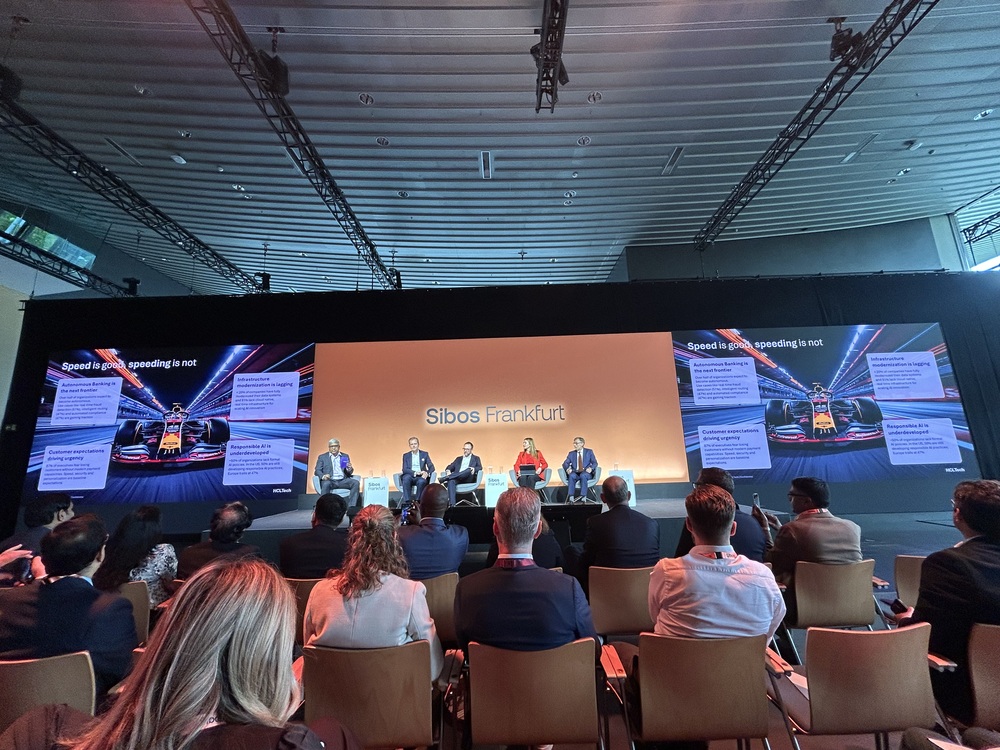
12:00 – The future of instant payments is autonomous?
On the same panel as Thalhamer, real-Time, instant payments have caught the attention of the globe, and the topic of conversation at Conference Stage 5 here at Sibos.
According to Mastercard’s Helena Forest, more than 100 countries now have access or are using instant payments.
“Next phase is interlinking,” remarked Forest.
“Interlinking is something we can support multi-lateral. Programmability is the next stage, more commerce payments for value will see that for both instant and programmable and there are many technologies that will enable them. It’s definitely coming.”
11:45 – Embedded solutions for SMEs
“Payments are embedded by nature, it’s a process method,” said Deutsche Bank’s Kilian Josef Wilhelm Thalhammer.
He delved deeper into the consumer and merchant needs for payments and whether it matters if payments are visible or invisible.
“We’re seeing different developments, to make payments as invisible as possible, and drivers from the market/regulators to ensure consumer is aware of the payments they are making,” said Thalhammer.
The arrival of AI-driven infrastructure’s has only made the integration of payment processing become more and more invisible, but is this necessarily a good thing? The autonomous nature of AI has the potential to accelerate payments to new speeds and heights, but Thalhammer argues payments for merchants will “never be invisible completely”.
11:30 – Industry reaction from new Swift blockchain ledger
| Hazem Mulhim, Founder and CEO at Eastnets: “Stablecoins represent a huge challenge to the payments system. They’re faster and cheaper to use. But they are also riskier because they sit outside existing safeguards. “SWIFT is now heading off the challenge with its own ‘shared digital ledger’. The key to success will be offering all benefits of stablecoins while cutting risk. Because digital money will only scale if it’s trusted. “To achieve this, fraud detection, AML and transaction monitoring need to be built in tandem with Swift’s shared digital ledger. Collaboration with fraud protection specialists, to ensure these transactions don’t cause greater vulnerability, to make this vision a reality.” |
11:00 – DBS Bank links up with Nium
Cross-border payments remain a prominent topic of discussion at Sibos 2025 and this partnership further contributes to the conversation.
Described as an “industry-first collaboration”, DBS will connect to Nium’s global platforms directly through Swift. This marks the first time a top-tier global bank is leveraging a modular integration which embeds Nium’s next-generation cross-border payment rails into its existing Swift architecture.
Following the deal, DBS will be able to send real-time payments to 190+ countries, without the need for a system overhaul.
10:20 – Formula One at Sibos
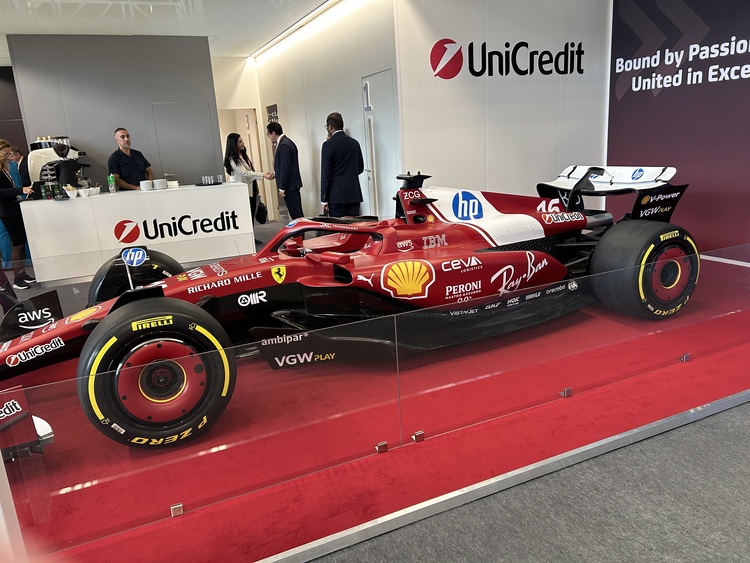
Financial service company’s have been some of the most prolific and visible sponsors of Formula One teams. Both UniCredit and Visa continue to showcase their respective Ferrari and Racing Bulls team sponsorships on the exhibition floor here at Sibos.

09:50 – JP Morgan Payments Global Co-Head: “There has been an explosion of innovation and needs”
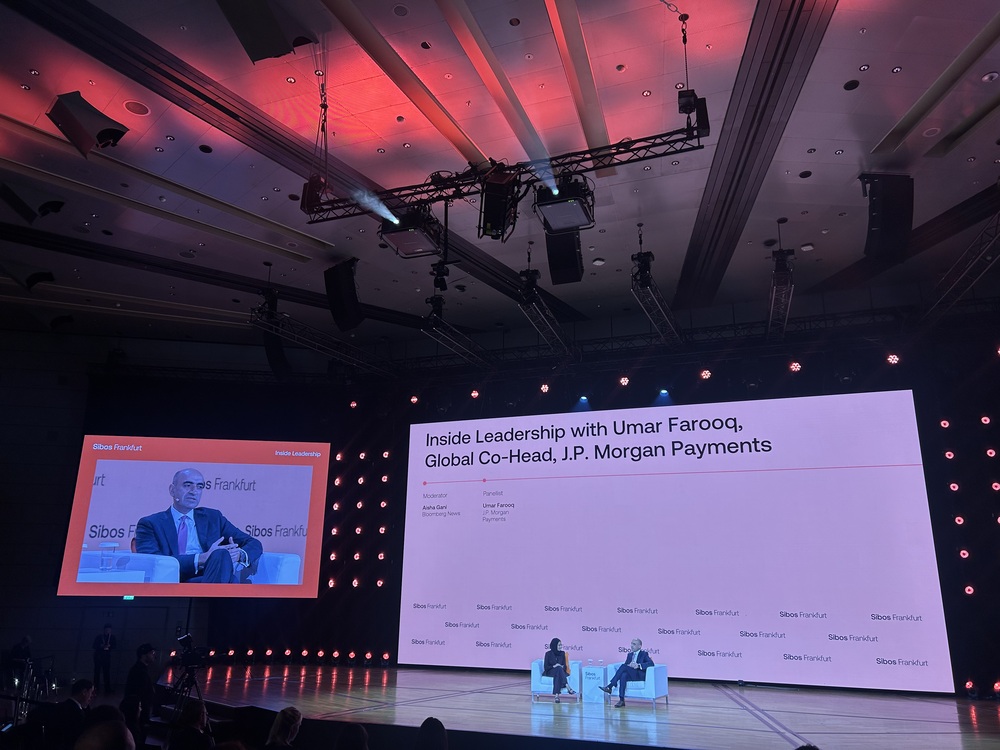
JP Morgan Payments Global Co-Head Umar Farooq took to Conference Stage 1 with Bloomberg’s Aisha Gani to share his thoughts on what the last several years of global payments has not only meant on the global stage, but also to him, consumers, clients and JP Morgan.
“Night & Day” difference
Farooq stated the difference in where the global payments industry was five years ago to where it is today is “night and day”. “When I Came in the space was still limited, treasury focused with old infrastructure,” said Farooq. “In the last five years, you almost have an explosion of payment needs, even as consumers, how many of us rely on phones for payments.
“It’s been an explosion of innovation and needs. It’s been a journey of getting faster and faster, I think the business now is a fundamentally different business, it’s more technology business now than ever”
“Digitisation has been the real innovation”
Real-Time Payments going global
Farooq then turned his attention to the rapid rise in demand from consumers on real-time, instant payments. Brazil with Pix and India with UPI have become the de-facto global leaders in this respect, but why is Europe and US lagging behind them?
“I think in other places like the US or even Europe, I don’t think real life payments have taken on quite the same pace (as Brazil and India), but that’s also because there’s an (traditional) infrastructure that existing,” said Farooq.
He also expounded on this point by explaining countries like India had an option to leave cash behind in favour of adopting a real-time payment rail like UPI as it did not have the established digital payment infrastructure in place beforehand what a market like the UK, for instance, already had.
How to become a payment leader? “It’s a combination of curiosity and paranoia”
Fintech ‘Frenemies’ and crypto “still mostly noise”
Drawing to a close, Farooq responded to Gani’s question of what the relationship between banks and fintechs stands in 2025. He likened fintechs as ‘frenemies’, needing one another to not only compete but to learn from one another. He also doubled down on a previous statement he made stating “crypto is just noise”, which he stood firm on, but noted the benefits Bitcoin holds as an institutional investment tool and the capabilities Ethereum’s blockchain can have on payment processing.
09:25 – The ECB are embracing DLT, but on their own terms
Florian Neuhaus and Dimitri Pattyn revealed the roadmap the ECB have embarked on when it comes to integrating DLT to the Eurosystem, having a profound effect on payments, settlements, bonds and more.
The two ECB members revealed they saw “big demand” from across the market which acted as a catalyst to not only begin implementing DLT systems across its infrastructure, but continually develop and test it capabilities while remaining as compliant and secure as possible.
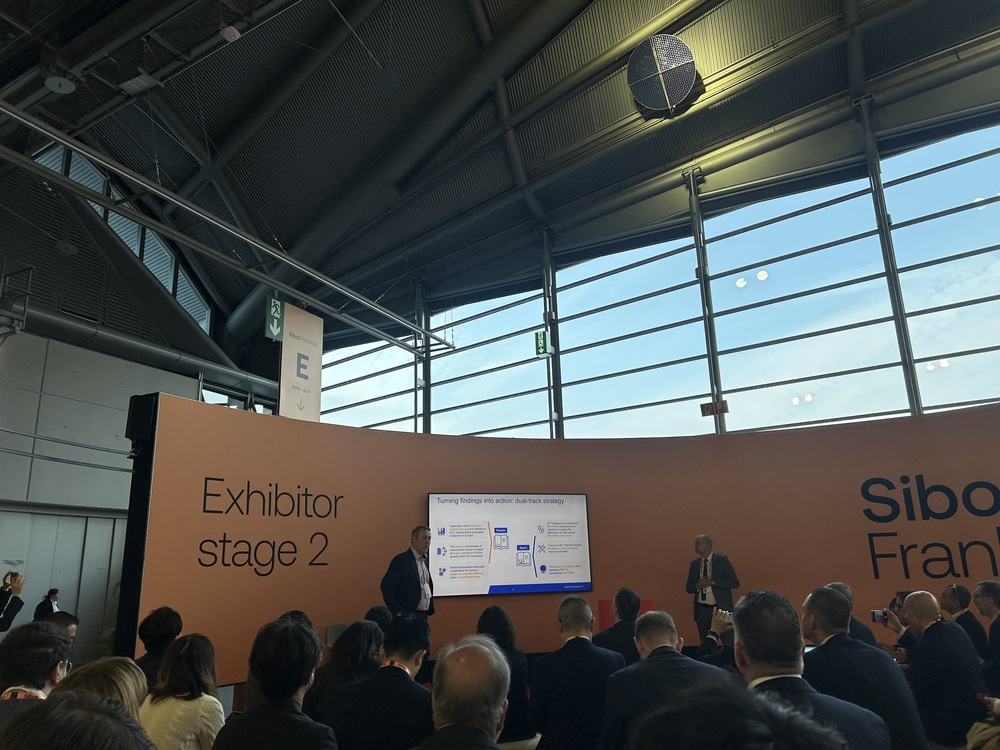
Neuhaus said the ECB has worked with 64 different market participants, ranging from central and commercial banks, to CSPs on pilot DLT programmes. The central bank has also worked on more than 50 experiments with DLT, covering payments use cases and automatically margining derivative contracts to open up new ways of helping businesses.
Central to this conversation was the use of DLT when designing the Digital Euro, Europe’s answer to act on the surging digital currency economy. Neuhaus said “Central bank money is an enabler for the (blockchain) market”, and while conversations today around stablecoins vs. CBDCs may heighten, Neuhaus believes this is all part of the ECB’s plan “leveraging all the possibilities DLT has”.
09:00 – We’re kicking things off with a discussion around Tokenisation and distributed ledger technology (DLT) with European Central Bank members (ECB) Holger Neuhaus and Dimitri Pattyn.

08:50 – Its Day 2 here at Sibos in Frankfurt. I’m Callum Williams and expect to hear lively conversations around the battle between stabelcoins and Central Bank Digital Currencies (CBDCs), embedded finance, and much more.