In iGaming payments, the brief is starting to look a lot like an F1 pit stop. Customers want to be in and out in seconds, but the only way to hit that speed is with choreography that never cuts corners.
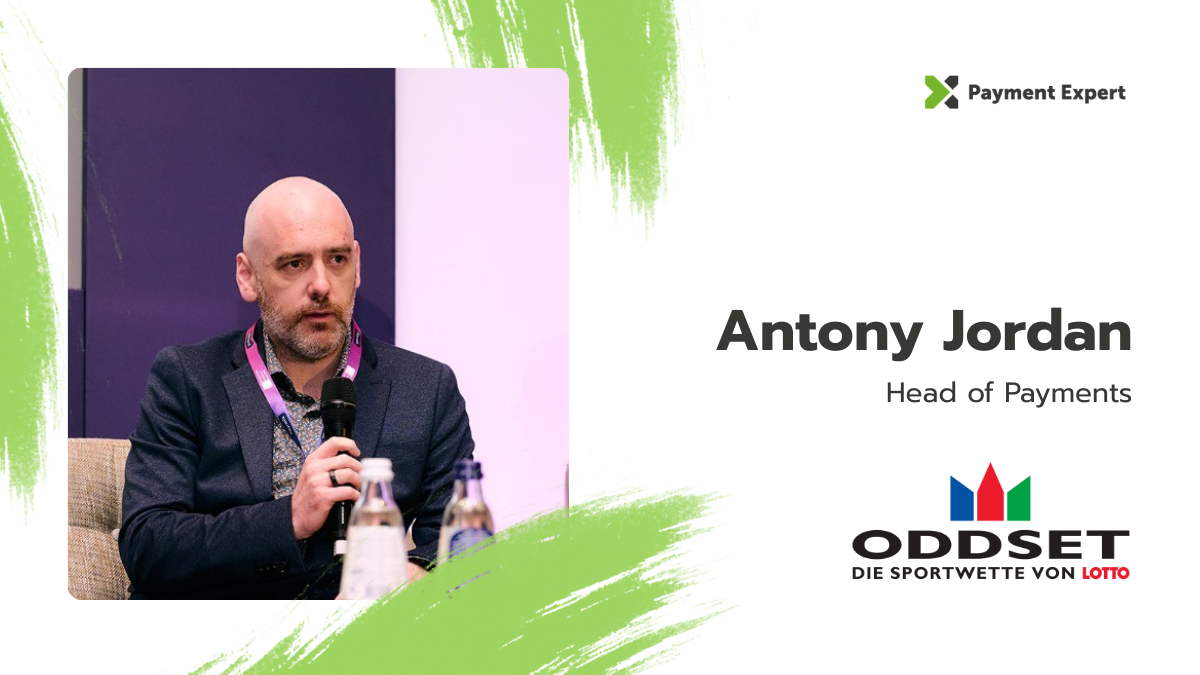
Speaking to Payment Expert, Head of Payments at ODDSET, Antony Jordan, says compliance should not be a brake on performance and instead be viewed as an operating system for a modern payments stack.
Jordan argues for a “compliance-first” product philosophy, where real-time data and AI are embedded in the flow rather than bolted on after the fact. The goal is modular infrastructure that can swap in new tools as regulation evolves, while still delivering a smooth deposit and withdrawal experience.
Looking ahead, he sees biometric authentication as the long-term login for a mobile-first sector, provided trust and legacy hurdles are handled on device. He also thinks the industry has homework to do on education, because most users care about outcomes, not acronyms.
And with A2A still underused beyond a few mature markets, the forthcoming SBC Summit Lisbon will be a timely stage to make the case for speed with control.
Read the full interview below.
Consumers now expect instant, seamless payments. What’s the biggest challenge in aligning backend payment infrastructure with those expectations?
The biggest challenge for operators is to balance the expectations of a frictionless user experience when making depositing and withdrawing funds with the regulatory and compliance obligations that accompany these transactions.
Thanks to a lot of hard work in the industry, the leveraging of real-time data from customer information, verification sources, and transactions has ensured that these regulatory and compliance obligations are met. The fact that these developments have kept pace with the change in consumer expectations has allowed operators to balance providing instant and seamless payment experiences with current regulatory frameworks.
As Head of Payments and KYC, how do you strike the right balance between a frictionless experience and robust compliance controls?
Operating in a highly regulated market and industry, I have found the best way forward is to embrace compliance as the driving force for both payments and verification.
Through the combination of customer and payment data, there is certainly enough information available to balance the provision of frictionless experiences for users that satisfy our internal ‘compliance first’ way of working as well as the requirements outlined by the regulator.
How are you currently leveraging AI or other emerging tech to improve fraud prevention and customer authentication at ODDSET?
As fraudsters are already using AI to circumvent anti-fraud measures in place at all iGaming operators – and they will continue to do so in the future in larger volumes and with more complex use cases – AI is a topic that everyone fighting fraud must embrace to level the playing field.
Synthetic identities to bypass KYC restrictions, account takeovers, and large-scale exploitation of promotional campaigns are already well-known ways that fraudsters leverage AI, and we are working with partners that are AI experts in many areas to mitigate risks and identify emerging patterns and fraud trends.
Omnichannel systems are gaining importance. How is ODDSET approaching the integration of online and offline payment experiences, particularly for cross-border expansion?
ODDSET does not operate in a cross-border capacity and our sole focus is the German market where cash still plays a large part in the makeup of how people make purchases. It is very important to understand the markets in which you are operating in and provide localised omnichannel solutions.
In Germany the big names in online payments are PayPal and Open Banking but customers are also wish to turn their cash into digital currency for use with online gaming operators. The classic ways of doing so are voucher solutions, such as PaySafe and Neosurf, but there is also a growing Cash to Digital channel that passes the requirement for buying a card and allows players to spend their cash through the scanning of barcodes and QR codes to fund gambling accounts directly.
All of these are individually important to cater to a wide range of users, but it is absolutely a requirement to offer them all in a combined product in order to provide a truly omnichannel experience.
With biometric authentication on the rise, do you see it as a long-term solution for the gaming sector, or are there too many barriers still in place?
I absolutely see biometric authentication as the long-term solution for the iGaming sector. Considering that the vast majority of gambling traffic is done via mobile devices and users are familiar with face/fingerprint verification, this is certainly something that can be leveraged to enhance, or even replace, username/password security for more secure access to accounts, and to assist in preventing account takeovers.
In the short-term, there are certainly barriers still in place with user trust and acceptance, as well as updating legacy systems providing challenges. Utilising solutions where user data never leaves the device will drive user confidence in the security of their data, will accelerate this process but we are still some time away from complete acceptance of biometric authentication.
From a regulatory and KYC standpoint, how can operators stay agile as customer expectations evolve faster than legislation?
Customer expectations in 2025 are for a seamless and personalised experience from onboarding through depositing, gameplay, and withdrawing funds. Each of these areas are heavily touched by ever increasing regulation aimed at player protection and the prevention of financial crime. Providing a satisfying customer experience whilst remaining compliant requires operators to combine their data with the latest industry tools, and the application of AI as an important tool that can be used throughout the business is a key requirement.
Front-end usage of AI allows individual customers to be provided with personalised sessions – with betting markets, bet types, and payment methods all provide competitive advantages – to help build brand loyalty, while real-time transaction and gameplay monitoring via AI integration in the data layer ensures that the equally important regulatory compliance side is also met.
What does the “right infrastructure” look like in 2025 and how do you future-proof payment systems while maintaining compliance and user trust?
I imagine that if you asked 100 people this question, there would be 100 different answers, depending on the needs of their businesses, their on-site offerings, and in which jurisdictions they offer their services. For me, part of the answer is touched on in the question as the “right infrastructure” in 2025 requires being future-proofed from the very start through modularity allowing the update, replacement and/or addition of new segments and tools to the payment stack in an agile fashion. As touched on in previous answers, having AI working with the company data to understand customer needs and ensure compliance with regulatory requirements is also at the top of pile.
Having access to the payments infrastructure in this modular manner allows operators to maintain pace with the ever-changing compliance requirements, while providing customers with what they are looking for in a gambling product. All of this combined allows customers to feel safe and heard, driving user trust forwards.
Do you think the payments industry is doing enough to communicate the value of innovation to end-users, or is there still an education gap?
As someone who has worked with payments for more than a decade, I have been asked on more than one occasion “What is it that you actually do?” and this, for me, highlights the gap between what the payments industry does with innovative new methods and how end-users see payments.
For the majority of users, they just care that their payments – whether gambling related or not – are sent and received quickly and safely, and not how these innovative methods provide value and improvement on the more well known and used methods.
To change this, it will require the payments industry as a whole to provide wider reaching, more localised, and easier to digest communication campaigns on the benefits of new and improved payment solutions to close the education gap and enhance user trust in these new methods.
You’ll be speaking on a panel at SBC Summit later this year. What are you most excited to contribute to the discussion, and why should operators and suppliers attend?
I will be speaking at the SBC Summit in Lisbon in September and I am very much looking forward to sharing the stage with some very smart people with great insights from across the payments industry. I wish to thank SBC for their invitation to participate in the Lisbon Summit in such a way.
As someone that operates in the German market where A2A payments and Open Banking have been well used for a long time, I am hopeful that I will be able to shine a light on what is an underutilised, but quickly growing, payment method in many other markets and jurisdictions.
SBC Summit will take place from 16–18 September at the Feira Internacional de Lisboa and MEO Arena, bringing together 30,000 industry stakeholders for an unmissable three-day experience.
Looking to attend? Here’s how:
- Secure your place with a VIP Event Pass – Enjoy full access to all conference sessions, the exhibition floor, exclusive networking events, and complimentary food and drink throughout the summit.
- Bringing the team? Take advantage of our Group Pass Discount — purchase three or more VIP Event Passes and pay just €400 per ticket (saving €200 off the standard price).
- Operator or affiliate? You may be eligible for a complimentary VIP Event Pass, which includes full access to the exhibition, conference, and exclusive networking events. Apply now to reserve your spot.
- Expo+ Pass: Gain access to the full exhibition floor and all conference sessions across the three days. This does not include access to our exclusive VIP evening networking events.