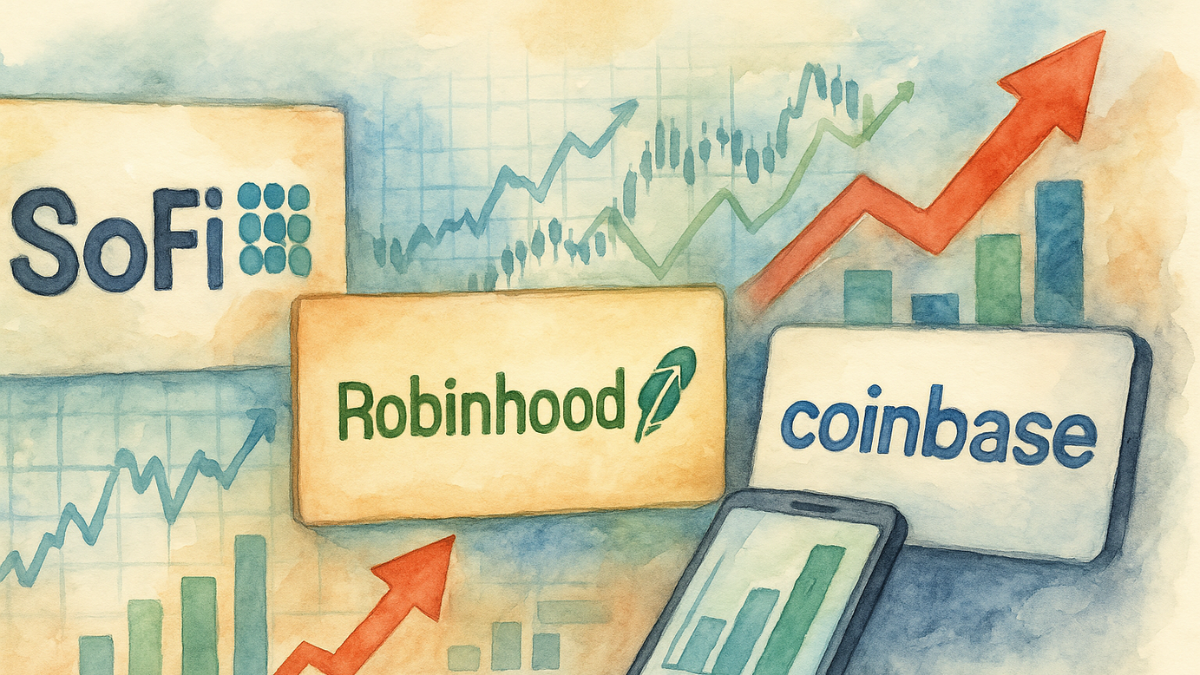
Three fintech giants, three strategies, and one shared reality: the age of easy disruption is over. As SoFi builds a bank, Robinhood scales its trading empire, and Coinbase redefines digital money, their Q2 results show how each is adapting to a financial landscape that increasingly favours maturity over momentum.
When the term “fintech” first emerged in the early 1990s, it described little more than a back-office experiment at Citigroup, a modest attempt to fuse finance and technology.
Today, it defines a multi-trillion-dollar reordering of global capital flows, banking infrastructure, and consumer habits. But for all the disruption promised by this portmanteau, its most influential champions are now facing a different test: maturity.
The latest quarterly results from SoFi, Robinhood and Coinbase reveal three distinct paths toward that future. One is building a bank, one is scaling a brokerage, and one is remaking the rules of money itself.
Each is deploying different rails – some fiat, some tokenised, some regulatory – in a bid to claim relevance not just as fintechs, but as foundational financial institutions.
| Metric | SoFi | Robinhood | Coinbase |
| Total revenue (Q2) | $854.9m | $989m | $1.5bn |
| Net income | $97.2m | $386m | $1.4bn |
| Adjusted EBITDA | $249m | $549m | $512m |
| Revenue growth y-o-y | 44% | 45% | Not disclosed |
| Users/members | 11.7 million | 26.5 million | Not disclosed |
| Transaction revenue | Not disclosed | $539m | $764m |
Divergent engines of growth
Each firm’s earnings tell a distinct story about its business model.
Once dismissed as just another neobank, SoFi now looks increasingly like a full-stack financial institution. In Q2 2025, it posted adjusted net revenue of $858 million, up 44% year-on-year, alongside GAAP net income of $97 million, its seventh consecutive quarter of profitability.
The firm’s adjusted EBITDA surged 81% to $249 million, supporting a strong margin of 29% and affirming the leverage in its business model.
Robinhood, meanwhile, remains tightly tethered to trading volumes. Revenues jumped 45% YoY to $989 million, largely driven by transaction-based revenue, which soared 65% to $539 million. Crypto trading revenue alone nearly doubled to $160 million.
Net interest income rose to $357 million (up 25% YoY), while Robinhood Gold, its premium product suite, added 1.5 million new subscribers, reaching 3.5 million total.
Coinbase posted the highest top-line of the three, with $1.5 billion in total revenue, but this included a one-time $1.2 billion gain from strategic investments. Core operating income was more modest: transaction revenue dropped 39% QoQ to $764 million, while subscription and services revenue held steadier at $656 million.
Platform scale and user engagement
SoFi’s membership growth continued at pace, climbing 34% to 11.7 million, while total products reached 17.1 million, driven in large part by its financial services flywheel – a strategy that emphasises cross-selling between deposit, lending and investment products.
Nearly 90% of product growth came from this segment, which now generates $98 in annualised revenue per product, up 52% year-on-year.
On the technology side, Galileo, SoFi’s B2B infrastructure arm, added marginally to performance, with revenue up 15% year-on-year. SoFi continues to diversify its client base here, recently adding Banco Nación in Argentina to its digital banking portfolio.
Robinhood added 2.3 million funded customers (now at 26.5 million) and saw a 99% increase in total platform assets to $279 billion, boosted by both valuation gains and crypto acquisitions. The firm’s Robinhood Retirement AUC climbed 118% to $19 billion, and margin balances nearly doubled to $9.5 billion
Coinbase’s user numbers were less prominent in its Q2 disclosure, but assets under custody rose to $245.7 billion, underpinned by $1 billion + in open institutional loans and steady USDC growth. The company continues to lead in global crypto custody, even as trading activity softened.
Charter vs. chaos
Among the three, SoFi arguably holds the cleanest regulatory footing, leveraging its national bank charter to operate across lending, deposits, and card issuance. This clarity is helping it outpace fintech peers in cost of capital and compliance overhead.
Robinhood’s regulatory profile is more layered. In Q2, it closed the acquisition of Bitstamp, bringing with it 50+ crypto licenses globally. It also signed a deal to acquire Canada’s WonderFi, expanding its digital asset reach—but also inviting new compliance complexity. Operating as both a broker-dealer and crypto platform across multiple jurisdictions adds friction as rules evolve.
Coinbase remains at the centre of the crypto regulatory battleground. Despite securing a MiCA license in Luxembourg—allowing pan-European crypto operations—the company still faces litigation in five US states, even after the passage of the CLARITY and GENIUS Acts, which introduced federal rules for stablecoins and crypto brokerages.
Infrastructure as identity
What binds these platforms together is their ambition to build financial rails, not just products.
SoFi continues to invest in embedded finance and personalisation, leveraging its tech platform to power third-party fintechs while offering in-house lending, credit, and money management products. Its bank charter also allows real-time payment experimentation that others can’t yet match.
Robinhood is leaning into product breadth: the launch of stock tokens in Europe, crypto staking in the US., and the growing adoption of Robinhood Legend tools among power traders all point toward a future as a hybrid investment/payments platform. Gold subscribers and retirement AUC gains signal a user base staying engaged beyond initial trades.
Coinbase, meanwhile, is doubling down on its identity as infrastructure-first. From Base chain decentralisation to USDC monetisation via Shopify and the upcoming Coinbase One card, the company is building payment and identity rails for Web3 commerce. Its acquisition of Deribit, a crypto options exchange, further underscores its institutional ambition.