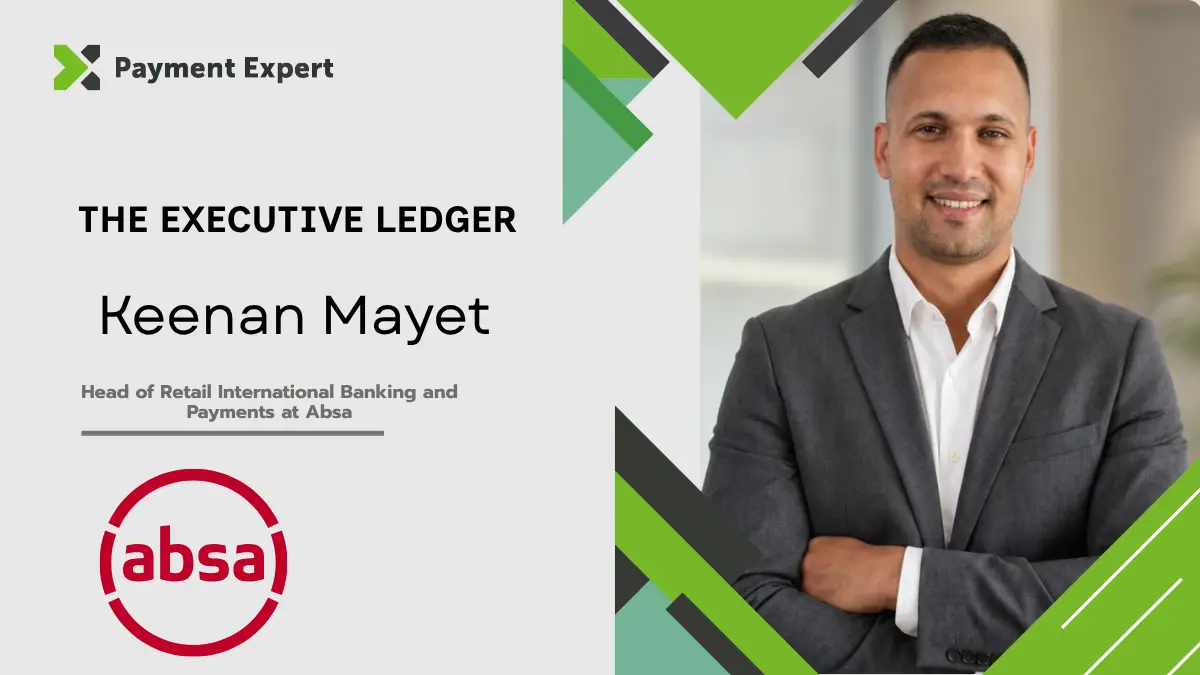
Keenan Mayet, Head of Retail International Banking and Payments at Absa, explains why South Africa has an opportunity to build for the future rather than replicate the past.
South Africa’s financial system is caught between two economies, one regarded as a leader in digital finance and the other still reliant on cash.
Because of this two-tier economy, banks must design products that serve both realities. Absa is doing so by removing friction between cash and digital payments and using partnerships like its collaboration with Thunes to modernise the remittance corridors that connect underbanked communities to the financial system.
Keenan Mayet, Head of Retail International Banking and Payments at Absa, spoke to Payment Expert about the bank’s approach to South Africa’s two-tier economy, why PayShap’s next chapter depends on merchant adoption and how the country’s young, digitally native population could allow it to leapfrog legacy card infrastructure.
Read the full interview below.
How can Absa design products that genuinely connect digital-first consumers with those who still rely on cash in South Africa’s two-tier economy?
South Africa’s reality is that digital and cash economies will coexist for some time. The objective therefore is not to force customers away from cash, but to remove the friction between cash and digital ecosystems.
The most impactful solutions are those that meet customers where they are. Whether a customer receives money digitally, pays electronically, or needs access to cash, the experience should be simple, affordable and seamless. That means leveraging trusted channels such as retailers, ATMs, mobile banking platforms and emerging digital ecosystems to create bridges between the formal and informal economy.
Ultimately, financial inclusion is not about digitising payments alone. It is about enabling greater economic participation. If digital payments help people transact more conveniently, manage money better and access broader financial services, adoption becomes a natural outcome rather than an imposed behaviour change.
What needs to happen for PayShap to move beyond P2P and become a daily payment method in township and informal-market commerce?
PayShap has already proven that South Africans value instant payments. The next chapter is merchant payments.
For PayShap to become part of everyday commerce, it needs to solve a simple question for both consumers and merchants: why should I use it instead of cash? The answer lies in convenience, accessibility and ubiquity.
The introduction of the PayShap QR standard is an important milestone because it creates a common and interoperable acceptance framework across the industry. Rather than a fragmented market of proprietary solutions, merchants can increasingly participate in a broader ecosystem where accepting digital payments is simple and affordable.
For townships and informal-market merchants, the benefits are compelling: instant settlement, improved cash flow, reduced cash-handling risks and lower barriers to entry. Once consumers can confidently use PayShap to pay for everyday purchases such as transport, groceries and community services, we move from person-to-person payments to a truly digital commerce ecosystem.

/ Shutterstock.com
How can Absa’s partnership with Thunes help modernise remittance corridors and expand financial inclusion for underbanked communities?
Remittances remain one of the most important financial flows across Africa, yet many corridors continue to face challenges related to cost, speed and accessibility.
Our partnership with Thunes helps connect Absa to a global digital payments network that can enable faster, more transparent and more convenient cross-border payment experiences. By linking accounts, wallets and various payout mechanisms, we can reduce friction for customers sending and receiving money across borders.
The broader opportunity extends beyond payments. Every digitally received remittance creates a potential entry point into the formal financial system. It enables customers to establish a financial footprint and gain access to additional services such as savings, insurance, payments and credit solutions. That is where the real inclusion opportunity lies.
South Africa has the potential to leapfrog legacy card infrastructure. What possibilities open up when an ecosystem builds natively for mobile-first, instant account-to-account payments?
South Africa has a unique opportunity to build for the future rather than replicate the past.
Mobile-first, instant account-to-account payment infrastructure allows us to rethink commerce from the ground up. Solutions such as PayShap QR create the foundation for low-cost, real-time merchant payments that can scale across both formal and informal sectors.
What makes this particularly exciting is South Africa’s demographic profile. We have a young and increasingly digital population. Gen Z and Gen Alpha are growing up with very different expectations of money compared to previous generations. They expect transactions to be instant, embedded, contextual and increasingly invisible within the digital experiences they use every day.
Modern payment rails therefore become more than payment infrastructure. They become platforms for innovation. Whether that is embedded finance, programmable payments, digital currencies or emerging forms of agentic commerce where intelligent digital assistants transact on behalf of customers, the underlying requirement remains the same: trusted, interoperable and real-time payment infrastructure.
The decisions we make today will determine how effectively South Africa competes in the digital economy of tomorrow.
What practical incentives or value-added services could make digital acceptance more compelling than cash for micro-merchants?
Micro-merchants adopt solutions that solve real business challenges. Technology itself is often secondary.
Instant settlement is a powerful starting point because it improves liquidity and gives merchants immediate access to funds. However, the real value comes from the services that sit around the payment.
Digital transaction histories can help merchants manage their businesses more effectively through record keeping, sales tracking and business insights. Over time, those same transaction histories can create opportunities to access working capital and other financial services that may previously have been unavailable.
When digital payments evolve from a method of acceptance into a tool for business growth, merchant adoption becomes far more sustainable.
With PayInc and regulatory modernisation underway, what excites Absa most about the current collaboration between banks, fintechs and the central bank?
What excites me most is that the industry is increasingly solving problems collectively rather than individually.
The modernisation of South Africa’s payments ecosystem requires collaboration between banks, fintechs, payment providers, industry bodies and regulators. No single participant can achieve the desired outcomes in isolation.
The progress made through initiatives such as PayShap and interoperable merchant payment standards demonstrates what is possible when the ecosystem aligns around common goals. We are creating infrastructure that promotes competition, innovation and inclusion while maintaining the resilience and trust that underpin the financial system.
The result is an ecosystem that is not only more effective today but is also better positioned to support the next generation of payment innovation.
As more informal transactions migrate to digital rails, what possibilities open up for using payment-data insights to serve underbanked communities?
The transition from cash to digital payments creates something incredibly valuable: visibility.
With appropriate customer consent and robust governance, digital payment data can help institutions understand needs more accurately and design solutions that are more relevant and accessible.
For consumers, this can enable more personalised savings, credit and financial wellness solutions. For informal businesses, transaction histories can help establish a financial identity that supports access to funding and growth opportunities.
Importantly, this is not simply about data. It is about creating pathways to greater financial inclusion. As more South Africans participate in the digital economy, payment insights can help us better understand underserved communities and develop solutions that enable broader economic participation and financial empowerment.

The Executive Ledger is Payment Expert’s new leadership series spotlighting senior payment executives across the global banking sector. The series explores how systemic institutions are responding to regulatory reform, real-time infrastructure demands, fraud risk, and intensifying competition in the payments market.
If you are a senior payments leader within the banking industry and would like to take part, please contact Senior Journalist Kieran O’Connor at [email protected].