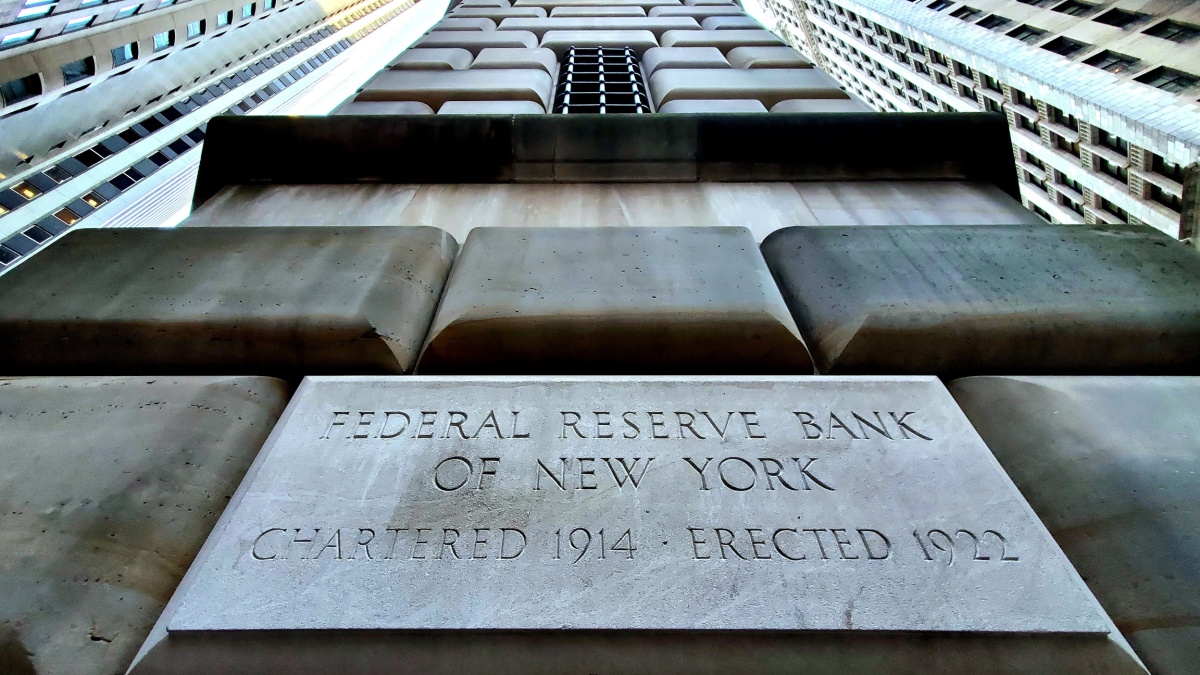
A new Federal Reserve Bank of New York working paper argues that the optimal design of tokenised money depends not on technology, but on how regulation and bank risk-taking interact.
Stablecoins can discipline risky banking, according to findings from a new working paper published by economists at the Federal Reserve Bank of New York.
The paper Stablecoins vs. Tokenized Deposits: The Narrow Banking Debate Revisited, which revisits the narrow banking debate through the lens of blockchain-based money, studies how the form of money used in crypto transactions affects “interest rates, investment, and welfare”.
Todd Keister and Xuesong Huang of Sun Yat-sen University conclude that the desirability of stablecoins, tokenised deposits, or competition between the two depends on regulatory costs and the extent to which banks are incentivised to take excessive risk.
A new monetarist framework?
The paper uses a dynamic general equilibrium model which introduces risky bank investment, safe storage (government debt or equivalent), government deposit insurance, and a regulatory tax on bank deposit.
Stablecoins in the model are fully backed by safe assets, while banks issue both traditional and tokenised deposits to fund portfolios of safe and risky projects.
The authors explicitly link the debate to historic narrow banking proposals. “The tradeoffs between these policies are reminiscent of both historical and recent debates over the desirability of narrow banking,” they write.
Unlike traditional narrow banking proposals, however, the reform examined here applies only to tokenised money used in blockchain-based trade.
When money type is irrelevant
The authors begin with a simplified case in which bank investment is risk-free and there is no regulatory tax. In this environment, they establish what they call a neutrality result. “In the absence of additional frictions, the type of money used in crypto trade is irrelevant”.
Stablecoins and tokenised deposits may circulate in different proportions, but allocations remain unchanged. It is only when risk and regulation are introduced that the composition of money begins to matter.
In the full model, banks invest in risky projects that fail with probability π. Deposits are insured by the government. Regulation is captured as a tax on banks’ deposit liabilities. The authors describe this tax as representing “capital requirements, leverage restrictions, and deposit insurance premia.”
With these frictions, they find that “the composition of money used in crypto trade between stablecoins and deposits matters for equilibrium allocations.” The equilibrium outcome depends critically on regulatory cost. When this cost is high, stablecoins dominate. When it is low, tokenised deposits dominate. In between, both coexist.
Deposits-only: more credit, less trade
The first policy alternative examined is a deposits-only regime, in which only banks may issue tokenised money.
If stablecoins are active in the baseline equilibrium, imposing this restriction leads to a fall in the deposit rate and an expansion in bank-funded risky investment.
As the authors put it, the model captures “a key element of the argument people make for this policy: discouraging stablecoin use leads to an increase in bank credit and higher investment”.
But the policy also reduces decentralised trade. Proposition 5 shows that a deposits-only regime “weakly decreases the equilibrium deposit rate” and reduces trading in type 2 meetings.
Whether this raises welfare depends on the social return of the marginal project banks fund. If that return is lower than the safe rate, restricting stablecoins is undesirable. In other words, if moral hazard is sufficiently severe, expanding bank balance sheets reduces welfare.
Stablecoins-only: constraining risky banks
The second alternative is to impose narrow banking for tokenised money – allowing only stablecoin issuers to create it.
Under this regime, “a stablecoins-only policy strictly increases the equilibrium deposit rate. Total safe asset holdings strictly increase, and risky investment strictly decreases”. Banks shrink, risky lending declines, and more money is backed by safe assets.
The welfare impact depends on whether banks were previously overinvesting in risky projects. The authors conclude that “a stablecoins-only policy can raise welfare if banks’ risk-shifting incentive is large and regulation is light”.
In such an environment, banks “tend to overinvest in risky projects,” and limiting their ability to issue tokenised money improves outcomes.
Competition as the middle ground
“In between these two cases, the optimal policy is to allow stablecoins and tokenized deposits to compete,” the authors write.
In this configuration, stablecoins intermediate safe assets efficiently, raising deposit rates and reducing incentives for banks to fund lower-return projects. At the same time, banks continue to fund higher-return investments.
The authors emphasise that the answer is structural. The desirability of narrow-style tokenised money depends on regulatory costs and moral hazard distortions within the banking system.