Open banking may offer speed and lower costs, but speakers at the Payment Expert Summit warned that fragmented regulation remains the biggest hurdle to meaningful adoption.
At the Payment Expert Summit in Lisbon, Flutter International’s Director of Payments Olga Gunchenkova made a remark which caught the room off guard: “Open banking bypasses the chain of regulators, making payments faster and cheaper.”
Her words cut to the heart of a debate which is gathering pace across financial services. Open banking, the framework that allows consumers to share financial data securely through APIs, has already transformed payments in Europe and the UK.
By offering a direct alternative to card rails, it promises lower costs for merchants and greater control for consumers. Coupled with the decentralisation trend in finance, it is seen as a route to faster, more seamless transactions – and, for some, a way of reshaping the entire financial ecosystem.
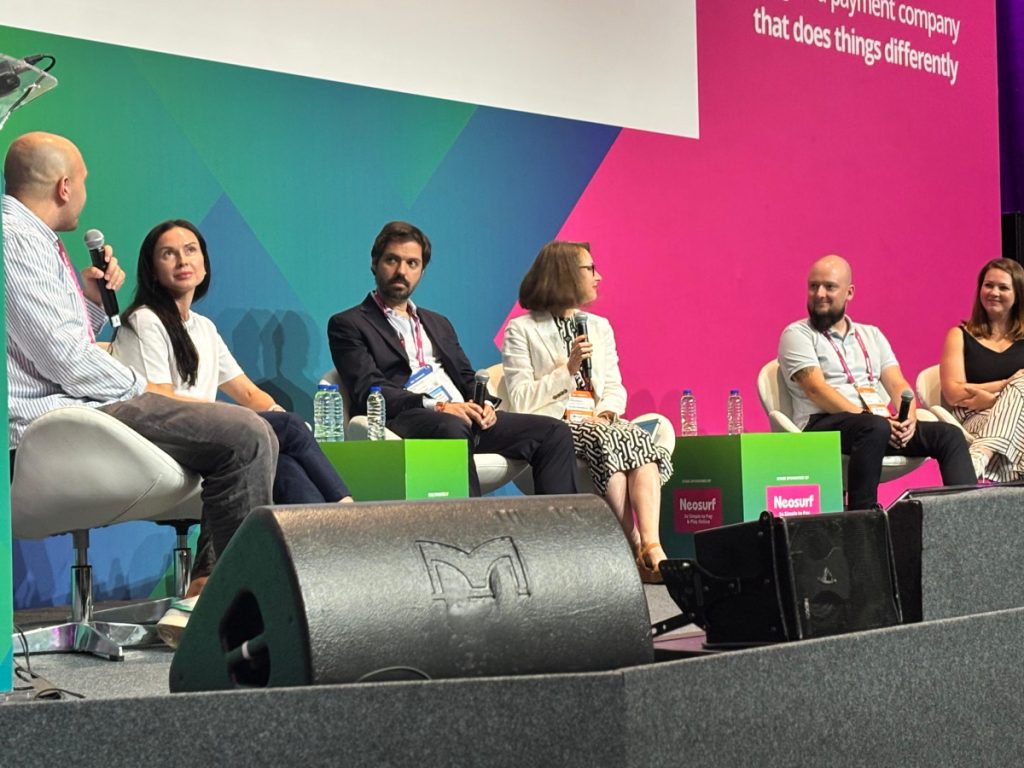
Yet the pace of adoption has been uneven. The UK and EU are furthest ahead, thanks to PSD2 and subsequent regulatory mandates, while Latin America has moved quickly with government-backed initiatives in Brazil and Mexico. The US, meanwhile, is still reliant on industry-led standards. The result is a patchwork of progress, where the opportunities are clear, but so are the hurdles.
Gunchenkova framed that tension directly. While open banking strips away intermediaries and delivers efficiency gains, the compliance burden remains heavy. “We cannot underestimate the compliance burden,” she added. “For operators, the challenge is to deliver seamless payments without adding friction, even as each market takes a different regulatory path.”
From the operator perspective, Rolands Grancovskis, Group Head of Payments at The Lotter Group, highlighted how instant settlement already makes a tangible difference. “The cash flow solution is huge… having funds available instantly, not next week when the jackpot will fall down, is a huge benefit,” he said.
But he also pointed to functionality gaps that limit how far the model can go: “Of course, there is still a lot of gaps. You mentioned recurring payments is an issue. One of the products I provide is a subscription, which I can’t do with open banking.”
Grancovskis noted that innovation in other regions may help close this gap. “In Brazil, PIX introduced PIX Automatico in July. I’m not ready with it yet, but it looks like it’s going in the right direction,” he said.
One approach does not fit all
The panel also reflected on the differences in adoption across markets. Nataly Shpak, CFO of 13Aff, observed the UK has been a “pioneer” in open banking. “We already see about 13 million customers using open banking day-to-day, and the products which are built on top of the open banking ecosystem are very promising,” she said.
But she cautioned against assuming that success is uniform: “In Europe, the infrastructure is more fragmented, so there is no standard APIs, and the adoption varies from country to country.
Martinho Lucas Pires of Portugal Fintech and BlockReg Advisors argued uneven regulation is at the heart of this divergence. “I think that open banking is above all a regulatory question… the problem is not in the regulations per se… it is in the application of those regulations and how banking supervisors in specific countries protect their national systems and their national APIs to prevent competition coming from abroad,” he explained.
He added other jurisdictions – Brazil, such as India, some Eastern European countries – were moving faster than a lot of western markets and were “pretty well developed” in his view.
UX at the heart of the opportunity
For Elaine Smith, Head of Partnerships at Volt, consumer experience remains the most immediate obstacle.
“Until the user journey is significantly improved, that is a barrier to entry today when you have a very quick checkout with an Apple Pay,” she said. UX, she suggested, will determine how quickly adoption scales: “We want to make sure the barrier for the consumer isn’t restricted from that and I think the UI, the UX we generally see in Europe, sometimes there is a barrier to entry.”
Moderator Pavel Dergachev, advisor and co-founder at 4H, closed the session with the central question: is the industry truly ready for a decentralised financial ecosystem?
The discussion suggested while open banking is already changing the way payments are made, its future depends on bridging regulatory divides, closing functionality gaps, and improving user experience. Gunchenkova’s remark served as a reminder of the paradox at its core: the very qualities which make open banking appealing – speed, cost efficiency and simplicity – are those that regulators find hardest to reconcile.