
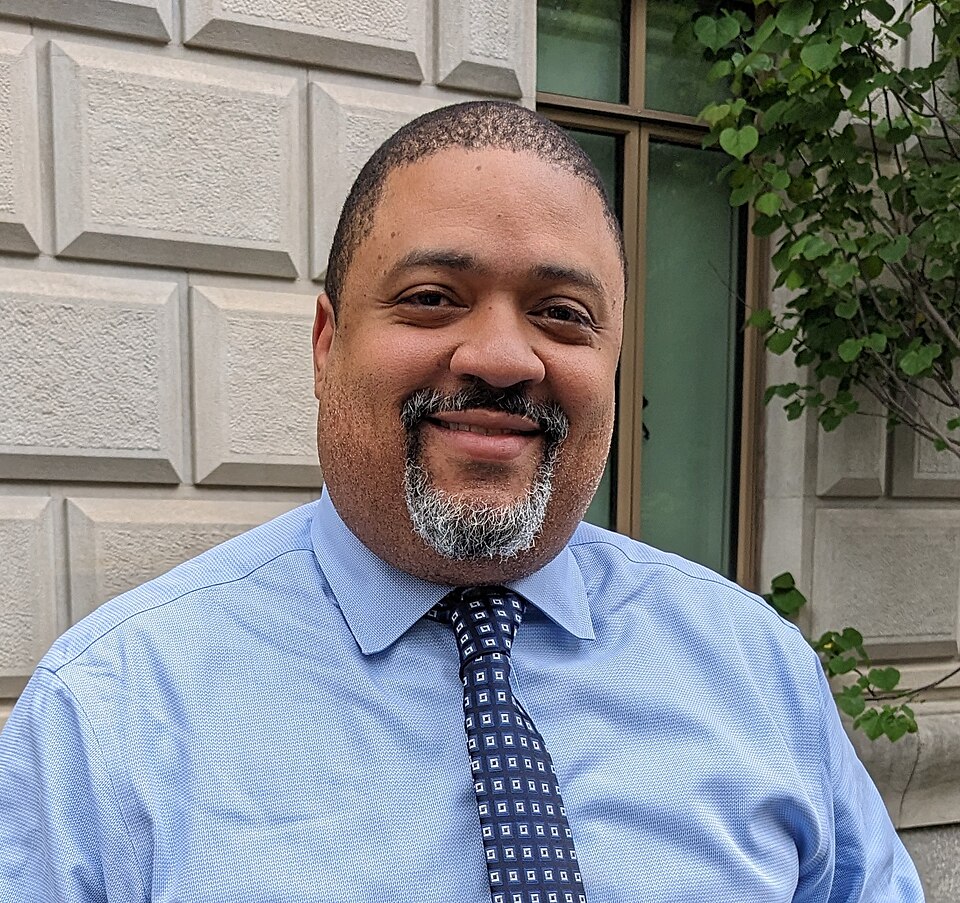
New York’s Manhattan District Attorney Alvin Bragg has called for criminal penalties against unlicensed crypto businesses, arguing that gaps in licensing and oversight have allowed digital assets to become a scalable conduit for illicit finance.
Speaking at New York Law School during a Centre for New York City and State Law event, Bragg placed crypto alongside gun violence and organised retail theft as a priority area for prosecutors, describing it as an example where traditional enforcement tools have failed to keep pace with how value now moves through the economy.
“We need systemic accountability like on steroids here,” Bragg said, framing crypto not as a speculative asset class but as financial infrastructure increasingly used to finance crime.
Closing the enforcement gap
Bragg’s central argument is that much of the crypto ecosystem operates outside the regulatory expectations applied to banks and money transmitters, despite performing similar economic functions. While New York already requires certain firms to obtain a virtual currency licence, commonly referred to as a BitLicense, Bragg argued that the framework lacks meaningful deterrence.
“If you are operating a crypto business, if you are transferring, trading or moving virtual currency, you should be licensed and you should have to abide by know your customer obligations,” he said. Operating without that licence, he added, should carry criminal consequences.
He contrasted the current position with federal rules governing money transmission, where unlicensed activity can already attract criminal liability. At the state level, Bragg said, enforcement options are more limited, even as transaction volumes and criminal exposure continue to grow.
Crypto as financial plumbing
Bragg’s remarks consistently returned to a single premise: crypto has become financial plumbing, not a fringe technology. As such, he argued, it should be subject to comparable safeguards.
In traditional banking, customer due diligence, transaction monitoring and suspicious activity reporting form the backbone of financial crime detection. Those obligations not only constrain bad actors but also generate intelligence for prosecutors. In large parts of the crypto market, Bragg said, those safeguards are absent, inconsistently applied or easily bypassed.
The result, he warned, is an environment where crime can scale efficiently, with limited visibility for law enforcement and few friction points to disrupt illicit flows.
Bragg highlighted crypto on-ramps as a particular vulnerability. He described three primary routes through which illicit funds are converted into digital assets: regulated exchanges, crypto ATMs and informal peer-to-peer markets.
While licensed exchanges typically apply identity checks and charge relatively low transaction fees, Bragg said less regulated channels operate very differently. Some crypto ATMs, he noted, apply minimal customer verification and charge fees as high as 20 percent, while peer-to-peer swaps often sit only slightly lower.
“The pricing structure reflects it,” he said. High fees, in his view, act as a premium paid for anonymity and weak controls, particularly when funds are linked to gun trafficking, narcotics or fraud.
Obfuscation by design
Once funds enter the crypto ecosystem, Bragg argued, further mechanisms are used to frustrate tracing efforts. He pointed to mixers and tumblers that pool and redistribute funds to obscure their origin, as well as “crypto hopping”, where assets are repeatedly converted across tokens or platforms to complicate audit trails.
These tools, he said, are not accidental by-products of innovation but services designed explicitly to make financial flows harder to follow. Prosecutors, as a result, are often forced to rely on surveillance or operational mistakes by suspects rather than systematic controls.
“We shouldn’t need someone to slip up,” Bragg said.
Despite these constraints, Bragg said his office has brought successful cases involving crypto-enabled crime, including terror financing, dark web drug trafficking and unlicensed crypto ATM operations. In many instances, however, those cases depended on suspects interacting with the traditional banking system or leaving digital footprints outside crypto itself.
Such investigations are resource-intensive and, Bragg argued, unlikely to scale in line with the growth of crypto markets, which he cited as exceeding $3tn globally.
A broader signal for payments firms
While Bragg’s comments were delivered in a criminal justice setting, they carry wider implications for payments and financial services firms operating at the boundary between fiat and crypto.
His call for criminal penalties reflects a broader shift in regulatory thinking that intermediaries facilitating value transfer cannot remain neutral when their infrastructure enables harm. That logic already underpins enforcement pressure on banks, card networks and payment service providers, and is increasingly being applied to digital asset businesses.
For New York, where much of the US financial system is anchored, Bragg suggested crypto firms performing payment-like functions should expect to be treated as financial intermediaries, not technology providers, with corresponding responsibilities.
You can watch Bragg’s full lecture here: